This past weekend I led a private tour of three days of birding the Yucatan Peninsula, a fascinating tropical region where coastal scrub grades to rain forest in a complex fashion on a limestone substrate. I've led four tours here – three in late November and one in early May. This was my first trip here in June.
One of our goals was to search for sea birds that breed in summer on offshore islands – which are more or less in accessible. So we did what we could from the coast.
The one spot with a recent history of nearshore sightings is Punta Cancun, now occupied by an all-inclusive resort called Dreams Cancun. Here we staked out a seawatch in the late afternoon of our first day and dawn of our second day. This rocky point was once a little islet and a good place for birds, now connected to the mainland by a dredged beach and this rip-rap jetty. This is where Steve Howell found Mexico's first Black Noddy.
There were depressingly few birds, but our patience was rewarded with a Brown Noddy perched on a distant buoy at dawn, identifiable only after the sun had risen far enough to show the white crown and some more color.
We also saw an active flock of Sooty Terns (another one of our target birds), as well as the usual Magnificent Frigatebirds, but one of the cooler sights was at least two Green Sea Turtles, apparently mating.
In some desperation on our first afternoon, we drove to the north of Cancun, beyond the resort zone, and ended up at a beautiful area of short coastal scrub and mudflats. We found Zenaida Dove here (another target bird), probably at the extreme southern limit of their distribution on the east coast of the peninsula, as well as some shorebirds that were probably one-year-olds summering but not breeding, including White-rumped Sandpiper, Ruddy Turnstone, and Semipalmated Plover. Resident Snowy and Wilson's Plovers were also here. Tropical Mockingbirds, Hooded and Yellow-backed Orioles, and Mangrove Vireos were common in the scrub.
This is the Pallid Beach Tiger Beetle (
Ellipsoptera hamata pallifera), an endemic subspecies. (Thanks to David Pearson for the identification.)
We worked our way inland and south, stopping to bird the botanical garden in Puerto Morelos.
We were looking for White-necked Puffbird, which has been seen here. We were frequently distracted by the butterflies, such as this Yucatan Cracker (
Hamadryas julitta), apparently rarely photographed in the wild (a quick Google search resulted only in several photos of misidentified Gray Crackers). Note the flattened (instead of round) eyespots on the hindwing.
We were also distracted by this gorgeous Regal Hairstreak (
Evenus regalis), one of the fanciest hairstreaks in the region.
We turned our attention even further inland, to the Maya ruins of Dzibanché.
These ruins may be much less known than the famous sites of Cobá, Tulum, Chichén Itzá, Calakmul, Tikal, Palenque, Yaxchilán, and Bonampak, but they are still impressive.
The birds here aren't too shabby either. This is the Yucatan Woodpecker.
A pair of Spot-breasted Wrens were particularly territorial.
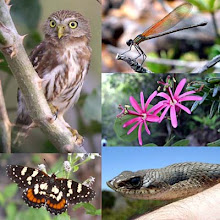
This Ferruginous Pygmy-Owl responded to my imitations meant to elicit the mobbing responses of the smaller birds in the canopy, which here included Yellow-bellied Tyrannulet, a species rarely encountered in the Yucatan.
Our best bird here was perhaps the three Plumbeous Kites soaring overhead with a pair of circling Great Black-Hawks. Apologies for no photo.
We spent a lot of time searching for Jabiru, and our only hope was to scour the open fields nearby, though we also quizzed several locals about any recent sightings.
The road was temporarily blocked as this Mexican vaquero herded his vacas down the main road.
A family Fork-tailed Flycatchers here was certainly a colonist taking advantage of the deforestation. We also had Plain-breasted Ground-Dove and Yucatan Bobwhite, birds that would not have been here when this was originally forested.
Back north, we birded the well-known Vigia Chico Road to the NE of the town of Felipe Carrillo Puerto. We saw a huge number of birds on this road, such as this Red-legged Honeycreeper.
We came across a pair of Royal Flycatchers near their nest. This photo shows the habitat and the hanging nest at the end of the pointer.
A close-up of the Royal Flycatcher nest.
We went owling on this road, seeing Mottled Owl, Vermiculated Screech-Owl, Common Pauraque, and Yucatan Nightjar. We also heard Yucatan Poorwill, one of our target birds. Stauffer spotted this young Common Lancehead (
Bothrops asper), also known as "fer-de-lance." It was rather frantic in its attempt to escape and was frantically striking at thin air (we didn't try to get too close). My first instinct is always to leap down and grab snakes before they escape (I grew up in western Oregon where there are no venomous snakes), but this little guy reminded me that I need to check that impulse when in the tropics.
While birding here in the day we also enjoyed the numerous butterflies and lizards, but this was one of just a few grasshoppers we saw. It appears to be a nymph of a bird grasshopper (genus
Schistocerca or close to that – thanks to Bob Behrstock for the suggestion).
Our final birding destination was Cobá, famous for its Maya ruins, but also one of the few areas in Mexico where Spotted Rail is sighted, even if seldom and irregularly.
We scoured the shoreline for over 2 hours, and found no rails. This Least Bittern was one of at least two that were easy to spot.
A Tropical Kingbird, actually outnumbered here by Couch's Kingbirds. This one was vocalizing, making the ID easy.
Birding with me were Stauffer Miller, who has been with me several times, mostly on private tours to look for birds new for his Mexico list. He got five this trip.
Joining us was Tim Hodge, an 18-year-old university junior. Here he's taking photos of a butterfly milkweed, assisted by these local kids.
Stauffer took this photo as I scanned the shore and trolled with several types of Spotted Rail vocalizations with my iPod. My assistant here was telling me all about the birds of the area, giving me their Maya names. He didn't seem to be familiar with Spotted Rail, though.
At this gorgeous sunset we finally gave up on the Spotted Rail and began to mentally prepare for the 4:00 a.m. departure to the Cancun airport for Stauffer's flight.
Tim and I had later flights, so we found a side road just south of the airport to look for one last lifer for him. This Plain Chachalaca was eating berries, but Tim had seen this species in Texas.
I gave him a short lecture on Asteraceae, my favorite family (Tim will be studying landscape architecture, so he needs to know plants). This is Yerba Porosa (
Porophyllum ruderale).
This colorful Arctiid moth, a wasp mimic, is probably in the tribe Euchromiina. The plant might be a
Baccharis, another member of Asteraceae.
This tiny cloud appeared to be way too small to produce any rain, but the rainbow streaming out of it belied that impression. Earlier in the morning when it was still dark, we drove through a similar rain shower, a sudden downpour that was only a few hundred yards in diameter – a five-second surprise when going 60 miles an hour; most of the sky was perfectly clear. During the three days we saw very little rain, and temperatures ranged from about 75 to 94°F.
We didn't find any new birds for Tim in our extra hour of birding, but he was happy having seen 110 lifers in three days.



 Posts
Posts


