
Tuesday, July 31, 2012
The Most Beautiful Spot on Earth
Steens Mountain, Oregon. The highest road in the state ascending a spectacular fault-block mountain to a summit that peers down a mile to the desert below. This is looking north down the glacier-carved Kiger Gorge, with Pine Whites (Neophasia menapia) on Orange Sneezeweed, Dugaldia hoopesii. We also saw Black Rosy-Finches here.


Monday, July 30, 2012
Malheur Again – This Time the National Forest
Highlights from the diverse coniferous forests north of Burns in Harney and Grant Counties:
White-headed Woodpeckers. Such a cool bird.

Rubber Boa – the northernmost member of the family that includes the famous Anaconda and Boa constrictor. And my dad's special research subject since before I was born.

An incredible Pine White outbreak. It looked like it was snowing.

Lots of butterflies at mountain wildflowers, this a California Hairstreak.

White-headed Woodpeckers. Such a cool bird.

Rubber Boa – the northernmost member of the family that includes the famous Anaconda and Boa constrictor. And my dad's special research subject since before I was born.

An incredible Pine White outbreak. It looked like it was snowing.

Lots of butterflies at mountain wildflowers, this a California Hairstreak.

Malheur is Amazing
We had a great drive through Malheur National Wildlife Refuge yesterday. So many birds! We actually started with this Short-eared Owl just south of the town of Hines on Potter Swamp Road.

And we finished the day with Flammulated Owl at Idlewild Campground north of Burns. Malheur was in between the two.
On our way back from owling I pulled over to save this Western Rattlesnake (Crotalus oreganus, split from the Prairie Rattlesnake). We were too late for at least two others long the Devine Canyon section of Hwy 395.


And we finished the day with Flammulated Owl at Idlewild Campground north of Burns. Malheur was in between the two.
On our way back from owling I pulled over to save this Western Rattlesnake (Crotalus oreganus, split from the Prairie Rattlesnake). We were too late for at least two others long the Devine Canyon section of Hwy 395.

Saturday, July 28, 2012
Clouds and Clouds of Wilson's Phalaropes

A measurable percentage of Wilson's Phalaropes have gathered on Lake Abert in south-central Oregon. If only you could count that many. The north and south ends had dense groups of them that were uncountable.


And then scattered thinly across the entire surface of the huge lake were feeding phalaropes. A distant scope view:

So it seems silly to think that we had been thrilled to find this one Baird's Sandpiper at the Summer Lake Wildlife Area farther north.

Thursday, July 26, 2012
Our Third Woodpecker – Red-breasted Sapsucker
Oregon has a surprisingly high woodpecker diversity, but we haven't been to the hottest spot yet – the central Oregon Cascades. So it shouldn't come as a surprise that we've only had three species so far: Northern Flicker, Acorn Woodpecker, and now Red-breasted Sapsucker. This isn't a rare species, but they are very quiet now and are quite hard to find. We caught up with this one, after my having practically already given up on the species, at one of my favorite places for it, Bellfountain Park in southern Benton County. Note that due to feather wear at the end of the breeding season, this normally intensely red nominate Sphyrapicus ruber ruber is approaching the appearance of a hybrid or a daggetti subspecies.


Wednesday, July 25, 2012
An Aggressive Little Gnome
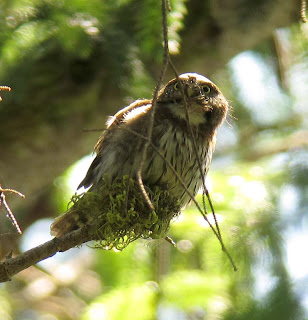
This Northern Pygmy-Owl at Kilchis County Park (Tillamook County, Oregon) on the tour yesterday was perhaps the most agressive one I've ever encountered. In less than a minute after we first heard it responding to my whistle, it flew across the river and descended from the canopy to the mid-level branches of the old-growth trees overhead. It paid no attention to the mobbing American Robins.

Tuesday, July 24, 2012
More Mustelids in Oregon
Wow – Our second day on my Oregon in Summer tour, and we've seen a second species of mustelid! This time it was a Northern River Otter swimming around in the channels near the base of Bayocean Spit near Tillamook. I think there are 8 more species in the family in Oregon. We'd be lucky to see even one of them.


Subscribe to:
Posts (Atom)

 Posts
Posts


