Friday, March 13, 2015

Some Plants from Chaparrí Reserve

If you haven't been keeping up on my blog the past week or so, I've been trying to bring attention to the WINGS tour to northern Peru that I'm slated to lead with Fabrice Schmitt this coming July. Tell your friends about it. 

I'm on my way to Costa Rica right now (though a bit waylaid due to Turriabla spewing stuff into the air that jets are apparently allergic to). I'll have plenty of blogging material from Costa Rica, assuming I get there, but in the mean time I have just two more blogs to share from the delightful Chaparrí Reserve, where the WINGS tour will be staying a couple days in July. Before I get to some of the other birds, here are the plants that I photographed there on my stay in early December 2011.

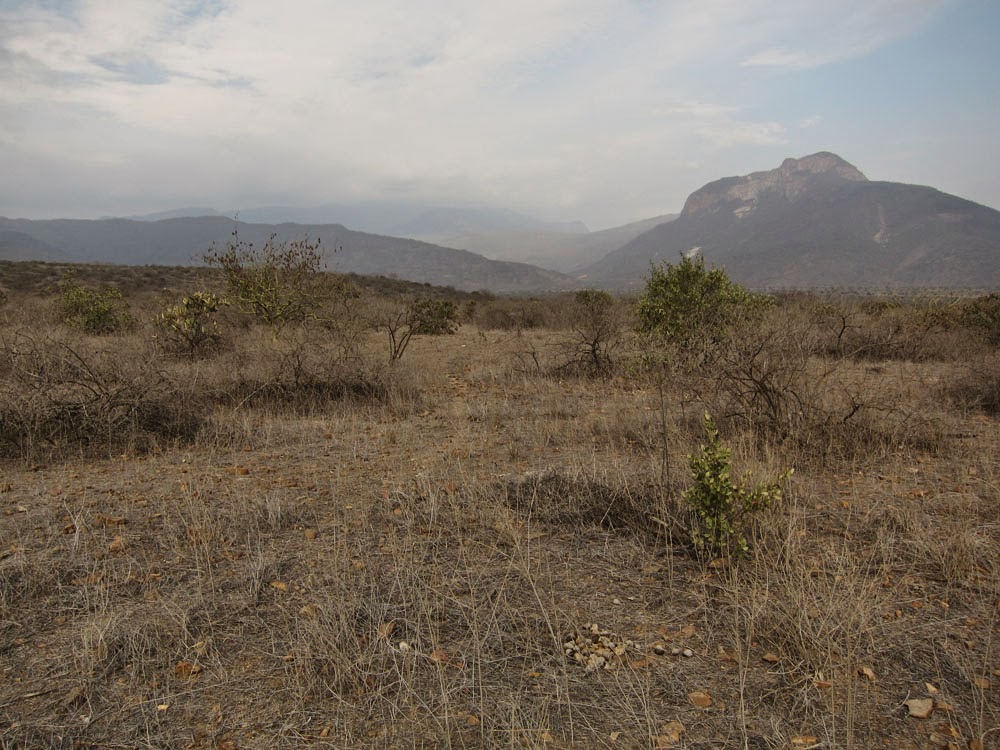
I don't know what they all were, but this being a tropical deciduous forest, many were at least somewhat familiar. The dry season is quite harsh here, which does limit the species diversity, at least locally. One could hike for an hour into the hills and diversity would explode, but the plants that are adapted to these lower elevations are fascinating.
Some are quite familiar. This appears to be a palo verde, Parkinsonia praecox, which is native north to Sonora, not far south of the Arizona border.

I thought this tree resembled members of the caper family, and indeed it is sometimes placed in the genus Capparis. But the most current name for it seems to be Colicodendron scabridum. The big fruit is apparently edible and is eaten by the Senchuran Foxes and Spectacled Bears.


Another plant that looked vaguely familiar was this flower, which I thought was a Cordia species. But upon closer inspection, those dense, globose flower heads and five, finger-like sepals under the flowers look rather un-cordia like.

This one reminded me of Ayenia, and looking into that family (formerly Sterculiaceae, along with cacao, but now that whole family is part of Malvaceae) I was led to Byttneria, probably B. parviflora.

It was surprising to see even some smaller flowers in bloom, but most were near the stream. The very open, flat shape of this morning-glory flower makes me think Evolvulus, but there is also the similar genus Jaquemontia.

A couple flowers in the family Acanthaceae caught my eye. This one is a Tetramerium.

This is a Ruellia.

Finally, I thought this last pink flower was also an acanth, but now I'm not so sure and think it might be a scroph, which would mean now that it's in the plantain family (Plantaginaceae, nothing to do with bananas). Or maybe it is an acanth...


Sunday, March 8, 2015

Some Chaparri Critters

Continuing the theme from my previous posts, here are some photos of the critters I saw in 2011 in the Chaparrí Reserve in northwestern Peru.

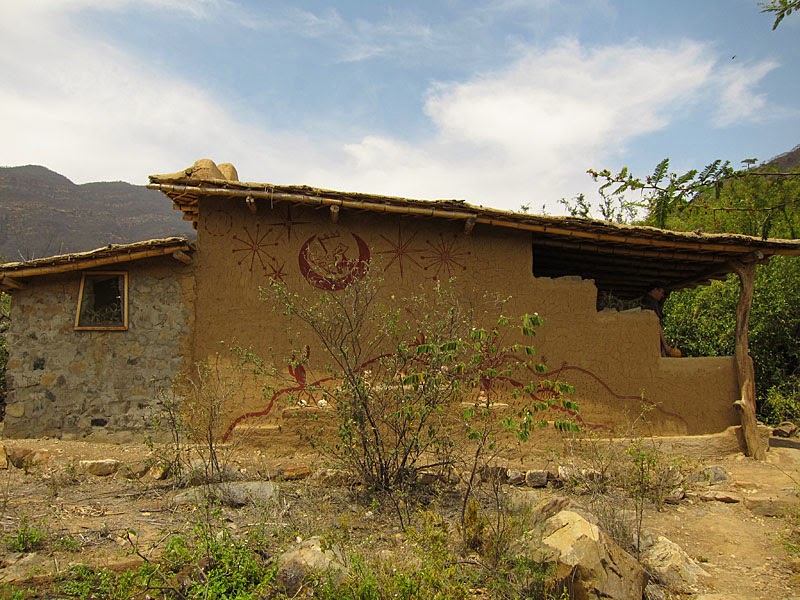
Actually, first some photos of the area. This is a view of the cabins, looking across the small stream that divides the property.

For someone who loves to cook and eat, I have amazingly poor food memory, so I'm really pleased that I snapped this shot of the food.

I was here with a small group of tour operators as guests of PromPeru, the national board of tourism. So I did do some activities with them as a group. We were here in the dry season, and it's doesn't seem they had had a very good wet season in 2011.


Happily, I had plenty of time off to wander around on my own and see some nice animals. This Culpeo, Lycalopex culpaeus, has become quite habituated to people. Update: Rob tells me that this is actually a Senchuran Fox, Lycalopex senchura. And I also had wanted to mention how amazing it is the similarity it has with our North American Gray Fox, even though they aren't closely related.

The perennial stream is a huge boon to wildlife, especially during the driest times. This appears to be a male of the very widespread Band-winged Dragonlet, Erythrodiplax umbrata.

But without any regional field guide to the odonates, I haven't been able to get names for everything I saw there. This dragonfly may also be an Erythrodiplax, and bears some resemblance to the female of the above species, but is indeed different.

Damselflies are even less known. These two are dancers in the genus Argia, possibly the same species, the upper one a male, the lower a female.


Bee flies, family Bombyliidae, are always fun to see – this is a group that could certainly stand to have field guides. They often perch, have field marks, and are only half as diverse as birds worldwide. Yet there doesn't seem any hope of getting these two to species.


There are five or six species of fish native to the stream here, and though I don't normally “do” fish, the clear water of the stream and very isolated nature of this stream suggested they might actually be known species. And with help from my friend Rob Williams, I have names for them. This one is the Characid Brycon atrocaudatus, closely related to the Matrinxã, a very popular edible fish in Amazonian Brazil.

This colorful fish is a Cichlid and appears to be the Peruvian endemic Andinoacara stalsbergi,  described to science only two years before my trip here.


Finally my favorite, the only snake I saw on the entire trip: the viper Bothrops barnetti.

Saturday, March 7, 2015

Bathing Hummingbirds of Chaparrí

It's been a while since I have gone over all of the photos from my December 2011 visit to Chaparrí Reserve in northwestern Peru. There are a lot more than I thought, so I'll post a few more blogs from there in order to help promote the WINGS tour that Fabrice Schmitt and I are scheduled to lead this coming July.

The stream that flows through the middle of the property separates the communal buildings and dining area from the cabins, connected with a foot bridge. Just below the bridge is a point where you can sit and watch hummingbirds come in to bathe.

This one is a female Purple-collared Woodstar.

Amazilia Hummingbird is one of the more widespread species from western Ecuador southward.


Tumbes Hummingbird is not a very colorful species, but it is endemic to this region, barely getting into SW Ecuador.


Here are some shots of the funky, but surprisingly nice rustic cabins they've constructed in this remote reserve.


Thursday, March 5, 2015

Butterflies of Chaparrí Reserve

As long as I'm blogging about Chaparrí Reserve in northern Peru (where Fabrice Schmitt and I are scheduled to lead a WINGS tour), here are some of the butterflies that I saw there in early December 2011.

This region has a very pronounced dry season, supporting an isolated TDF – Tropical Deciduous Forest. It is isolated in the north by the wet Chocó region, in the east by the Andes (topped by the moist cloud forests on the ridges, though the TDF of the Marañon Valley is very close), and to the south by the Atacama desert. There are a lot of widespread TDF species and genera (among plants and animals) that occur here and this Pale Cracker is one of them, occurring north into the Caribbean. But the subspecies here, Hamadryas amphichloe lamasi, appears to be endemic to Peru and probably also Ecuador.

This blue is in the genus Leptotes, like our familiar Marine Blue. It looks most like Leptotes trigemmatus, the type specimen of which is from the rather distant Chile. Leptotes lamasi, from the nearby Marañon Valley, is much closer distance-wise but doesn't look very similar. Some variation in the pattern is possible, but it's also possible that this is an undescribed species.

This skipper is in the very large (55 species) and confusing genus Staphylus, known as sootywings, some as scallopwings. This is closest to S. huigra.

This brave or determined hairstreak is Strymon daraba, endemic to this region of Peru and Ecuador; it's possibly interested in laying eggs on this lantana, but the host plant is unknown.

The widespread Lantana Scrub-Hairstreak, Strymon bazochii, on the other hand, is well-known to use lantana as a host plant, but this one is imbibing nectar from this composite (note the unusually large phyllaries, one of them perhaps aberrantly exceeding the ray flowers in length; this reminds me of Zexmenia, but there's also the closely related genus Oyedaea, which I'm not familiar with).


This Red-crescent Scrub-Hairstreak, Strymon rufofusca, is known to use mallows as a host plant in Mexico, so I presume it was searching for nectar on this plant, which I think is a Croton species.

Wednesday, March 4, 2015

An Elegant Crescentchest from Peru

A new WINGS tour this coming early Julyto northwestern and north-central Peru promises to be a really great tour for a couple reasons. First, it's being led by Fabrice Schmitt. Fabrice is a really fun leader to go with, and he has extensive guiding experience in Peru. Second, I'm scheduled to co-lead it with him! But that will only happen if enough people sign up for it, so I'm going to make a few blog posts to highlight some of the amazing things I've seen on my three trips there.

There are only four species in the distinctive and enigmatic family Melanopareiidae, all restricted to South America. They were once placed with the tapaculos, but skeletal characters, and now solid genetic data, prove that they have nothing do to with tapaculos. The current checklist sandwiches them between true antbirds and gnateaters, suggesting that they are more closely related to one of those families.

I had seen my first, the Olive-crowned Crescentchest, in the highlands of central Bolivia in 2000 with Dan Lane. Two years later, I saw my first Collared Crescentchest in Noel Kempff Mercado National Park, also in Bolivia, with Brian Gibbons.

With current taxonomy, Bolivia, Peru, and Ecuador are the only countries that can claim two species within their boundaries. But the subspecies pallida of the Olive-crowned Crestcentchest, found in the Chaco region of Bolivia, Paraguay, and Argentina, sounds so different that it will surely be split when someone gets around to writing a proposal to the checklist committee. That would make Bolivia the only country with three species.

My first trip to this part of Peru was a personal trip with my friend Alan Grenon in July of 2010. On that trip I saw my first Elegant Crescentchest, and on the very next day completed the family with the Marañon Crescentchest. We have a very good chance of seeing both in July.

This series of photos of an Elegant Crescentchest were at the Chaparrí Reserve in northwestern Peru on the scouting trip I took in November-December 2011, my second to the area. Fabrice's tour stays here for two nights.

Monday, March 2, 2015

Tucson Moths in February

We've had a very mild, if unusually moist, winter in Tucson, and while the mothing at the porch light has been not been anything like during the monsoon, I still am checking it every evening.

This moth is Idaea bonifata, given the English name Fortunate Idaea, and is one of the smallest geometrids in North America. This individual wasn't such a fortunate find, however. It flew out of my kitchen cupboard, and the larvae are known to feed on decaying leaves and...stored grains. So I better get around to cleaning out my kitchen cupboard.

At the porch light was this Rindgea cyda, the Mesquite Looper Moth. Looper is another name for inchworm, also geometrids. Not a surprise here, as we have many mesquites in the yard.

While house-sitting at my friends' house in NE Tucson, I found this similar moth, and it actually appears to be exactly the same species – just a very variable one.

Yet another geometrid at the light was this Iridopsis dataria. It's a rather large genus with many confusingly similar species, but the thin, straight black line on the hindwing (as opposed to wavy) as well as the coppery-brown strips just below that black line and on the forewing look like good field marks to hone in on.

It seems that February is the month for geometrids. This is Synchlora frondaria, Southern Emerald Moth. The emerald moths are the “classic” inch worms, subfamily Geometrinae.

Finally, this last moth is still in its pupal stage. I dug it out of the ground by my back patio while removing an old chaste tree (monk pepper tree), which was always struggling with a lack of water and had put on a sum of about 2 feet of growth in 17 years. At 52 mm, naked (not in a cocoon), and with that prominent proboscis, it's clearly a sphinx moth, and is almost also certainly one of the individuals that defoliated and eventually killed my tomato plant last year while I was away on tour. Both Manduca sexta (the Carolina Sphinx, also called Tobacco Hornworm) and Manduca quinquemaculatus (the Five Spotted Hawk Moth, also called Tomato Hornworm) will feed on tomatoes. I put this one in a jar with some dirt and will see what emerges.