I was at
home just a week between tours, but I got a lot done, not just editing all the
photos from the Galápagos. In the garden I sowed about a hundred black-eyed
peas as a suggestion for a nitrogen-fixing green cover, and I bought another
tomato plant (guess what happens when the landlord turns off the automatic drip
timer and doesn’t water until it’s too late…). The first pea was out in just 4
days, a ton more after 5. It should be a veritable carpet when I get back.
I missed the
117.5°F temperature on the 19th, just as forecasted. But then we did
get some niceearly rain. About 1
1/3 inches fell in a big storm the day before I came home, and then we had
another 3/4 inch in two different long, slow night rains early in the week. So
even before the traditional average starting date of the monsoon (July 5 in the
past) we’ve received a third of the average allotment. Then again, we might
night get any more the rest of the summer.
A big cholla
cactus toppled from too much water, so I carefully chopped it up and worked it in
into two big compost piles, layering with old straw, wind-blown leaves and bark
from the Eucalyptus after the storm, and partially finished compost from the
previous pile. That took parts of 3 days.
After the
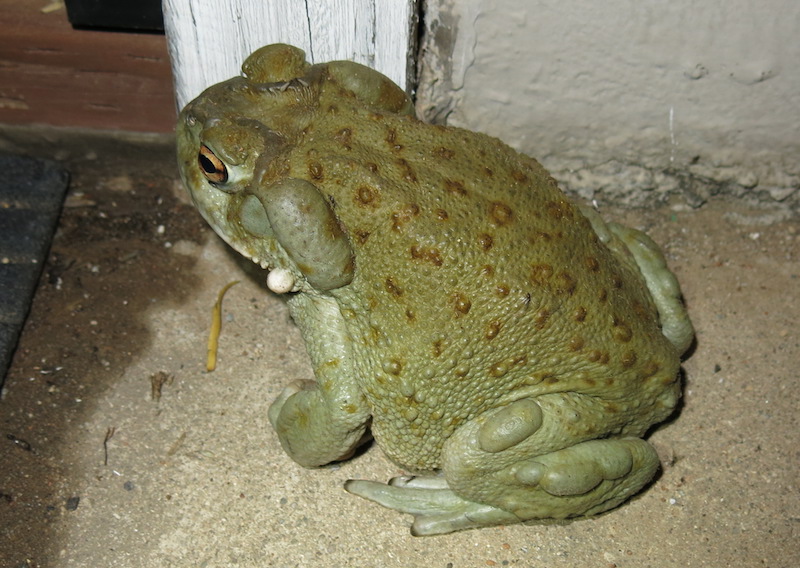
second long rain, this Incilius alvarius,
Sonoran Giant Toad was on my doorstep eating the insects attracted to the porch
light. It’s the first I’ve seen in the yard.
This is what
it left the next morning, which had Paul really guessing. It’s mostly indigestible
beetle elytra and wings.
This jeweled
flower beetle is Acmaeodera gibbula,
the first one I’ve seen in the yard; sadly it was dead in a hummingbird feeder
moat, but there aren’t many flowers to be looking at yet.
My spearmint
was doing really well, then just two days ago it suddenly looked like this,
overnight.
I looked
very carefully and found three little green caterpillars, and by using the
handy “site:” search feature looked for the word mint at the MPG (moth
photographers group) website. After cross-checking with Bugguide, I’ve decided
they almost have to be Pyrausta
laticlavia, Southern Purple Mint Moth, though there are no photos of
caterpillars online. Other mint-feeding Pyrausta
species have similarly shaped caterpillars, though most have more
distinctive stripes, and they don’t seem to be known from Arizona. In any
event, I put them in a small jar with some leaf litter and sticks, capped it
with cheese cloth, and will inspect it for moths when I return in 3 weeks. One
had already started to pupate in a loose webbed cocoon yesterday.
Just a week
ago I came home from my fifth trip to the Galápagos Islands. And already I’m
headed out for my next tour, a private tour to Mato Grosso, Brazil.
Everything
about the Galapagos is photogenic and easy to photograph, so I came home with
lots of photos. Much of the week I spent organizing and labeling them, and here
are just a few from the trip.
This was the
first time WINGS has chartered the Nemo III, a catamaran with eight very nice
cabins. Everyone in the group gave the boat a big thumbs up.
We were on
the boat for seven nights, on this particular boat’s set itinerary in the
central and southeastern part of the archipelago. One of the group’s favorite
activities was sitting on the bench on the bow, overlooking the ocean as we
motored between islands
This is a Small
Ground-Finch, the most abundant and widespread of the currently recognized 15
species of “Darwin’s finches” (they are really tanagers) in the Galapagos.
Recent genetic evidence has led one group of ornithologists to recommend
splitting some of the six ground-finches (genus Geospiza), making them eight species. Others have looked at the
same data and recommend lumping all into one species of Geospiza with various “ecomorphs.” The problem with the first is
that it doesn’t give enough thought to how much hybridization and back-crossing
must go on among some forms, making a lot of the birds intermediate and
impossible to identify. The second school ignores some clear cases of strongly
assortative mating and complete allopatry – distinctions that are obscured if
you’re not a birder in the field and obsess in a lab over numbers and letters.
These
finches react to pishing by coming in close, but their reaction is very
different from the noisy mobbing and scolding response you see in our sparrows,
warblers, and chickadees at home They mostly don’t call, and the just fly in,
perch near you, look confused, and then soon lose interest and start feeding. They
don’t tend not to hop around rapidly, act agitated, or say much. Once one
landed on my tripod while I was carrying it on my shoulder.
One of the
more distinctive of the finches is Vegetarian Finch, though I don’t know how
much hybridization it experiences. It’s currently the only member of its genus,
Platyspiza, and we actually got to
watch this one consume a large portion of this fern frond.
This is Española
Mockingbird, one of four species of mockingbird we saw (which is all that are
currently recognized). They are all quite tame, but this single-island species borders
on psychotically curious.
Maybe
because of worries about El Niño we had two cabins unoccupied just a couple
weeks before the cruise, so WINGS offered them to any leaders who had the time
free; here is Steve Howell getting friendly with an Española Mockingbird.
When I
called out to Steve to pose for the above photo, a Nazca Booby flew in and
displaced the mockingbird, all within about 3 feet of Steve.
Even the Yellow
Warblers (an endemic subspecies) are fearless here – while they chip more and
act like our birds at home, a simple pishing can bring them to your feet, such
as this immature bird that I’m looking down on.
Elliot's
Storm-Petrel is almost always present around the boats, whether we are between
islands or anchored right offshore, but they are constantly moving and
difficult to photograph.
We walked
through a few different seabird colonies, and it didn’t look like the recent
very strong El Niño was having much of an effect any more – water temps had
returned to normal (or even a little below normal) by early April, according to
earth.nullschool.net, andmaybe
the were able to respond immediately. This and many other Great Frigatebirds
were already tending older chicks.
Blue-footed
Booby displaying.
We saw 23
Galapagos Penguins one day. The island of Bartolomé is apparently now
completely rat-free, and the birds seem to be having greater nesting success
here.
We even
caught two in the act of mating; maybe they’ve noticed an uptick in food with
the dropping water temperatures.
The Waved
Albatross colony on Española was doing well, with many birds incubating and
some even still reaffirming their pair bonds with their fabulous, complex
displays.
This close-up
on the waved pattern on the side of the breast shows where the species gets its
most accepted English name. (Galapagos Albatross would have been a good name
too, as all but about four pairs nest on this one small island.)
Swallow-tailed
Gulls were also in full breeding mode. This one may have had something stuck in
its gullet, or this was a repeated yawn display that I hadn’t seen before.
We saw so
much more than just birds. Snorkeling is always a major part of a Galapagos
cruise, and we had five different opportunities, identifying over 50 species.
For the first time I had a camera I could take underwater, but even putting it
on the automatic underwater mode, my results were very mixed.
Many islands
have their own endemic lava lizard, and we saw four species. This is Microlophus delanonis, Española Lava
Lizard.
There are
four endemic snakes, and this Pseudalsophis
biserialis, Galapagos Snake is the only common one; I had seen it twice
before.
The Galapagos
Giant Tortoise is now considered to comprise 17 species, five of which are
extinct. This is Chelonoidis nigrita,
Santa Cruz Giant Tortoise on a private ranch where a over a dozen were lounging
and feeding.
This Scinax quinquefasciatus, Fowler's Snouted
Treefrog appears to be common in the moister highlands of Santa Cruz. There was
one in our bathroom in the hotel, and two were on the keyboard of the piano in
the restaurant when I lifted its cover. It is introduced, and who knows what
effects it has had on the ecosystem.
It’s amazing
how fearless the animals are. On Santa Fé, we chose a spot well away from the
Galapagos Sea Lions to put our shoes on. Then this one came on the beach and
insisted on walking right through our group, as if we were merely bushes in the
way.
One of my
participants was a moth enthusiast (with a yard list in England of a couple hundred
species). So it was fun to find two endemics, however tiny. This is Aetole galapagoensis, Galapagos Saltbush
Moth, with it’s highly modified third pair of legs.
This
colorful one is Atteva hysginiella,
Galapagos Bitterbush Moth.
New for me
was this tiny grasshopper, Sphingonotus
fuscoirroratus, an endemic band-winged grasshopper. I’ve now seen half of
the eight grasshoppers here, all endemic.
Dennis
Paulson identified this Erythemis
vesiculosa, Great Pondhawk for me which was on the farm with the tortoises;
it was the first one I’ve seen here, and I’ve seen it also in southern Florida
and NE Brazil – obviously a very wide-ranging species.
There are
several endemic darkling beetles in the genus Blapstinus, which I think this one is, probably requiring
microscopic inspection to identify to species.
Argiope argentata, Silver Garden Spider
is a very widespread species. Spiders that spread on gossamer threads can
populate even most remote islands around the globe.
This small
orbweaver with a tubular house in the middle of its web is Metepeira desenderi Baert 1987, an endemic. I contacted Baert
himself to get confirmation on some of my spider IDs.
This is Selenops mexicanus, Mexican Flatty,
apparently introduced, and only recently reclassified as this species
(originally thought to be an endemic).
One of two
endemic scorpions and still the only one I’ve seen, this is Hadruroides galapagoensis, Galapagos
Scorpion.
The
introduced pest Polistes versicolor,
Yellow Paper Wasp.
Many plants
are endemic: Lecocarpus pinnatifidus,
Wing-fruited Lecocarpus.
Opuntia echios var. echios, Giant Prickly Pear (this variety only on Santa Fé, where it
presumably has extra tall trunks to avoid predation by the long-necked
tortoises, which are sadly long extinct.)
Others are
more widespread, found on the nearby dry coasts of southern Ecuador and Peru or
even Central America. Maytenus octogona,
Leatherleaf (family Celastraceae).
I would like
to get to know the ferns better, as there are many species here, though not
many endemic (12 out of 131). I was glad to have figured out this Phlebodium pseudoaureum, Blue Rabbit's
Foot Fern, as it’s the species that the Vegetarian Finch was eating on our
first day.
My two weeks
at home between Nepal and my next tour, the Galapagos, are up. In fact, when my
flight takes off tomorrow morning, I will have been in Tucson two hours short
of exactly 14 days. I’ve gotten a lot done.
I got back
into baking right away, first making a seeded sourdough loaf using 65% sprouted
whole wheat and 35% white bread flour. I roughly followed the very slow rise,
relatively wet-dough proportions shared by Tartine Bakery’s Chad Robertson,
said to be the “most imitated bread.”
But then I wanted
to take advantage of this gorgeous heirloom Pullman bread pan that was given to
me by a friend. And the one bread I know made in this form is a superdense,
sunflower seed-studded sourdough rye loaf I got to know in Germany, simply
called Vollkornbrot. So I found a recipe online that looked like what I wanted,
and it turned out fabulous.
Before being
baked:
After
baking, looking good:
The real
test: moist and dense, yet full of holes, and not in the least bit crumbly. One
slices this bread very thin, and it’s even better toasted. It’s really good
with a thin-sliced Schinken or Speck, or a smelly German or Dutch cheese, but
I’m enjoying it with just butter.
Then my
friend Beth and I went to a demonstration at a farmers market about how a local baker uses locally
milled mesquite flour (from the seed pods) in various baked goods, and the
bread she had on display was almost exactly the same as the Tartine’s Country Bread I
had made, just with the addition of mesquite flour.
So I
experimented, made the same Vollkornbrot as before, but I replaced 15% of the
rye flour with mesquite flour, and to try to emphasize this as a savory bread
(mesquite is very sweet and can make things taste like dessert), I added
chopped onion and Emmentaler cheese. This is the result, and I’ll probably
write up the recipe for this, but I’m not sure exactly how to call it or where
to put any hyphens. Sonnenblumenkernvollkornroggenmsequitesauerteigbrot?
I did a bunch
of work in the garden. The tomato plants I put in should have been lush and
green but were spindly and anemic. None of the seeds I scattered around before
Nepal ever emerged, and it seems that the drip hose and the timer weren’t on
the ideal settings. At the farmer’s market, a couple of tomato growers
suggested that my soil might be too alkaline, and I found a soil test kit for
1/2 off at Lowe’s.
Indeed, the
pH is just a bit too high; most of our veggies and flowers prefer a slightly
acidic soil, closer to 6.
The nitrogen
is low, not a surprise.
Phosphorus
is also low.
The
Potassium levels in the soil are very high, so that’s not an issue.
I needed to
do a couple of runs for big garden supplies, so I looked into renting a car for
a day, thinking this time of year there might be a last-minute deal at
Enterprise, which has an office relatively close to me. But as it turned out, I
have enough points in my frequent renter profile to rent a car for an entire
week for free. So I got a car for 24 hours for just a few dollars in taxes and paid a visit to a few stores for soil, pots,
a hose, fertilizer, soil amendments, and some plants.
I pulled up
the soaker hose and dug in some aluminum sulfate. I repositioned the soaker
hose, setting it deeper, then plunked in another tomato, three peppers, and a dozen
annual Salvias to add color. I added some fertilizer higher in nitrogen and
potassium, and watered it well.
Then I stole
some straw from my landlords as a mulch, as the dry air and heat really dry out
the soil surface quickly. Now to hurry and wait. Actually, it’s probably time
to start thinking about what to put in for a winter garden already.
For the
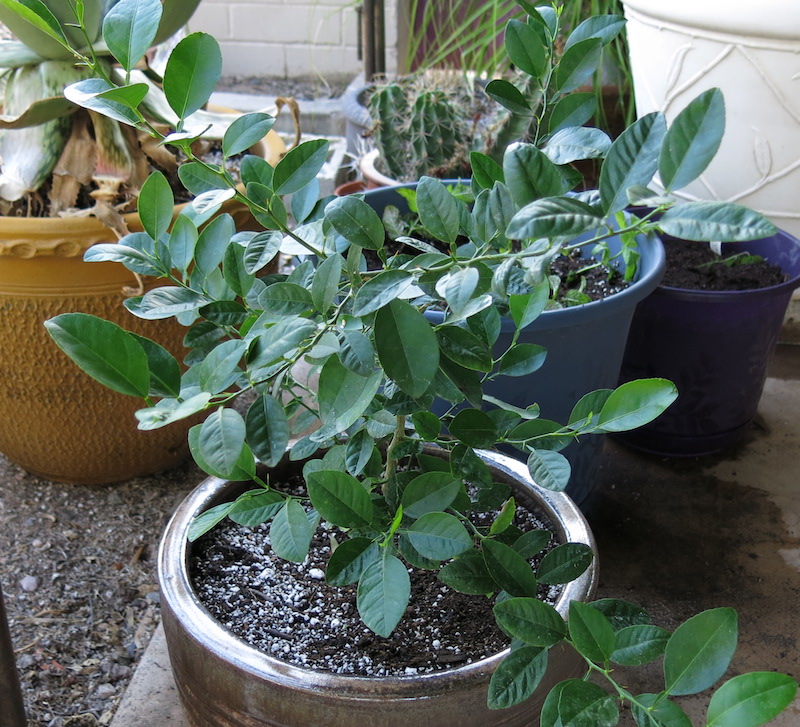
patio, I needed to repot some plants. This little key lime tree sprouted from a
seed just 16 months ago and already looks like a tree. It was in a stupid
plastic lard tub, and now has it’s own beautiful glazed pot.
These
seedlings are from a super sweet and delicious tangerine I had in northern
Brazil last July. I pocketed a few seeds and stashed them in my camera bag,
which I then discovered this past January. I sowed them all in one pot, and
finally assumed they were dead after 3 weeks of no life, but then when I
returned from my Costa Rica tour in March, all had sprouted. They were very crowded and
now each has its own pot – all 11.
Finally, I
needed to free my Gardenia from the spearmint that I planted in with it. The
spearmint had sent runners all around the rim of the pot and were shading out
the gardenia, not to mention masking the smell of the flowers. So here’s the
Gardenia freed.
And a few pieces the
spearmint on its own (a bunch went into the compost).
I also just
barely managed to salvage the one last stem of Corvallis peppermint that had
been holding its own for a few months but was all but lost in the spearmint. It now has its own pot, and I can only
hope that it recovers.
I also got
in a bit of knitting, but only in bits and pieces. I knitted up this totally
seamless potholder, a design I made up but was quite surprised to not find
already published. I’ll write it up and sell it on Ravelry some day.
And I got
back into working on this hat that I started in Nepal, but ran out of yarn for.
I hadn’t bought enough of this very nice wool-yak blend, and as soon as I got
home I ordered more of the same dye lot from the shop where I bought it not far
from the Chicago airport. It arrived, and I now I can finish the hat. And start
on something else.
Of course, I
also did some work. For example, I finished the text and bird list for a new WINGS tour I’m offering to Oregon in August 2017 – a one-time tour to see some nice birds
and habitats, including Malheur National Wildlife Refuge, but the main
attraction being the total solar eclipse on August 21, 2017.
Other things
that have made coming back to Tucson worth it: seeing the Pine Flycatcher, dinners with friends, birthday
parties, and singing five-part madrigals (just started working on a fabulous trio
of Orlando Gibbons pieces starting with Nay Let Me Weep).





 Posts
Posts


