
Friday, April 21, 2017
Red-fronted Rosefinch!


Thursday, April 20, 2017
A Brief Note From Upper Mustang, Nepal


We have two more days of trekking on the N edge of the über-popular Annapurna Circuit based in Muktinath (hence the Internet connection).
Thursday, April 13, 2017
Tigers at Bardia National Park
I’ve been in
Nepal on my usual busman’s holiday for a week now, and already I’ve seen 13
lifers and some amazing animals. Less than 24 hours after I arrived, my friend
Mich and I flew to the small but bustling town of Nepalgunj, and late afternoon
on the next day we were watching a Tiger.
We’re now
headed to the Mustang Valley for a 10-day trek, so when I get back I’ll post
more here. Stay tuned.

Wednesday, March 29, 2017
Peru Summary – Abra Patricia and the Rio Mayo Valley
I'm going to cheat a bit for this blog post, pasting in the summary I wrote for the WINGS website's "From the Field" section, one of the many post-tour chores I have to complete whenever I get home.
Our tour to northern Peru’s cloud forests of Abra Patricia and the Alto Mayo Valley was full of exciting and beautiful birds. We saw over 350 species in nine days, many of them with exceedingly small world ranges and drenched with colors. It helped that there are now eight hummingbird feeding stations on our route, and we tallied at least 45 species of these jewels, including such scarce and little known species as Koepcke’s Hermit, Blue-fronted Lancebill, Greenish Puffleg, and Rufous-vented Whitetip. One of our main targets was the unbelievable (even when you actually see it) Marvelous Spatuletail, which was already at the feeders when we walked up to them.

The big bully and most abundant hummingbird at a couple of the stations, including at our lodging at Abra Patricia, was the nonetheless stunningly attractive Chestnut-breasted Coronet.

One of the feeding stations also has a brilliantly engineered blind with a hopper that delivers grain, and we were the lucky group one day to witness the arrival of a covey of Rufous-breasted Wood-Quail.

One of the most attractive birds with a limited range in Peru is the Yellow-scarfed Tanager, never a guarantee, and we were lucky to have a few on one day, including one on our hotel grounds.

The much more widespread and common Paradise Tanager never ceases to attract attention.

We heard a few Golden-headed Quetzals before one came into view for a most memorable encounter.

Even drab birds were part of the tour’s experience, such as a Sulphur-bellied Tyrant-Manakin on a nest, perhaps still undescribed.

The odd Oilbird is always a highlight of this tour, given that we view them from a small bridge on the main highway, perhaps the most accessible breeding colony in the world.
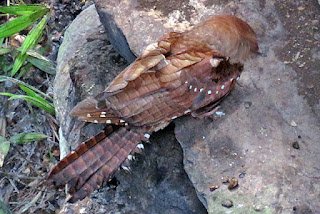
We were awash with blooming orchids, many of them fragrant, and the huge, recently described Phragmipedium kovachii was simply spectacular, described as the most important orchid discovery in the past 100 years.

The lights at the owlet lodge drew our attention every evening and early morning with a bewildering diversity of moths, beetles, and other invertebrates; this Rothschildia aricia silk moth was by far the most spectacular.

Our tour to northern Peru’s cloud forests of Abra Patricia and the Alto Mayo Valley was full of exciting and beautiful birds. We saw over 350 species in nine days, many of them with exceedingly small world ranges and drenched with colors. It helped that there are now eight hummingbird feeding stations on our route, and we tallied at least 45 species of these jewels, including such scarce and little known species as Koepcke’s Hermit, Blue-fronted Lancebill, Greenish Puffleg, and Rufous-vented Whitetip. One of our main targets was the unbelievable (even when you actually see it) Marvelous Spatuletail, which was already at the feeders when we walked up to them.

The big bully and most abundant hummingbird at a couple of the stations, including at our lodging at Abra Patricia, was the nonetheless stunningly attractive Chestnut-breasted Coronet.

One of the feeding stations also has a brilliantly engineered blind with a hopper that delivers grain, and we were the lucky group one day to witness the arrival of a covey of Rufous-breasted Wood-Quail.

One of the most attractive birds with a limited range in Peru is the Yellow-scarfed Tanager, never a guarantee, and we were lucky to have a few on one day, including one on our hotel grounds.

The much more widespread and common Paradise Tanager never ceases to attract attention.

We heard a few Golden-headed Quetzals before one came into view for a most memorable encounter.

Even drab birds were part of the tour’s experience, such as a Sulphur-bellied Tyrant-Manakin on a nest, perhaps still undescribed.

The odd Oilbird is always a highlight of this tour, given that we view them from a small bridge on the main highway, perhaps the most accessible breeding colony in the world.

We were awash with blooming orchids, many of them fragrant, and the huge, recently described Phragmipedium kovachii was simply spectacular, described as the most important orchid discovery in the past 100 years.

The lights at the owlet lodge drew our attention every evening and early morning with a bewildering diversity of moths, beetles, and other invertebrates; this Rothschildia aricia silk moth was by far the most spectacular.

Tuesday, March 28, 2017
A Paradise Eagle Quetzal

With three
back-to-back tours that spanned three continents, I haven’t had much time to
post to my blog. I plan to get caught up this week. The photo montage above
very quickly sums up where I’ve been – with all three photos above having been
taken within a single four-week period.
Paradise
Tanager – on my tour to northern Peru: The Cloud Forests of the Rio Mayo and
Abra Patricia
Steller’s
Sea-Eagle – on a one-week private tour to Hokkaido, Japan
Replendent
Quetzal – on my just completed tour to Costa Rica
More soon!
Friday, February 17, 2017
Baja California: A Final Morning in Todos Santos
There are
just a few photos from the relaxed, final few hours of morning birding on my
WINGS tour to the Cape Region of Baja California. The tour officially ended
around noon with our arrival at the San José del Cabo airport.
We actually had
one outing after our late afternoon arrival the day before, after the long
drive from Puerto San Carlos. With memories of the whales still fresh on our
minds, we walked down to the beach to watch the release of hatchling Green Sea
Turtles by a team of volunteers who collect the eggs and incubate them safely
from the many predators and people who use the beach. They eventually released
somewhere around 60 hatchlings at dusk this evening.

While
waiting for the volunteers to get the last turtles from their nests, we watched
the sun set and noticed a fascinating tail-slapping display of a Humpback
Whale, perhaps a mile out at sea. I was able to get it in the scope, as the animal
“stood” on its head for at least ten minutes, slapping the water aggressively
back and forth with each side of its flukes without pause. This is likely part
of a mating display, perhaps aggressive, but no one really knows.
We stayed at
the Serendipity Bed & Breakfast, a delightful place that everyone opined would
be a nice place to stay for a few days. I agree, and it would be fun to really
scour the region for vagrants, but we had pretty much run out of expected bird
species to add to our list, and that would just make the tour more expensive.
Sigh.

We did add
White-crowned Sparrow (the interior western subspecies oriantha), Brewer’s Sparrow, and California Quail, as well as had more enjoyable
views of Scott’s Oriole, Hooded Orioles, Lark Sparrows, and Costa’s Hummingbirds, among others.
This Hyptis laniflora, Woolly
Desert-Lavender, endemic to Baja California Sur, was the primary food for the
Costa’s Hummingbirds.

This bushy
composite, forming shrubs taller than me, is Bahiopsis tomentosa, Felt-leaved Goldeneye, and is endemic to the
Cape Region.

We saw
several Northern Mockingbirds every day of the tour – the deserts here
apparently offer plenty of food and the right structure.

The
mockingbird is perched on this fascinating shrub, which might be a food source.
It is Stegnosperma halimifolium,
Sonoran Stegnosperma, in the strange and small family Stegnospermataceae.
Although there are specimens of this species from Caborca, Sonora, less than
100 km from the Arizona border, there are no members of this family here.

It was
starting to get warmer, and more butterflies were around. This is the very
widespread Pyrisitia lisa, Little
Yellow.

-->
I saw a few
of these every day of the tour (unlike the dozens in previous years), but
usually only in flight as I was driving. This is the first one we had perch in
front of the group where we could see the lovely colors. It’s the endemic
subspecies Myscelia cyananthe streckeri,
Blackened Bluewing.

Thursday, February 16, 2017
Baja California: Puerto San Carlos and Bahia Magadlena
My WINGS tour to
Baja California’s Cape Region includes a boat trip on Bahia Magdalena, leaving
from Puerto San Carlos west of Ciudad Constitucion. This is about a 4-hour
drive from La Paz, and on our way we made a stop in the unique desert of the
Magdalena Plain.

One of the
most distinctive features one notices in this type of desert are the lichens
growing on everything. Fog is common here at any time of year, though rains are
infrequent and unpredictable.


This is Lophocereus schottii, Senita Cactus,
which barely makes it into the U.S. at Organpipe Cactus National Monument.

I was
especially hoping to find a patch of the cactus Stenocereus eruca, the Creeping Devil, endemic to this particular
area. I had seen it a couple years ago on a side road we didn’t have time to
check this year, and back then I didn’t realize how local an endemic it is. We
couldn’t find it, unfortunately. But the plants, birds, and animals here were
good. A pair of Harris's Hawks let us approach quite closely.

This male Costa's
Hummingbird appeared out of nowhere, seemed to choose a perch to check us out
for a minute, then zoomed off.

When I saw
this lizard run on the sand and hide under a bush, I assumed it had to be the drab
local subspecies of Zebra-tailed Lizard, but Brian Eagar explained to me that
it’s a female of the extremely variable Uta
stansburiana, Side-blotched Lizard – despite the lack of a blotch.

About 15 km
before we reached the coastline of Magdalena Bay we started seeing Ospreys on
their nests on transmission line pylons as well as on the many platforms
erected for them. There is an active nest every few hundred meters after this.
I’d be surprised if there were a denser breeding population anywhere else in
the world.

This
pond just before Puerto San Carlos
is a roost for many ibises, herons, and egrets, and we watched about 100 birds
come in at sunset, including an impressive total of 14 Reddish Egrets.

This is also
where we finally got good views of this Ridgway's Rail, a recent split from
Clapper Rail. The Baja California Sur endemic subspecies here is Rallus obsoletus beldingi, which
supposedly looks different or has different measurements from the subspecies in
California, Arizona, mainland Mexico.

The main
purpose of our big detour this far north is to take a whale watching trip on
Bahia Magdalena. The day started with thin low-level fog, the first time I’ve
seen that here. But it burned off very quickly, and the nearly perfectly still
air (one reason for the fog) resulted in a gorgeous, nearly flat and mirror-like
sea.


We saw
whales – at one point one could scan a 90° swath ahead and see about 15 whale
spouts in the distance. As we got closer to the main area of activity, we had
very good views of several whales and their flukes: Eschrichtius robustus, the Gray Whale.

After about
an hour of waiting (and never aggressively approaching any), we found ourselves
next to what appeared to be a mating orgy, with three or four individuals
flailing about. In this one shot, you can even the see the penis of one whale
as he rolls on his back.

There was
some exciting birding too. Before we even got to the whales, I directed José,
our pilot to motor towards a group of plunge-diving Brown Pelicans. As we got
closer, I noticed several Black-vented Shearwaters amongst the group, the first
I have seen in the bay. I quickly made sure my group could see them, then tried
getting some photos, vaguely aware that there were some small dolphins in part
of the feeding frenzy. To my surprise, I got not only an in-focus photo of one
of the shearwaters in flight (not very easy with the Canon PowerShot type
cameras), but also an identifiable shot of what turned out to be a Delphinus capensis, Long-beaked Common
Dolphin.

On our way
back to port we came across a resting group of Black-vented Shearwaters,
allowing excellent views.

Out of
nowhere came a Pomarine Jaeger, which briefly chased one of the shearwaters and
then quickly vanished to the south. One of my participants got much better
photos than this – this is more typical of the kind of photo I can get of a
bird in flight with this camera.

José paused
to show us several of these young Urobatis
halleri, Round Stingrays, common in the shallower parts of the bay.

-->
With only a
few effortless flaps and no wind, this Brown Pelican skimmed the surface of the
water and passed us.

Subscribe to:
Posts (Atom)

 Posts
Posts


