Tuesday, August 8, 2017

Highlights from Chapada dos Guimarães National Park

I’m currently in the middle of five back-to-back tours, so I’m a bit behind in blogging, struggling just to keep up with post-tour duties. My Marvelous Mato Grosso tour finished up on July 5 already, and I did make three posts from there during or the tour. But I’ve finished the summary for the tour participants thought I could use that as template for a more detailed series of blogs.

It’s impossible to pick just a few favorites out of about 560 birds seen and heard in just under three weeks, and I could write an epic-length book about all the amazing things we saw in Mato Grosso and at Iguazú. Each day I had my participants choose a favorite bird, and these formed the skeleton around which I built the tour’s narrative summary. But one bird did stand out as a top for the tour, and that was our Harpy Eagle. On our fourth day at Cristalino we had spent the morning boating upriver, seeing several nice things, and then did the whole Castanheiras loop (the trail named after the giant Brazil Nut trees along it). We were almost back to the boat at about 11:00 a.m. when I heard a boat zooming upriver and then stop near ours. Diego, one of the lodge’s guides and boatmen came running up the trail and said “Harpia!” I then said to my group, “Run!” To make a long story short, we got there about 20 minutes later, just in time to watch the bird on its riverside perch for about one minute before it flew over the river and off into the forest. It had been there for over 45 minutes, which is longer than we could have expected. Diego had left Jorge there on the opposite bank that whole time, and he occasionally waived his hands as a decoy to keep the bird’s attention. What made this bird even more amazing is that it came only three days after we had seen a Crested Eagle – seeing one of these two rarities on a tour is super lucky, but seeing both is plain ridiculous. I got only a couple usable shots of the Harpy Eagle before it took off.

So to back up a bit and mention the daily favorites, we began our birding in earnest in the afternoon of our first day with a stroll to the short canopy tower at our lodge in the middle of Chapada dos Guimarães National Park. A flurry of activity on the way was highlighted by a Pale-bellied Tyrant-Manakin and a Sepia-capped Flycatcher, while we had our first taste of the real tropics at the tower with perched Channel-billed Toucans in the distant canopy trees. It had been a warm, sunny day, and butterfly activity was high, especially in the flowers by the lodge. We had several of these Actinote sp. (Heliconius longwing relatives in the tribe Acraeini). The taxonomy of this genus has been very confused, and though there have been some recent papers that reassigned some subspecies, described some new species, and clarified some populations, this area wasn’t part of the study, and my photos don’t match any of the known ones perfectly. That the website butterfliesofamerica.com hasn’t used any of those papers’ findings in it’s list makes it even harder to identify the ones we saw.

We spent the next morning on the Geladeira road in some sandy cerrado habitat where a Pale-breasted Spinetail perched out in the open.

Our only White-vented Violetear came in to my pygmy-owl imitations.

A Planalto Slaty-Antshrike responded to the mob as well.

A Helmeted Manakin surprised us in the scrubby habitat, and a pair of Coal-crested Finches perched up nicely, if only briefly (too brief for photos). We then had another, even closer Helmeted Manakin back near our lodge.

And then on a hike to the small pond on the lodge grounds we had a pair of adorable Brown Jacamars and a family group of Least Grebes.

Our first, furtive Yellow-tufted Woodpecker in distant trees while a stunning male Band-tailed Manakin came into a mob and a male Flame-crested Tanager, scarce in the area, was very territorial but seldom perched on any open branch for long; we eventually had good looks in the spotting scope. On our night walk we had an amazing very close Common Pauraque encounter, followed by an altercation among two or more Scissor-tailed Nightjars right over the road.

On our second day a cold front suddenly arrived, and a beautiful sunny morning became completely fogged in by noon.

We continued to look for birds anyway. On our way down the Aroe Jari caverns road, we saw our only Red-legged Seriema on the tour.

A Burrowing Owl was alongside the road; the ones here are a different subspecies than those in North America.

But bird activity was very low in the increasing fog and dropping temperatures, so we did some botanizing. This is Eschweilera nana, in the Lecythidaceae, the same family as the giant Brazil Nut.

This is Davilla elliptica, in the family Dilleniaceae, in its own order Dilleniales, a group I know nothing about, other than that it was once thought to be related to peonies (but genetics dispelled that theory).

Confusingly similar is this Cochlospermum regium, in the family Bixaceae (along with annatto), which is related to the mallows.

I always stop to take photos of Passiflora mansoi when I’m here; it’s a very odd passionflower, growing as a spindly shrub rather than a vine, and though it’s quite common here, very few are ever in flower at once.

Our last morning it was still quite foggy and cold (about 52°F), so bird activity was still low. And our views of the Véu de Noiva waterfall wasn’t so great either.

But one of the most amazing finds on the tour as far as I’m concerned was this tiny metalmark that brushed off the wet trees overhanging the dirt road to our lodge and was deposited on the wet windshield. I first got a photo from inside the van.

It stayed long enough for me to get a photo from the outside. It looks most like Syrmatia nyx, the Spotted Tailwing, though specimens confirmed to be that species (on butterfliesofamerica.com) have a red dot at the base of the forewing and a white dash at the base of the hindwing. Butterflies in this genus are hardly ever observed in nature, and nothing is known about their natural history, and it’s possible that there are several species still undescribed.

We left the Chapada with busy mixed mob of birds that included our only Green-winged Saltator.

We had our best views of a Burnished-buff Tanager here as well.

White-lined Tanager was part of the mix.

The birds were in the roadside vegetation below us, giving us unusually good views, such as this Masked Gnatcatcher.

This Red-crested Finch was particularly excited; they don’t often have their crest raised like this.

For me the, the most interesting bird was this milky white leucistic Rufous-collared Sparrow.

In the afternoon we flew to Alta Floresta and via van ride and boat ride arrived at 

Saturday, July 1, 2017

Snakes in Mato Grosso

The main part of my WINGS Marvelous Mato Grosso tour has come to an end, and it has been a spectacular tour for birds and animals. It will be impossible to match this one in future years, with such amazing sightings as Crested Eagle, Harpy Eagle, and five different Jaguars, as well as an above-average bird list of about 490 species. But for me, it’s been particularly exciting to have had five snakes – on a typical tour we’d see between zero and two, and I’d not necessarily get to handle any of them. I was able to pick up three of these.

The first might be the most interesting one for me, because I had no idea what it was. I did know it was not something dangerously venomous – it was small, and a “colubrid” (in the broader sense), and in the Americas you really have to be wary only of snakes that are brown and blotchy and obviously viper-like or colorful and obviously coral like (of course there are some corals that are almost unicolor too, but they are easy to recognize). This tiny thing was spotted by my participants as we completed a late afternoon and evening walk at Pousada do Parque at Chapada dos Guimarães north of Cuiabá early in the tour. It is either Sibynomorphus mikanii or S. turgidus, and even the experts seem to disagree on how to ID them. It specializes on feeding on slugs, and its saliva is probably venomous to them. It would be in the family Dipsadidae were that split from Colubridae, most members of which have some sort of mild toxin in their saliva. If you could make it bite you, it might be something like a bee sting.

At Cristalino Jungle Lodge we had just one snake – this Boa constrictor, the only animal in the world that most people know only by its scientific binomial. (Ocean Sunfish, also called Mola-mola (Mola mola), would be a contender, except it’s also known by that English name.) The lodge groundskeepers found it while weed whacking, and our boatman Waldirio saved it for us while we were out on the trails. I was told by the bartenders to be very careful with this dangerous snake, and of course it was more docile and less of a threat than any kitten one wouldn’t normally think twice about holding.

I did not pick up this gorgeous Bothrops matogrossensis, the Mato Grosso Lancehead, which our driver Robson spotted on our night drive at Pouso Alegre in the Pantanal. This is a pit-viper, and probably dangerously venomous, and at the very least would deliver an extremely painful bite. Members of the genus Bothrops and related genera are often called “fer-de-lance,” a name perfectly analogous to and equally useless as “sea gull.”

In this close-up you can see the heat-sensing pit between the eye and the nostril, hence the name pit-viper.

On a night drive north of Porto Jofre we came across this large colubrid stretched out across the road. I wasn’t sure of the species at first, but my friend Luis Vicente, one of the owners of Pouso Alegre lodge, tells me it is Clelia plumbea, one of the several species known as “mussurana.” I’ll call it Lead-colored Mussurana, just translating the specific epithet. Interestingly, the musk of this snake wasn’t the least bit disagreeable, actually being somewhat minty and citronella-like.
.


Finally, this Chironius laurenti, Bolivian Sipo was on the road yesterday as we drove from Porto Jofre to Pousada Piuval, our last lodge. It’s a very fast racer and probably very bitey, so I didn’t attempt to catch it. We briefly saw one on the tour last year, but it vanished before we got photos.

We’re headed to Iguaçu tomorrow for a three-night extension – spending all of our time on the Argentinean side of the border where the spelling changes to Iguazú. I suspect we’ll add well over a hundred new species to the already huge bird list.


Friday, June 23, 2017

A Night Walk at Cristalino Jungle Lodge

Full birding days on my WINGS tours don’t leave much time for blog posts, and yesterday was even longer than normal, as I offered an after-dinner night walk. We usually see something, and everyone usually really hopes for owls, but you never know what you’ll find at night. As it turned out, within about 15 minutes we were looking at a Crested Owl at the first spot we stopped at along the trail. It came into playback and perched high in a tree, not at all conducive to photos. But we saw other stuff. Almost back to the lodge, I spotted this ball of fluff on a sapling just off the trail. I couldn’t tell if it was feathers or fur, but the spherical shape indicated a sleeping bird.

My attempt to get closer woke it up, and out came a very, very long bill on a tiny bird: Long-billed Gnatwren. They live high in vine tangles during the day, and apparently sleep within a meter of the ground. We’ve heard a couple over the past days without seeing one.

Down at the river’s edge we found a Hypsiboas boans, Gladiator Tree Frog in the leaf litter after it had fallen out of a tree. It’s the largest tree frog here.

There were lots of interesting fish to look at in the shallows, but most fascinating was this Trechaleid spider feeding on a fish it had caught.

Wednesday, June 21, 2017

Crested Eagle at Cristalino!

I'm at Cristalino Jungle Lodge, having arrived yesterday with my WINGS tour group. This is Day 5 of our 19-day tour, and today we saw what will almost surely be the best bird of the tour: an immature CRESTED EAGLE!
Crested Eagle

I've seen this species three times before, all quite distant from canopy towers – 2011 and 2012 here at Cristalino, and just this past October at Sani Lodge, Ecuador. But this time I spotted it through many layers of foliage in the canopy overhead, having been alerted by a huge mob of noisy Chestnut-eared Aracaris, Channel-billed Toucans, and a Crimson-crested Woodpecker. We moved down the trail and got a better view of the tree and our local boatman and guide Valdirio spotted it out on an open branch. What a thrill.

It was a very good day even without the eagle. Here are some additional photo highlights:

Blackish Nightjars on a roof in the lodge clearing.
Blackish Nightjar

Dusky-chested Flycatcher from the canopy tower.
Dusky-chested Flycatcher

Great Potoo from the canopy tower, a very lucky find.
Great Potoo

Morvina morvus, Morvus Eyed-Skipper.
Morvina morvus, Morvus Eyed-Skipper

A puddle party hosting six pierids, two swallowtails, and two daggerwings

A red army ant (Eciton sp.) and its booty, a pupal ant from a just-raided colony.
red army ant, Eciton sp.

Red-billed Pied Tanager at the tower.
Red-billed Pied Tanager

Santarem Parakeets feeding on açai palms
Santarem Parakeet

Swainson's Flycatcher from the canopy tower, where a rare winterer.
Swainson's Flycatcher


Variegated Flycatcher from the canopy tower.
Variegated Flycatcher

Wednesday, June 7, 2017

My Job as Chef for the 2017 WINGS Tour to Gambell, Alaska

I just returned to civilization from my week of cooking for the WINGS tour at Gambell, Alaska. Seven days, three gourmet meals a day for 15 people…up at 4:20 a.m. each day, in bed no earlier than 10:30 p.m., but sometimes I went birding and didn’t get in until after midnight. So 18-20 hours every day. It was exhausting, yet exhilarating and very rewarding.

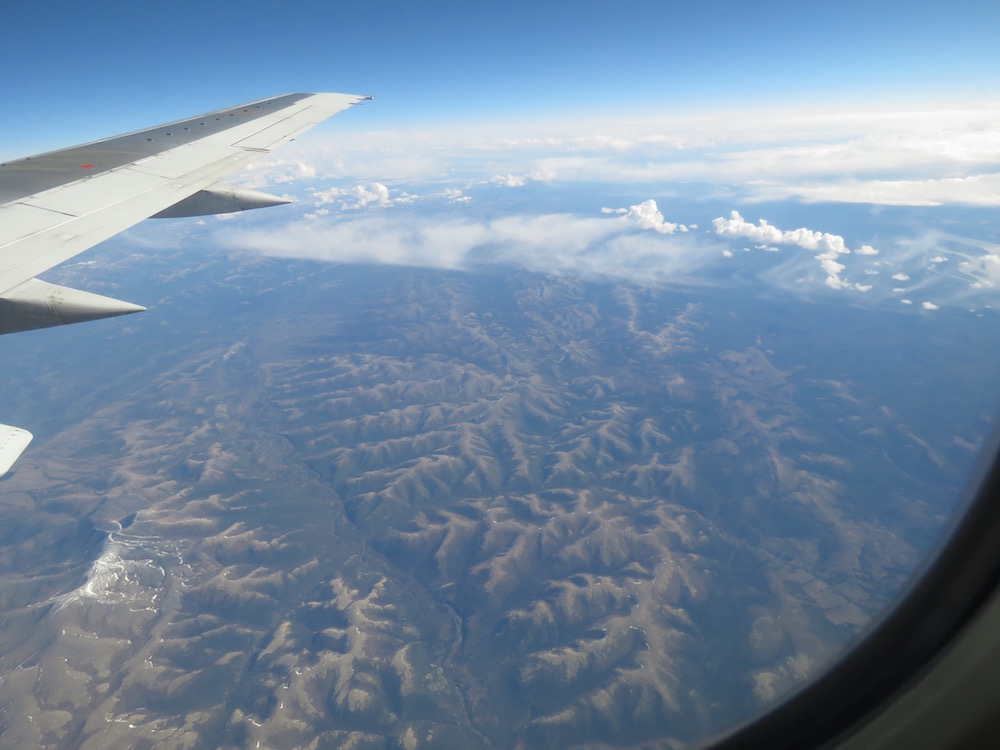
After spending two days in Anchorage buying nearly $2000 worth of perishables and organizing it all in 23 boxes and our stored coolers, I joined the WINGS tour group, and we all took the flight from Anchorage to Nome on Alaska Airlines. Our route took us over the terrain covered by the Iditarod race.

Approaching Nome, we flew over Safety Sound, well known among birders.

Then we transferred to the Bering Air terminal for our 50 minute flight SW over the Bering Sea to Gambell.

Approaching Gambell, on the northwestern-most tip of St. Lawrence Island.

Here’s the kitchen workspace I shared with the cooks of other birding groups in the Sivuqaq Lodge.

I baked a lot of bread – seven different kinds including six loaves of challah for breakfast strata and French toast.

This is the famous no-knead bread that takes very little effort and work time.

Jennifer Jolis was the cook for the VENT tour, and behind her is her assistant Ahi.

I made buttermilk and buckwheat pancakes for breakfast one morning, and my leaders (Gavin Bieber here) and sometimes even the participants helped take the food out to the dining area each meal.

Here’s the group at dinner one night.

One of the more ambitious meals I prepared was what I called Nepali Night à la Saraswoti. Saraswoti is the head cook and nanny for my friends Kate and Mich, who are living in Kathmandu, and when I visited them this past April I helped Saraswoti in the kitchen from time to time and took notes.

Here are most of the main ingredients I bought in Tucson and shipped up here.

The day before I had to make the paneer from whole milk, buttermilk, and lemon juice.

From left to right are fried tofu salad, chatpate, fried paneer curry, cauliflower curry, chana dal, and basmati rice.

Chatpate is traditionally a spicy street snack in India and Nepal, served in a cone of newspaper, but it’s mostly fresh vegetables and serves perfectly as a salad, perked up by crunchy potato noodles and puffed rice.

On the last night I made Lemon Mousse Pie, a huge hit. I’ll be making this one again.

I did get out birding on five occasions, three of which were spurred by the presence of a Pallas’s Bunting, found by Stephan Lorenz. I missed it the first two times, seeing a super rare Siberian Chiffchaff as a consolation (but I saw one here two years ago) but when I went out on my own the third time on June 1, I got fabulous views – and of course, that’s when I forgot to bring my camera. It was my ABA bird #753. There are about seven previous records for the United States, and this is the first verified spring record from Gambell. It mostly hung out in what is called the Circular Boneyard; here a Walrus skull in the foreground where I had it.

I looked for but did not see the Hawfinch and Eyebrowed Thrush that were south of the boneyards. Find the Snow Bunting in this boulder field near the same location.

This is Troutman Lake, always still frozen this time of year.

Red-necked Phalarope is a common breeder in any little puddle of water. The female is the stunning, more colorful of the pair.


Common Redpolls forage on seeds in the boneyards.

Lapland Longspur is the most common breeding passerine here.

Much of the birding time at Gambell is spent at the northern point watching seabirds fly by as one looks towards the Chukotsky Mountains of Russia.

On June 5, we flew back from Gambell to Nome.

From up high we had a much better view of the very mountainous Chukotsky Peninsula.

Here’s a shot of the GPS screen on our flight from Gambell to Nome – east is straight up.