Tuesday, August 20, 2019

Blog Backlog Catch-up: Minas Gerais, Brazil in November 2018


Three of the participants from my SE Brazil tour continued with me to Belo Horizonte to join Fabrice Schmitt’s tour of the state of Minas Gerais. This was my first time to this state, and even though I’ve birded the Cerrado biome of Brazil in several disparate areas, there are some birds with very restricted distributions that occur only in this area.

Our first destination was the Serra do Cipó northeast of Belo Horizonte.

One of my favorite sightings from here was Hyacinth Visorbearer, which we saw while looking for (but not seeing) the much less showy but rarer Cipo Canastero.

A specialty of these habitats it the Gray-backed Tachuri.
Gray-backed Tachuri

Cinereous Warbling-Finch was a lucky find and the only lifer for Fabrice on the tour (and of course for me).
Cinereous Warbling-Finch

I could botanize here for weeks. This Cambessedesia hilariana may be the most unusual melastome I’ve ever seen.
Cambessedesia hilariana

This monocot is a Vellozia, a South American counterpart to the South African Xerophyta, and the majority of species are found just in the state of Minas Gerais.
Vellozia

Another monocot is this Paepalanthus, in the family Eriocaulaceae. Other than the flowers, it looks a lot like a grass, and genetics show it is actually in the same order.
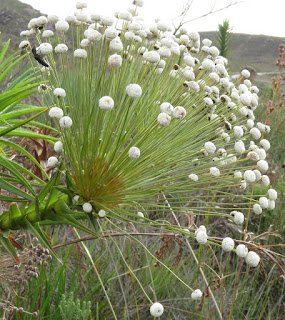
Paepalanthus

After Cipó, we traveled to Caraça Sanctuary, an old monastery in a magical setting. The habitat here is actually a transition from SE Atlantic Rainforest to Cerrado, the former dominating.

Cliff Flycatchers breed in the monastery buildings, close enough to cliffs for them.
Cliff Flycatcher

Swallow-tailed Manakin is a bird of the Atlantic Rainforests – the original “tanager,” as its local name, probably derived from the Tupi-Guarani, is tangará. My guess is that the first collectors in Brazil bunched these up with hundreds of specimens of other colorful birds (including what we now call tanagers) from the region and sent them back to Europe for official scientific description. The name suggested would have been attached to the first ones grabbed.
Swallow-tailed Manakin

Maned Wolf is the main reason that so many tourists come to Caraça. It was a very special experience to be so close to one of these normally very wary and hard-to-see mammals, but they have become accustomed to this feeding station only after many years.
Maned Wolf

We birded the trails at Caraça as much as we could, but a series of fronts brought a lot of rain, making it difficult.

The rain brought our a lot of fungi though, including this Clavulinopsis.
Clavulinopsis

This Lafoensia, probably L. pacari, a member of the family Lythraceae.
Lafoensia pacari

Butterflies were hard to come by in this super wet period (supposedly one of the wettest Novembers ever in Minas Gerais), but when the sun came out the ones we found were quite special. This is the metalmark Panara soana.
Panara soana

This firetip skipper is the little known Sarbia catomelaena.
Sarbia catomelaena

On our way westward to the final tour destination several hours to the west, we stopped by a lake in the city of Belo Horizonte where we found Southern Pochard, a long expected lifer for me.
Southern Pochard

Here is our hotel for the last few days near Canastra National Park, Pousada Chão da Serra.

It continued to rain here, usually not very heavy, but rather constant and difficult to bird in. But it clearly had been raining harder, and the river where we usually find Brazilian Merganser was a raging torrent for its entire length.

Yet we did have some breaks in the weather and were able to see birds from the bus during the drives. Red-legged Seriema is one of the most photogenic birds I know.
Red-legged Seriema

These two nestling Burrowing Owls were right next to the road. I find it interesting how they prefer to rest on their entire foot rather than just on the toes, the way most birds perch.
Burrowing Owl

Rain makes for perfect knitting weather, so I was able to finish this Apple Pie Hat that I had started on the SE Brazil tour.

Saturday, August 17, 2019

Blog Backlog Catch-up: SE Brazil in November 2018


My fourth birding trip to Southeastern Brazil took place in early November. Covering the states of Rio de Janeiro and São Paulo only, we started the tour at Itororó Lodge on the outskirts of Novo Friburgo.

The lodge owns several acres of regenerating forest, and in just two years I could see a noticeable increase in native bird life here due to the habitat improvements. But some of the more enjoyable birding is right at the lodge’s feeders. Brassy-breasted Tanager is one of the lookers.

Brazilian Ruby is one of several species of hummingbirds there.

To see these Orange-eyed Thornbirds we walked one of the loop trails.

This cicada, Carineta diardi, is the most colorful species I’ve ever seen, and they are common here.

This was the second time I’ve discovered the stunning Passiflora catharinensis in bloom, this time on the road up to Pica da Caledônia.

Our second bit of birding was at Itatiaia National Park, where we were greeted by the arrival of a super wet low pressure area that brought us two solid days of rain. Here our driver William Riame is getting friendly with a Brazilian Ruby.

We had a nice break in weather on our day to the high elevations of the park where we saw this Itatiaia Spinetail.

Another good find there was this toad Melanophryniscus moreirae, one of the hallmark species for the national park.

The moths at the hotel lights were really good. This silkmoth is Rothschildia hesperus.

This is Rothschildia jacobaeae.

We saw several good birds during our days on and near the coast at Ubatuba, but this frog Physalaemus atlanticus was my favorite sighting.

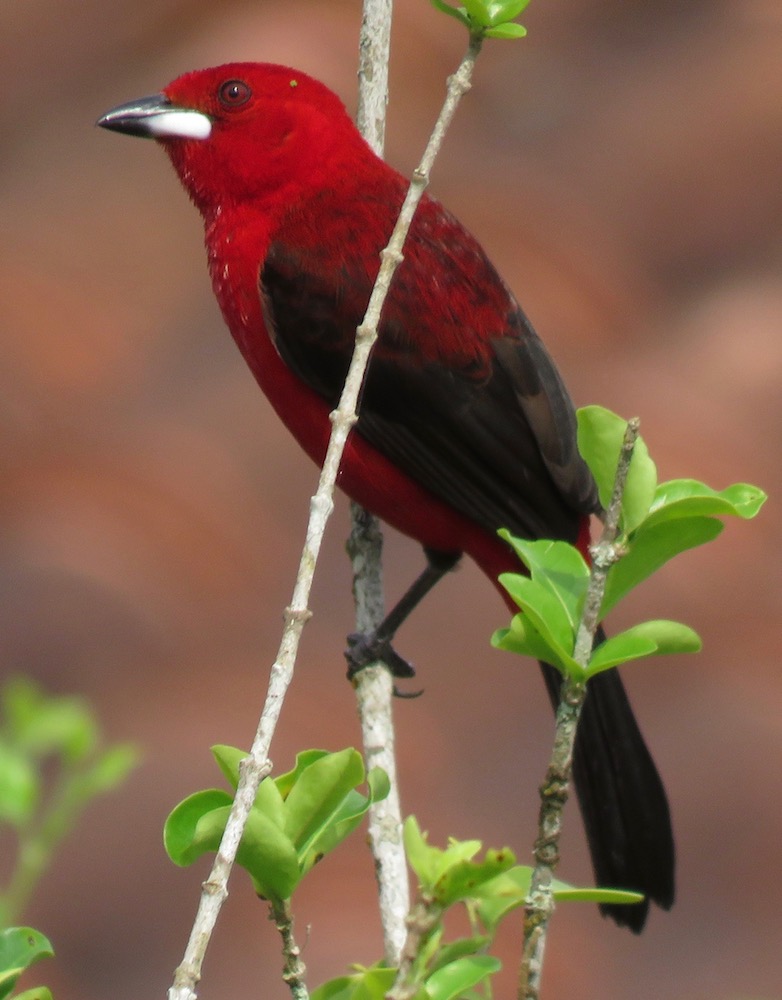
Farther down the coast at Cananeia Brazilian Tanager became common.

The first time I saw Scarlet Ibis here I was surprised; I had no idea they got this far south. They aren’t always findable though.

The sandy soils here are perfect for small insectivorous plants. This one is Utricularia tricolor.

This sundew is Drosera capillaris.

We finished the tour at the marvelous Intervales State Park. The lek of Purple-crowned Plovercrest here makes it easy to find them.

And now they have a feeding station making Spot-winged Wood-Quail nearly a sure thing.

I haven’t yet figured out this butterfly caterpillar, but I thought it was fantastic enough to include here.

I found this microteiid lizard Colobodactylus taunayi on our hotel grounds.

Just down the drive from the hotel was this rear-fanged colubrid Tomodon dorsatus. It’s not an aggressive snake, but the venom is potentially dangerous, so I didn’t handle it.

Friday, August 16, 2019

Blog Backlog Catch-up: SE Arizona October 2018


-->
When I got home from Bolivia, I found this dead Western Threadsnake, Rena humilis on my carpet. Thank goodness for a dry climate that mummifies little things like this before they can rot.

With just under two weeks between tours back at home, I made the most out of my time. In the past few months three of my nieces had babies, so I quickly knitted hats for two of them.


I also had a chance to visit with my friends David and Andy Sonneborn and helped them load this sculpture, which they had bought at a gallery in Tubac, into their rental car.

We did a bit of birding on the nearby Santa Cruz River where this Western Tanager was a bit on the late side.

Then I had a short private tour of three and a half days for a single client who has been on a few regular tours with me. Pam and I started in Madera Canyon, awash in fall colors.

I got an unintentional response from a Whiskered Screech-Owl, which surprised me by flying in and landing just a few feet away from me.

We enjoyed the birds at the feeders, including a Blue-throated Hummingbird, and then this White-nosed Coati came in and took his fill.

We stayed three nights at the Amado Territory B &B, which had some nice birds, including a big flock of Lawrence’s Goldfinches. There were a few nice moths a the porch lights each evening, such as this tiger moth Ectypia clio.

One of the more rewarding birding spots we visited, for the views and variety of plants and birds was Rock Corral Canyon.


We found a pair of Black-capped Gnatcatchers here; there have been a few pairs in this canyon ever since the original invasion was detected about 15 years ago.

There were plenty of butterflies too, this puddle party consisting mostly of Mexican Yellows, Eurema mexicana.

We also birded along the Santa Cruz River where we spotted this Arizona Mantis, Stagmomantis limbata.

This formerly Magnificent, now Rivoli's Hummingbird, was at the Paton’s Birding Center.

An amazing stinkhorn mushroom was in the lawn there, Lysurus cruciatus. As an aside, this generic name was shared by a couple South American birds – Sooty-faced Finch and Olive Finch – as botanists and zoologist have completely separate nomenclatural rules. But they were moved into the brushfinch genus Arremon recently.

We ventured as far as Huachuca Canyon, hoping for the Sinaloa Wren that was being seen sporadically.

Under our picnic table was this odd, beardlike growth.

Closer inspection revealed it to be a roost or hibernaculum of dozens of daddy longlegs.

The small stream here had a few Painted Damsels, Hesperagrion heterodoxum.

Our last day saw us northwest of Tucson in the Santa Cruz Flats, hoping for the often elusive Mountain Plovers. We didn’t see them but saw plenty of other birds. This Harlan’s Red-tailed Hawk was apparently back on the same power poles for the second or third year in a row.

Much of the habitat there is intensive agricultural, if not disused wasteland, so I was surprised to find this Great Blue Hairstreak, Atlides halesus in a patch of desert broom.