Sunday, June 16, 2013

Borneo Blog: My First Acquaintances with Pittas, Gibbons, and Wren-Babblers

Links to this post
May 1, 2013

Finally – another installment of my recreated Borneo Blogs.

Maybe I should get the leech story over with first. In case you haven’t heard, in much of southeastern Asia there are terrestrial leeches waiting on the tips of leaves in the forest that want your blood. Yesterday wasn’t a problem, as I was on the road almost all day. But today I tackled the forest trails across the Segama River, crossing the foot bridge and entering the 500 meter-by-500 meter grid of trails used by researchers. The further you get into the grid, the narrower the trails and the denser the low vegetation at ground level. But I stayed on top of the problem, constantly checking my legs for leeches, flicking them off, and teasing them when I saw them waiting patiently on their leaf perches before they noticed me. In the late morning I paused to look inside my boots and discovered 20 in each, all in their infrared heaven but no manna – hunkered down and pressed flat either on my socks or against the inside of my rubber boots. It took a good 10 minutes to get them all out, flicked off (with some effort) into the woods. I was a little more vigilant the rest of the day, but when I got back to the dorm, there were again a few inside my boots, and I scraped them out and flicked them off into the grass where they probably perished from exposure. Then inside, getting ready for my shower, I took off my shirt, and there above my left nipple was a nearly fully engorged leech, fast attached. “You little f*er,” was all I could say, and I dislodged his-her mouth by scraping it off with my fingernail, shuddered as it stuck to my finger like glue, and hauled him-her outside. It would have been too much work to try to kill it, so I just flicked it off into the lawn like the others. So, permethrin-treated socks, pants, and long-sleeved shirts will not deter them. Obviously, having button-down shirts is no insurance that they won’t sneak in between the buttons or down the collar if their journey begins where I can’t see them, such as on my back.

Ok, done. I took no photos of engorged leeches or blood (sorry Kate). I think most people just wouldn’t like that, and I don’t really want to be reminded, even though I’m usually of an extremely hardy constitution. Just google “leeches and blood” if that’s your thing (and you can move on to botflies if you haven’t had enough). But I did have a spectacular morning of birding, even if most of the sounds I recorded are still mysteries. Birding in the understory of tropical rainforest is hard anywhere, but it’s particularly hard when you don’t know the vocalizations and when the canopy is 60 meters tall. I eventually decided that one of the amazing, loud and surprisingly melodious sounds coming from many directions belonged to Bornean Gibbons in the canopy. Others might have been Agile Gibbons. But then I never even glimpsed a monkey, so my second guess is that they were Thick-billed Pigeons, a bird I did see way high in a tree through a tiny gap in the mid-story umbrella of foliage. As you see, I have no clue, and I’m grasping square straws and putting them in round holes.
I was excited to see my first pitta today – a colorful beauty which in the book is called Black-and-crimson Pitta, by the IOC Black-crowned Pitta, and in the Clements list Black-headed Pitta. I’m sad that I don’t have a photo to share of it, as it’s a gorgeous gem of a bird, but I did get excellent sound recording of its simple song – a 3.5-second pure whistle starting at about 1190 hertz and gradually rising to 1260, a barely noticeable increase in pitch. I later heard a few more and saw three by the end of the day, but it was the first one that was so spectacular, as I was not at all prepared and in retrospect realize that I was whistling the song only absentmindedly, not actually expecting a bird to fly up so abruptly from a hidden ground perch. Its wings gave a loud, snapping rattle, adding to the drama.

Then not far down the trail, while recording the second pitta, I recognized a two-noted whistled that I had been studying – the endemic Bornean Wren-Babbler. I hadn’t studied the pictures, so it was quite a surprise to see this quail-sized bird with long legs, long neck, brown-and-white streaked breast and an odd walking behavior hop on to a fallen log and pace back and forth in excited response to my whistled imitation. The other babblers I had seen were all vireo- or antbird-like foliage dwellers, not something rather like an oversized, disproportionate antthrush. Here's a horrible digibinned image.

By mid-day the cicadas had become impossibly loud, and I wanted to avoid getting caught in what seemed like would be a daily afternoon downpour, so I spent most of the afternoon back at the dorm, studying for tomorrow’s outing (and to take a break from the leeches, to be honest). Before I left the forest, a couple critters caught my attention: a small frog in the leaf litter, and a showy damselfly.


Walking back across the footbridge over the Segama River is this view of some of the Field Centre’s buildings, in what is a ridiculously oversized, spread-out campus that could have been more concentrated, allowing for a larger area of forest regrowth. Is a half-mile walk between the dorms and the dining hall really necessary?

This is the suspension bridge which doubles as a Whiskered Treeswift hunting perch, which I learned after flushing one at a distance of only a couple feet before I noticed it. I’ll try to remember another afternoon.


This evening, a few interesting moths visited the lights by the kitchen (I love the green one, and am very curious what family the big, square-winged one might be in), and a Bearded Pig cruised the grounds looking for handouts.


Sunday, June 9, 2013

My Sixth Year of Cooking at Gambell

Links to this post
On my feet and cooking nonstop for about 16-18 hours every day for this past week has kept me from blogging, and I will get back to my Borneo accounts later this week. Before I do, a quick recap of what has a been a very rewarding though exhausting week at Gambell, on the northwestern tip of Saint Lawrence Island.

First step was buying and boxing the nonperishables in Tucson the day after I got back from Indonesia. Second step was buying all the fresh food in Anchorage for two days and boxing it all up in 9 coolers, 8 boxes and two cartons (the 27 dozen eggs).

Then as a group, 15 of us flew to Gambell via Nome, and our Bering Air pilot Larry gave us a very nice view of the village before landing. (En route we also had views of Big and Little Diomede Islands to the north.)

This is the kitchen in the Sivuqaq Inn, my home for the week.

I cooked and baked up a storm. Here are whole wheat sandwich bread, no-knead bread (makes the best garlic bread), and challah (for the breakfast strata and french toast).

This is Nina Hansen, a saint and my savior in the kitchen. She washed 95% of the dishes while I kept prepping for the next meals, but that gave her bowl-licking privileges as well as license to give a few cookies to the kids. This Snowy Owl is one of a few pieces of precious ivory she bought from the local Yupik Eskimos who come in to the lodge to sell their works; exhausting her budget, she promised herself to not to buy any more. Then she bought some more.

And if you weren't there, here's what you missed:
Gambell Meal Plan
WINGS Tour, 2013
Rich Hoyer

Day 1, May 30
Afternoon flight to Gambell
Lunch: At Anchorage Airport
Dinner: Oven-roasted Salmon with Tangerine and Ginger relish, Green Beans with Toasted Hazelnuts and Browned Butter, Leafy Salad with Blue Cheese Dressing
Dessert: Strawberry-Rhubarb Fool

Day 2, May 31
Breakfast: Fluffy Scrambled Eggs, Cream Biscuits with Cheddar Cheese, Oven-fried Bacon                 
Lunch: Classic Chicken Salad Sandwiches, Barley Soup With Mushrooms and Kale
Dinner: Crispy Roast Lemon Chicken, Baked Wild Rice, Maple-roasted Brussels Sprouts and Rutabaga with Hazelnuts, Apple-Pear Salad
Dessert: Orange-scented Olive-oil Cake with Orange Compote and Ganache

Day 3, June 1
Breakfast: Fluffy Scrambled Eggs, Buttermilk and Buckwheat Pancakes and Sausage
Lunch: Slow-roasted Beef and Easy Roast Turkey Breast, cheese, West African Peanut Soup with Chicken
Dinner: Glazed All-beef Meatloaf, Quinoa-stuffed Eggplant, Shaved Kohlrabi and Arugula Salad with Chunky Garlic and Pimentón Dressing
Dessert: Blueberry-Peach Cobbler with Lemon-Cornmeal Biscuit Topping, whipped cream

Day 4, June 2
Breakfast: Sonoran Sunrise Bake, Fresh Tomato Salsa, Fresh Fruit
Lunch: Grilled Cheese Sandwiches on Homemade Whole Wheat Sandwich Bread and No-knead Bread, Creamless Creamy Tomato Soup
Dinner: Lasagna di Carnevale, Fennel-and-Endive Salad with Red Grapes and Walnuts, Classic American Garlic Bread
Dessert: Wicked Good Boston Cream Pie

Day 5, June 3
Breakfast: Fluffy Scrambled Eggs, Blueberry Scones, Oven-fried Bacon
Lunch: Roast Beef and Roast Turkey Sandwiches, Broccoli-cheese Soup
Dinner: Urban Tavern's Spice-rubbed Pork Spare Ribs, Couscous with Carrots, Raisins, and Pine Nuts, Evelyn’s Killer Kale Salad
Dessert: Classic Apple Pie with Foolproof Pie Crust and vanilla ice cream

Day 6, June 4
Breakfast: Fluffy Scrambled Eggs, French Toast, and Oven-fried Bacon
Lunch: Grammy Hoyer's Olive Spread, Hearty Chicken Noodle Soup
Dinner: Roast Cod Fillets with Potatoes, Garlic and Olive Oil, Walnut-Apple Celery Salad w/ Mustard Vinaigrette
Dessert: Triple Chocolate Mousse Cake

Day 7, June 5
Breakfast: Spinach-And-Fontina Strata, Sausage, and Fresh Fruit
Lunch: Homemade Pizza, Zuppa Toscana
Dinner: Egg drop soup, Gingery Chicken Stir-fry with Bok Choy, Steamed Jasmine Rice
Dessert: Blood Oranges with Caramel Sauce and Cocoa Nibs

Day 8, June 6
Breakfast: Fluffy Scrambled Eggs, Overnight Sticky Buns, and Oven-fried Bacon
Lunch: Leftovers
Departure to Nome in afternoon.

Also:
Home Made Whole Wheat Sandwich Bread
Challah
New York Times No-knead Bread
Perfect Chocolate Chip Cookies
Snickerdoodles
Classic Brownies
Ultimate Turtle Brownies
Key Lime Cookies
Pumpkin and Currant Cookies


Monday, May 27, 2013

Borneo Blog: Square Pegs and Round Holes

Links to this post
April 30, 2013

It perhaps would be of more interest to a psychologist than a biologist to know that this morning I heard Dull-capped Attila, Plain Wren, Red-billed Pied-Tanager, and Piratic Flycatcher. You see, I’m in Borneo, and those birds of the New World Tropics have no chance of occurring here. Yet time and again, I’d hear a new bird call or song, unseen in a dense thicket or from the top of an incredibly tall tree, and though a little odd, I’d find something in my brain to match up with it.

This was my first full day in the tropical elevations here, and everything is new to me. Everything. But I have this library of bird sounds in my head, probably numbering over 5000 separate vocalizations (some birds have many different call types),  and I just can’t help but try to match what I know with what I'm hearing. Almost all of the birds I know are strictly American species, with a few vocalizations I can recall of European, African, and Australian birds (who can possibly forget the song of Eastern Whipbird?). If each and everyone one of these sounds in my head represents a square peg, every sound I heard this morning was a round hole. And I’m apparently quite good at putting square pegs in round holes if I heard a Dull-capped Attila this morning.

I’m at the Danum Valley Field Centre for only six full days, so I’m determined to make the most of my time. I was out before sunrise this morning and decided I would not go far from the dorm and open areas of the complex, thinking that it would be a good idea to familiarize myself with all the species that would be common in the disturbed habitats where they are easier to see. Then I would start on the forest interior species.

I started the day an hour and a half before sunrise in the kitchen with my Nescafe and met another traveler staying in the hostel, Belinda from Australia. This is her next-to-last morning, and she’s headed up the tree platform for sunrise. She’s here to see all kinds of rainforest nature but especially likes fascinating insects. I heard the first bird singing in the shrubby row next to the dorm well before sunrise, and I had no idea what this one is – a low, throaty “tyork, tyork, tyork...” repeated at a rate of about 2 per second. But it will be too dark for at least a half hour more before I have any hope of seeing what this is, so I moved on to more vocalizations beckoning from down the road.

I spent the rest of the morning on the entrance road, not making it more than about 500 meters from the reception office. Activity was high, and by noon it felt like I’d seen a hundred new birds. But I most definitely recorded more mystery sounds than identified seen birds. I got frustrated at some of the drab bulbuls (and it doesn’t help that the illustrations in the book don’t always match the text, nor the bird in real life), but those were more than made up by four species of gaudy and easy-to-see sunbirds in one small flowering tree overhanging the road. Van Hasselt's Sunbird is just stunning.

Here’s a view of the second growth along the road from a small observation tower just above the road.

I stepped off the road along a small shaded stream to try for birds in the undergrowth but all I found were these huge mayflies on territorial perches.

Later in the afternoon after what seems to be the daily rain shower I wandered up the Nature Trail near the dining hall, one of the few trails that they officially allow visitors on without having to hire a ranger guide, though this isn’t strictly enforced, and I think with my experience in tropical rainforests they seemed to have given me tacit permission to go where I wanted. The first section of this trail has a wooden boardwalk, then follows a stretch of the Segama River, here a particularly nice view. That's mostly primary rainforest on the other side of the river.

 This part of the forest is partly disturbed, but some original trees and their ancient vines still live here.

A terrestrial orchid was particularly common here. It looked like it should be fragrant, but at least in the afternoon there was no scent.


And here I saw my first leech crawling up my pants, duly flicked off. Looking around, I was able to spot some on the tips of leaves next to the trail. They sense the infrared radiation coming from passing mammals and birds and reach out or drop to the ground and inch their way to the potential host.

Maybe more menacing looking to some, but most certainly completely harmless in contrast to the leeches was this orb weaver with some amazing protrusions on its body. The genus is probably Gasteracantha which translates to stomach-spine.

Insects were attracted to the lights at the dining hall as well as by the dorms. This most amazing moth had me fooled for a bit, thinking it was a large planthopper. It has a very muscular body and very strangely-shaped antennae. I’d wouldn’t be surprised if this belongs to a family not found in the New World – everything about it seemed so utterly foreign to me.

This gigantic cicada is a common one around the lights and is probably one of the really loud ones that drive me crazy during the day.

I saw few katydids, but all were big, showy ones like this.

And then a few more moths, starting with yet another belonging to the same family as the first one above. It plays dead as a defense.


Friday, May 17, 2013

Borneo Blog: Travel Day Travails from KK to Danum Valley

Links to this post

April 29, 2013

I finally made it to the Danum Valley Field Centre tonight, despite some travel issues today. With only two weeks in Borneo, I had decided it was best to shave off travel time between cities by booking short internal flights, rather than taking the bus, though the latter is much cheaper. It turns out that would have been faster and a lot cheaper than I calculated after all.

I left the Mount Kinabalu Holiday Home in a shared taxi at 8:20 for the 90-minute ride back to Kota Kinbalu, got a quick taxi to the airport, and soon was notified that my noon flight to Lahad Datu was canceled--but no worries, I had alread been rebooked for the 3:50 flight, getting into Lahad Datu at 4:45. The problem is that the Field Center offers transfers (at a very high rate of about $22) only on Monday, Wednesday, and Friday, departing their office near the airport at 3:00. There is no public transportation option, and a private transfer for the two-hour ride is about $120. The Malaysian Airlines agent was very helpful in trying to solve the issue, calling the Field Centre twice and giving me a voucher for lunch until she heard back from her supervisor. But in the end, the option of losing two valuable days in the Danum Valley (to be filled with what and where and at what cost?) wasn't a viable one for me. So with the second phone call to the Field Centre, it was arranged that a Mr. Noh would meet me upon arrival at Lahad Datu in his black Toyota Hilux. And in the end, when I submit the form given to me by the agent and a copy of the receipt, Malaysian Airlines may actually reimburse me.

I had never even heard of it before starting to plan this trip, but Lahad Datu is a bustling city, a wealthy center of logging and palm oil production. Unfortunately, both have led to the utter distruction of unimaginable riches of biodiversity. Upon approaching the city, all I could see for miles and miles was African Oil Palm plantations. Please, please read the labels of the food you buy, and don't buy anything with palm oil. Otherwise there is Oruangutan blood on your hands (and you'll get atherosclerosis or something and die an early death). And I learned that Lahad Datu is also the world's Toyota Hilux capital of the world. I waved at four or five of them at the airport curb before Noh found me (it turns out they have a habit of adding "Mr." as a title before your first name--I was often referred to as Mr. Rich). Every fourth vehicle in the city's congested streets is a Hilux.
After stopping at grocery store for my field breakfast and lunch food for the next week (eggs to boil, carrots, peanuts, and sardines), it took us a half hour to escape the rush hour traffic before we were on the highway. It became dark not long after we turned onto a dirt road, and it was clear that we were entering a very humid area as water continually condensed on the outside of the Hilux's air-conditioned windows (the tropical models don't have defrost or heating of any kind). Despite the bad visibility, it was hard to miss the six Bornean Pygmy Elephants on the road. Noh had warned me that there had been a lot around, but the enormous piles of dung along a 15-kilometer stretch of the road was kind of a giveaway before we saw them.

After arriving at 7:40 p.m. and checking in at the Field Centre's reception and receiving a brief orientation, Noh drove me and my bags to the "hostel" (the shared dorm, the cheapest of the accommodations here, other than camping) and then to the dining hall where they kept dinner ready for me. I met two other travelers staying here, also staying at the hostel, Ingo from Germany (though living in Switzerland) and Anita from The Netherlands.

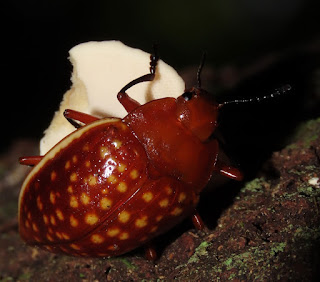
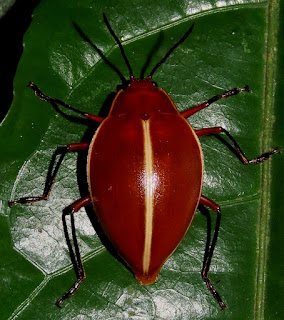
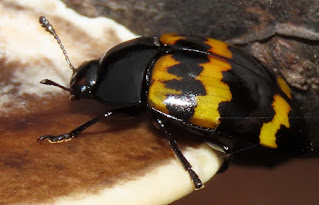
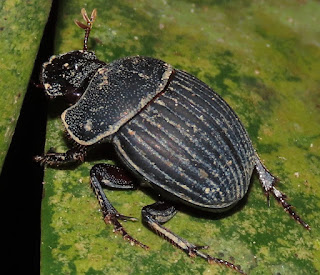
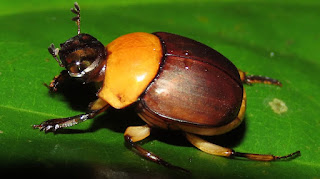
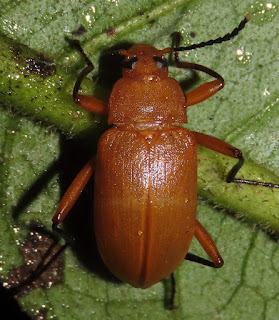
It turns out that the building lights here are pretty good for attracting interesting insects. Back at the kitchen building between the men's and women's dorms (a full half mile walk from the dining hall, I was unhappy to learn) were this beetle and two moths.


Reflections on My Three Days At Mount Kinabalu

Links to this post

April 29, 2013

Apart from my layover day in Hong Kong on my way here (where I nonetheless saw eight lifers), the last four days we an amazing introduction to birding in Asia.

It wasn't all perfect, and I will always remember the frustration at missing Whitehead's Trogon, even though I knew a pair or two were breeding in areas where I birded. But I saw a ton of new things (families, even) and even got recordings of many of them. As I work my way to the Danum Valley for my next week of adventure, I thought I would try to boil down my experiences here into some good and not-so-good categories.

Delightful: The cool, moist, mountain air. The elevation here is just perfect, and I was prepared for hot and muggy. Very few biting insects.

Not so great: The two afternoons mostly lost due to rain that started around noon and continued into the late afternoon. It made walking the trails difficult...no, treacherous...and after a bit, even the birds give up. But this mountain, the largest in Malaysia and the highest peak between the Himalayas and New Guinea, makes its own weather when it wants to.

Awesome: The plantlife. I saw my first Nepenthes (the genus of amazing pitcher plants with the modified leaf tip), lovely Rhododendrons, many orchids, and some pretty amazing conifers. I was particularly surprised by the diversity of Melastomes, a family I know from the Neotropics.

A nuisance: The spiny palms. They have a ridiculously long, extended rachis covered in claws used to clamber up into the taller understory trees. Ok, it's pretty cool that a 15 meter tall palm tree can have a dbh (diameter at breast height) of less than a centimeter, but they grab, pull, cut, and tear with no provocation.

Bad: the leeches. Actually, on the first day in the park I was very careful. I tucked pants in my socks, checked frequently, and all day saw nothing. I was going even higher on the mountain the next day, so I was lax, and only back at my room noticed the ring of blood stains on my lower pant legs. Sure enough, right above the top of my sock line were three bleeding bites. In the shower and then for over an hour afterward, they continued to slowly bleed, as the leech saliva has a powerful anticoagulant. I never felt or even saw the buggers -- they obviously have a good anesthetic too.

Good: The rigorous 4-km hike up to the Layang Layang shelter early in the morning, with my lifer Blyth's Shrike-Babbler (recently reclassified as a member of the vireo family), and mixed flocks in the mossy forest. A Mountain Treeshrew was also pretty cool.

Not so good: I didn't see or hear the Friendly Bush-Warbler or Island Thrush, but I knew my chances were not so great here. They're a good reason to come back some time and hike in from Mesilau.

Bad: the hordes of hikers coming back from doing the whole climb to the mountain peak at dawn (another 2-3 km straight up), especially heaps of noisy (even singing loudly) older Koreans. The many young German backpackers were quiet in comparison. You have to pay a lot of money to reserve your spot, hire a guide, and stay in the shelter the night before to get an early start. You don't want to hike this mountain in the afternoon.

Astounding: Walking the Kilau View trail lower in the park (essentially deserted, as nearly all tourists are here to hike to the peak or just say they were in the park and saw the peak), and bumping into my friend Bill Talbot from Albuquerque. He had been on the road for months, mostly doing research for his doctoral thesis in the Kalahari, and had added a few weeks in Borneo to help out some of his colleagues doing similar bird physiology work here (from the University of Montana -- I saw their survey flagging and net lanes everywhere). I think I blogged about Bill's helping me out on the rugged Pine Canyon area on the Atascosa Highlands Christmas Bird Count three or four years ago. What a trip. I also met three of the biotechs (Ed, Tori [?], and a local guy whose name I didn't get) and the project leader Andy, all of whom were really nice and offered helpful birding info.

Really fun: all the fabulous moths at the lights each night at my hotel. I'll have to post a full gallery some time. Especially interesting was the extremely high diversity of pyraustine crambids; I'm used to seeing two or three simple ones in places like Peru or Costa Rica, but here there would be ten or more, some quite ornate.

Meh: Most of the bird songs here are rather uninteresting, either being dull or extremely high pitched, or both. The White-browed Shortwing does do a favorable impression of Winter Wren, and the gradual increase in volume is a nice touch, though it stops short and is still ridiculously high-pitched. Standing out as good songsters on the other hand were the duets of Red-breasted Partridge and Bare-headed Laughingthrush, but it wasn't like the haunting dawn choruses of Australia or Africa.

Very cool: Things named after Whitehead that I did see -- Whitehead's Spiderhunter, missed by many birders, and the adorable Whitehead's Pygmy-Squirrel. It's like an abbreviated chipmunk with the ear tassels of an Abert's Squirrel.

Even cooler yet: The several species of little squirrels that thought they were birds, running through the undergrowth and the canopy keeping up with mixed flocks of warblers, babblers, and laughingthrushes. I had never heard of such a thing, but the association was instantly obvious. And then there it was, stated in the Mammals of Borneo field guide that they do just that.

Now to the hot and humid tropical elevations of the Danum Valley in eastern Sabah. I made a week's reservation at the Field Centre, but I'm not at all prepared to know how to cover the place, let alone how to identify any of the birds I will see and hear. I've been told three days is a good amount of time to get the specialties of the area, so I'm hoping six full days will give me a good foothold.

Captions to the photos:

One of the more spectacular pyraustine crambid moths at my hostel.

The nasty, grabby rachis of one of the spiny palms.

A Mountain Treeshrew feasting on some noodles apparently upchucked by a hiker overcome with exhaustion on the hike up Mount Kinabalu. My camera battery died, so this is with my low-quality phone camera.

A view of the mountain with my hostel Mount Kinabalu Holiday Home ($10/night) in the foreground.

---
Sent with my iPad

Thursday, May 16, 2013

Departing Scene From Lombok

Links to this post

This was the morning scene from my two-star hotel in Batu Leong, Lombok, just before my ride to the airport arrived yesterday. That's Gili Nanggu behind the fisherman, where I did some snorkeling the afternoon before. The fish were amazing.

---
Sent with my iPad

Last Days on Lombok

Links to this post


I'm on my way home after three interesting days in SW Lombok. I tried reaching a tract of remnant lowland forest, but it's very hard to get to. So I touched on the edges, mostly birding in secondary forest and scrub, and still having a good time. A serious effort to access the Batu Gendang forest reserve would take perhaps two full days of on-site planning and asking around, a day to get there, and then some camping. Another trip, probably for someone else.

But I did see some great things, perhaps most exciting an Orange-footed Scrubfowl; while known to locals, it had gone unreported by the ornithological community for over 100 years. There were no 20th century records.

Another good rarity to confirm from near Bangko-Bangko and even in poor habitat at Mekaki was Cinnamon-banded Kingfisher. I got recordings and even managed a digibinned image.


I spent the past two nights in the little Hindu village of Batu Leong, birded near Mekaki Beach by hiring a moped and driver, and spent an afternoon snorkeling at Gili Nanggu. It was great.I made friends with Madek from the hotel and his little friend Ketut.