
Two nights of camping in the high elevations of SE Arizona's Chiricahua Mountains was a welcome respite from the heat of the Tucson desert from July 25-27.
The main impetus of the trip was to help participate in Dave Prival's 13th annual Twin-spotted Rattlesnake roundup - a census of this rare and local species that is found only in the highest elevations of a few mountains in SE Arizona.
But the natural history in this area is fantastically rich, and while looking for snakes on the steep talus slopes above the Barfoot Park (a park is a high-elevation meadow in a valley surrounded by trees) I spent time looking at bugs, butterflies, birds, and plants.
Among the most obvious critters were the myriad bees, flies, wasps, and butterflies on the blooming shrubs scattered throughout the talus slopes. One of the more popular flowers was this rayless composite shrub Pericome caudata, Mountain Tail-leaf. And on it here is a syrphid fly, Eristalis stipator.

This fly is a close relative in the Copestylum marginatum group.

And this one is Copestylum mexicanum, the Mexican Cactus Fly. The larvae feed on rotting cacti.

This Adejeania vexatrix is in the family Tachinidae and is getting nectar from Littleleaf Mockorange, Philadelphus microphyllus.

This tachinid fly, Jurinella lutzi, likes this mustard Wright's Thelypody, Thelypodium wrightii.

Yet another tachinid fly, Belvosia species.

This day-flying moth was finally identified as Neofelderia rata, closely resembling the unrelated genera Lycomorpha and Neoalbertia; all are probably mimics of a beetle in the genus Lycus.

This is a long-horned beetle (family Cerambycidae) Judolia montivagans on Common Yarrow, Achillea millefolium.

I took few pictures of butterflies, though there was good diversity here. This is a Reakirt's Blue.


There were dozens of these Four-spotted Skipperlings on the slopes. It's a tiny skipper in a very small subfamily.

Moths were bound to be interesting up here, in a habitat that is more like the mountains of Mexico than elsewhere in North America. This is Lygephila victoria, in the underwing family Erebidae.

Some interesting moths came into the lanterns at the picnic table, such as this beauty, Caripeta suffusata. It is a geometer, meaning that it is in the huge moth family whose larvae are inchworms.

This erebid moth was identified for me on Bugguide.net as Hypena leuloa.
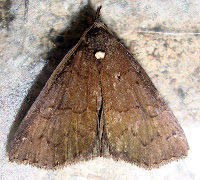
This is another geometer, and another tricky one to identify to species.

This is a day-flying moth, the Western Grapeleaf Skeltonizer, Harrisina metallica. There was a lot of wild grape in this area, which its larvae feed on.

The talus slopes were pretty tricky to walk on, but the upper slopes offered spectacular views of the surrounding peaks.

Yarrow's Spiny-Lizard was common on the rocks.

And quite common was this snail, most certainly some endemic species to these peaks. It's probably in the genus Sonorella.

A lovely little meadow at the end of the campground road (and doubling as a helicopter landing pad) was full of grasshoppers and wildflowers.

This is Wyoming Indian Paintbrush, Castilleja linariifolia.

This is the widespread Modest Grasshopper, Trimerotropis modesta.

This grasshopper nymph is tricky to identify, and may be in either the genus Conalcaea or Barytettix.

This is the Large-headed Grasshopper, Phoetaliotes nebracensis.

This is the Velvet-striped Grasshopper, Eritettix simplex.

This one has proven a bit trickier to identify and is probably the very local Chiricahua Spur-throated Grasshopper, Melanoplus chiricahuae.

This is the Blue-winged Grasshopper, Trimerotropis cyaneipennis.

Not a grasshopper at all, but in the same order Orthoptera is this katydid. The genus is Scudderia, and it's apparently not possible to tell the two possible species (S. mexicana and S. furcata) apart with female specimens.

A few other interesting invertebrates:
Golden Tortoise Beetle, Charidotella sexpunctata.

Ophion species, an ichpneumonid wasp.

Hemipenthes scylla, a beefly in the family Bombyliidae.

A leaf-footed bug, Catorhintha selector. It seems to prefer the four-o'clock, Mirabilis longiflora.

A walkingstick, Diaphomera species.

Pinesap, Monotropa hypopitys, a saprophyte, which is any plant that get its nutrients from decaying organic material, rather than synthesizing its own with cholorphyll.

Mahogany Milkweed, Asclepias hypoleuca.

I set out a few live traps the first night to see what sorts of small mammals might be around. Judging by the furred tail and orange wash on the side (not visible here), we figured this was a Brush Deermouse.

One of the best birds of the trip was a Spotted Owl, found by our friend Mark. When we walked up the road to find it around mid-day, it was hooting.

A Black-tailed Rattlesnake in the middle of the road on our way home.

A view from near Barfoot Junction looking eastward over the East Turkey Creek and Cave Creek basins.

On our way here and back to Tucson, Jake and I stopped at Lake Cochise, the sewage lagoon at Willcox. The 150 American Avocets, 59 Long-billed Curlews and several other shorebirds were a highlight.

An Ornate Box Turtle was crossing the road near here.

The gorgeous Horse-bean Longhorn, Trachyderes mandibularis.

A strange darkling beetle that can't be identified any further than the tribe, Epitragini.

Two-striped Mermiria, Mermiria bivittata.

Pallid Toothpick Grasshopper, Paropomala pallida.

Note: This blog was updated on 4/27/15 to remove complex formatting and to update identifications.



 Posts
Posts


