March 26, 2010
We arrived here at Chajul Biological Station yesterday afternoon. Getting to the small town of Chajul used to be a full day's drive on very bad roads. Now it's just a few hours on paved roads from either of two international airports. It's then a half mile boat ride to the dock of the biological station, which sits at the foot of one of the largest tracts of wilderness in Mexico. Enter the words "chajul, mexico" into the search field at maps.google.com, and be sure to click on the "Satellite" option.
This is the Dining Hall and one of the tame "rescue" Scarlet Macaws cavorting in the lower branches of the tree.
We birded from the clearing where the buildings are and walked a few miles of trails. The birding here was outstanding. On our one full day here, we tallied 139 species within about a kilometer radius, and added another 12 the next morning. We arrived when Plumbeous Kites were returning from their wintering grounds in South America.
We found many birds to be very responsive to our whistled imitations of pygmy-owls and on our last morning here were thrilled to have this Central American Pygmy-Owl come right in behind the buildlings. I had heard a few of these (in Oaxaca, Belize, and Costa Rica), but this was the first I've ever seen.
Here is the back of its head showing the fake eyespots.
For a while I thought the blob on the top of the radio antenna had some odd function. then I looked at it through the scope and saw it was a wasp nest.
One trail took us about 1.7 kilometers through rainforest, past a very small Maya ruin, and ended up on the shore of the Lacantun River.
There were some nice damselflies here, including this Dusky Dancer, Argia translata.
This rubyspot is probably Hetaerina cruentata. Thanks to Dennis Paulson for the names.
There were a few butterflies along the trail. This is probably Fruhstorfer's Owl-Butterfly, Caligo oedipus fruhstorferi.
This skipper is probably the Shy Saliana, Saliana longirostris (thanks to Richard Lindstrom for the suggestion.)
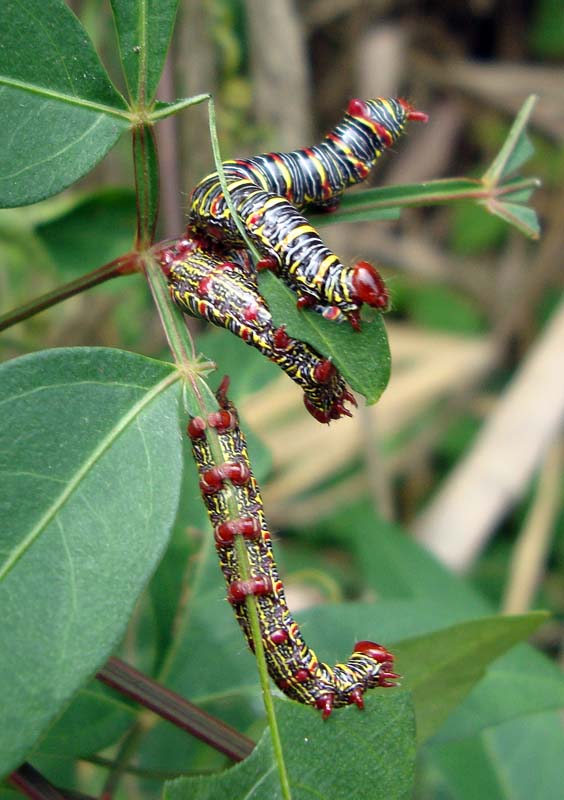
These wild looking caterpillars feeding on a plant in the family Malpighiaceae may be notodontid moths (thanks to Jim Brock for the suggestion.)
This skipper could be either Tanna or Teleus Longtail.
There were some nice herps here. This is Norops capito, the Pug-nosed Anole.
This is a young Giant Toad, Rhinella marina.
This is a Gulf Coast Toad, Incilius valliceps. (Yes, notice all the new toad genera, once all Bufo.)
This is Diploglossus (or Celestus) rozellae, Rozella's Galliwasp. I recognized it as a member of the alligator lizard family, but had never seen one in the tropics before. It turns out to be an arboreal species, rarely seen as it's normally 30 or more feet up in the epiphyte clusters. This one must have recently fallen down.
This very large (about 51/2 feet) snake skin was stretched across the trail. They don't last long in the tropical rainforest (quickly recycled by scavengers), so this must have been left very recently.
There was a terrific diversity of elegant understory palms here, most in the genus Chamaedorea. This one is Reinhardtia gracilis.
In addition to the tame Scarlet Macaws, there are a couple of orphaned Great Curassows (one that bullies people), and a couple of orphaned White-nosed Coatis. This one liked the smell of Negra Modelo.
One of the ways local people have tried to make money is by creating arts and crafts from butterfly wings. These are a series of bookmarks. This sort of economic activity is encouraged with the theory that the people will understand that there will be no butterflies if they continue to cut down the rainforest. Collecting live adults usually has little impact on populations. As long as a few remain to lay their hundreds of eggs, insect populations are designed to be able to sustain high mortality rates.
Tuesday, April 6, 2010
Bonampak Ruins
March 25, 2010
Today was the day that Steve and I planned to go to the famous Maya ruins of Bonampak in the morning, finished by a longish drive to Chajul Biological Station.
We had spent the previous afternoon birding along the entrance to Bonampak – a 9-kilometer dirt road that only the local Lacandón Maya are allowed to drive. That's once source of income, as they essentially provide a necessary taxi service. But one can walk in, and birding on the road is excellent. We saw a Pheasant Cuckoo (my second ever) and after dark heard a Great Potoo and Mottled Owl.
In the morning we got a ride in all the way to the ruins. The ruins are supposedly quite spectacular, but we were here to assess the access to birding habitat. I couldn't help but look at them, even when a Brown-crested Flycatcher had an altercation with a Green Shrike-Vireo from this very spot.
Near the entrance we saw a pair of Rose-throated Becards, the subspecies from here on south confusingly lacking the rose on the throat.
We then took a forest trail for the rest of the morning, encountering many mixed flocks. This Wedge-billed Woodcreeper was in one of them.
There were very, very few mosquitos this time of year. This one with white on the top of its thorax caught my attention. I wonder how many species mosquito are found here.
I call this Aphelandra species the "flibber flower."
Walking down this trail, we were required to have a local "guide." His name was Chambof. He told me that the leaves of the Aphelandra plant were used to dye cloth green. All of the locals here speak Ch'ol as their first language (one of many Mayan languages), Spanish as their second.
On our way to our next destination we stopped for lunch in the town of Benemerito de las Americas. It was sunny and hot this day, around 90°F. It wasn't much cooler in the shade, and Steve was about to comment that it was "like an an oven in here," when he turned and noticed that a large chunk of the restaurant space WAS an oven – a wood-fired one with chickens on a motor-powered spit inside.
Monday, April 5, 2010
Palenque to Yaxchilan Ruins
March 23-24, 2010
After Steve contributed his time and expertise in helping to train some locals who were taking classes, working towards becoming local birding guides in the region, we continued south from Palenque.
On the way we stopped to check out a side road that looked like it might have some good birds. But in the hot afternoon, the view of this distant canyon was the attraction here. This appears to be a gap that the Rio Usumacinta flows through as it passes the westernmost point of northern Guatemala.
We arrived in the small town of Frontera Corozal, once a tiny Maya village, now the launching point for dozens or even hundreds of tourists daily for the ruins of Yaxchilan. With the roaming chickens and turkeys, it still has the feel of a small village.
We started early the next morning to take the boat ride to the ruins, long before any other tourists even get out of bed.
It's about a 40-minute boat ride down the Rio Usumacinta to the ruins.
Most of the area is affected by patchy clearing for agriculture, but the hilly area immediately around the ruins is nice rainforest.
We arrived at the ruins with workers raking leaves and getting ready for the late morning rush of tourists.
We mostly birded on the grounds, but it was kind of hard to ignore the structures. This is the labyrinth you go under and through to get to the plaza.
This temple is high on hills behind the main ruins.
This pair of Northern Rough-winged Swallows appeared to be nesting in the ruins.
This White-whiskered Puffbird was the second of 25 new Mexico birds for me on this trip (the first was a Philadelphia Vireo in a fruiting gumbo limbo tree).
Pale-billed Woodpecker
Plain Xenops
Stub-tailed Satyr, Taygetis virgila
This tiny orchid was growing next to the entrance trail.
It was too small for the wimpy macro function of my camera, but I thought of digiscoping with my binoculars turned around. Not bad. [Gerardo Salazar has identified this as Notylia barkeri, a genus I've never seen before.]
After Steve contributed his time and expertise in helping to train some locals who were taking classes, working towards becoming local birding guides in the region, we continued south from Palenque.
On the way we stopped to check out a side road that looked like it might have some good birds. But in the hot afternoon, the view of this distant canyon was the attraction here. This appears to be a gap that the Rio Usumacinta flows through as it passes the westernmost point of northern Guatemala.
We arrived in the small town of Frontera Corozal, once a tiny Maya village, now the launching point for dozens or even hundreds of tourists daily for the ruins of Yaxchilan. With the roaming chickens and turkeys, it still has the feel of a small village.
We started early the next morning to take the boat ride to the ruins, long before any other tourists even get out of bed.
It's about a 40-minute boat ride down the Rio Usumacinta to the ruins.
Most of the area is affected by patchy clearing for agriculture, but the hilly area immediately around the ruins is nice rainforest.
We arrived at the ruins with workers raking leaves and getting ready for the late morning rush of tourists.
We mostly birded on the grounds, but it was kind of hard to ignore the structures. This is the labyrinth you go under and through to get to the plaza.
This temple is high on hills behind the main ruins.
This pair of Northern Rough-winged Swallows appeared to be nesting in the ruins.
This White-whiskered Puffbird was the second of 25 new Mexico birds for me on this trip (the first was a Philadelphia Vireo in a fruiting gumbo limbo tree).
Pale-billed Woodpecker
Plain Xenops
Stub-tailed Satyr, Taygetis virgila
This tiny orchid was growing next to the entrance trail.
It was too small for the wimpy macro function of my camera, but I thought of digiscoping with my binoculars turned around. Not bad. [Gerardo Salazar has identified this as Notylia barkeri, a genus I've never seen before.]
Thursday, April 1, 2010
Tabasco, Mexico – Pantanos de Centla
March 22, 2010
The tour that Steve Howell and I led in Oaxaca and western Chiapas officially ended this morning, with most of us flying home from the Oaxaca City airport. A couple remained in Oaxaca to visit markets, while Steve and I flew to Villahermosa, the capital of Tabasco.
Steve and I were on our way to eastern Chiapas to scout some new tour areas, but with this afternoon being a travel day to Palenque, I took the opportunity to show him a new area.
The Pantanos de Centla to the north and northeast of the large city of Villahermosa (where the major rivers of Grijalva and Usumacinta merge) are the largest freshwater wetlands between the Everglades and the Pantanal. It is STUFFED with birds. Steve has been birding in Mexico for nearly 30 years, and today he saw more Bare-throated Tiger-Herons (a good count of about 55) and Northern Jacanas (a rough guess of 1000) than on any other day of his life.
Here are some photo highlights from our afternoon drive.
A view of the marsh habitat.
Bare-throated Tiger-Heron adult
Bare-throated Tiger-Heron immature
Pinnated Bittern (we saw about 20 of these)
Black-bellied Whistling-Ducks in flight
Black-collared Hawk
Gray-breasted (left) and Purple (right) Martins
Vermilion Flycatcher (the reddest female either of us have seen). An adult male was courting it, and the plumage is wrong for an immature male.
This purple flowering tree was frequent along the roadside.
One of our last stops was for this Crane Hawk right next to the road.
I digivideoed the bird (held my little camera up to the spotting scope), showing how close it was to the road.
While I was digiscoping the Crane Hawk, a Snail Kite flew by, and then Steve noticed this Great Black-Hawk perched just a short distance away. What a place!
Subscribe to:
Posts (Atom)


