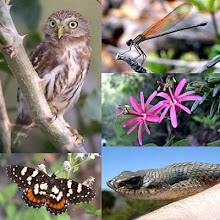
An early morning walk around our lodging near Port Antonio on the northeastern coast was a nice way to start what became a terrific day. We returned to the lovely panorama looking over San San Cove.
A Peregrine Falcon was perched in the highest tree of the islet just off shore.
This Spotted Eagle Ray was swimming just below the surface of the water. This may be the first ever digiscoped ray, which I did from the overlook above. Good spotting, Suann.
Walking up the road behind the lodge, we spotted this Cassius Blue.
We had our best views of Greater Antillean Bullfinch here.
We then made the hour-and-a-half drive westward along the scenic coastal highway (perhaps the best road in all of Jamaica) to the Green Castle Estate. Bob Lockett and Adrienne Wolf-Lockett, friends of friends, are Peace Corps Volunteers in the area and offered to show us some trails and arrange to have lunch made for us.
A stakeout Northern Potoo on its day roost was a highlight here. Find the potoo in this wide angle shot!
The wonders of digiscoping bring it forward.
They still harvest cacao – this is the plant that produces the seeds used to make chocolate.
It took some sleuthing to identify this as a Potrillo Skipper, Cabares potrillo potrillo. I had not seen one in Jamaica before.
This Ceranus Blue was in the grass near a reservoir that held one pair each of American Coot and Caribbean Coot.
There were quite a few damseflies and dragonflies here. This is the widespread Familiar Bluet, Enallagma civile.
This is a Three-striped Dasher, Micrathyria didyma.
This looks a lot like Roseate Skimmer, Orthemis ferruginea, but is still apparently an undescribed species.
Finally, this is a Slough Amberwing, Perithemis domitia. Many thanks to Dennis Paulson for identifying the odonates for me.
We finished the day with a drive to Kingston and then up a very winding road up into the Port Royal Mountains. The lower slopes are mostly deforested with much invasive grass and bamboo preventing regeneration of many native plants. But this lovely golden-flowered agave is probably native to the island and has managed to hang on. It was full of Bananquits feeding on the nectar.
Just about 10 minutes from our hotel in the cool cloud forests at 3500 feet elevation, I stopped to look for Crested Quail-Dove for just a few minutes, and almost immediately one flew in and landed on an open perch. It was a very dark, overcast late afternoon, so photographing it wasn't possible. See my photos from last year's tour to see almost exactly the same view we had this year
Wednesday, April 14, 2010
Monday, April 12, 2010
WINGS Tour to Jamaica: Day 2, The Wet Forest of the East
We had all morning to bird some of the best habitat on the island – the wet forests along the Ecclesdown Road at the far eastern end of the island. While we are still looking for good views of Crested Quail-Dove, we at least heard a few today. The area is mostly forested with a few cleared acres here and there for coconut palms and bananas.
On of the special birds at this end of the island is the hummingbird Black-billed Streamertail, here looking up at a male with his fantastic tail feathers.
The Rufous-tailed Flycatcher is a noisy Myiarchus flycatcher, reminiscent of Great-crested but with a very different voice.
The Blue Mountain Vireo must be one of the most aberrant members of the vireo family – no wing bars, no face pattern, and pink (rather than bluish) legs and toes.
This was our first Yellow-shouldered Grassquit, the only member of the genus Loxipasser. The current AOU classification still has it with other emberizid buntings, but most recent DNA research shows that it's probably related to tanagers.
One of the rarer birds on the island is the strange Jamaican Blackbird. We had great views of this bird bathing in a giant bromeliad.
This large, white geometrid moth landed on this breadfruit leaf, too far for anything but a digiscoped image.
The snail diversity on Jamaica is mind boggling. There are at least 555 species on the island. This hairy one seems to be common on the eastern end of the island.
This live snail was crossing the road.
I don't see very many dragonflies on Jamaica, but the striking striped pattern of this one really caught my attention. According to Dennis Paulson, this is the first known photograph of a live Bromeliad Dragonlet, Erythrodiplax bromeliicola. It apparently carries out its life cycle in the large tank bromeliads.
There were some interesting plants and nice wildflowers along the Ecclesdown Road
This is in the genus Bidens.
These are giant Heliconia plants.
This unusual little mallow reminded me of Claytonia.
This melastome is common along the roadside.
This milkweed is probably Asclepias curassavica, and is a hostplant for Monarchs on the island. It apparently doesn't contain the poisons that make Monarchs in North America toxic, and one of the participants indeed saw a Gray Kingbird happily munching on a Monarch today.
After a classic Jamaican jerk lunch at Boston Bay, we were back at our Goblin Hill lodging for the afternoon, where the view from behind the villas is stunning.
We saw quite a few birds on the grounds. This is a Jamaican Oriole.
The tanager Jamaican Spindalis was quite common here. In good light the males are gorgeous.
Before heading into town for dinner, we made another attempt to see Jamaican Owl on the hotel grounds. Last night after dinner we spent nearly 45 minutes trying to see one, hearing only two juveniles begging very close but buried in dense foliage. I assume the adults were off hunting out of ear shot. Tonight, with very little effort and before it was completely dark an adult owl flew in and landed in the open in a tree below the road in front of us. This was the first time I've ever looked down on a Jamaican Owl. Great end to a fun day.
Sunday, April 11, 2010
WINGS Tour to Jamaica: Day 1, Tropicbirds and Jamaican Blackbirds
What a fun day of birding today! A stroll around our hotel near the Kingston airport resulted in our first endemic – Jamaican Mango at very close range. But we also had several Vervain Hummingbirds, an endemic subspecies on the island. It's about the worlds second smallest bird, but the pugnacious males have no fear and sit on exposed branches to sing in defense of their territories.
We also saw a few wintering warblers in the area, including Northern Parula, Northern Waterthrush, Cape May Warbler, Prairie Warbler, and American Redstart. There were several territorial "Golden" Yellow Warblers around as well.
Our first birding stop after hitting the road was this gorgeous view where up to eight White-tailed Tropicbirds were flying back and forth in pairs, apparently courting. We saw them from the highway even before we had a chance to park.
We spent the rest of the morning and part of the afternoon on the famous Ecclesdown road. By the end of the day we had seen 19 out of 27 endemic species and heard another 5 or so. Our views of a foraging pair of Jamaican Blackbirds was a highlight. Jamaican Tody, Jamaican Spindalis, and Black-billed Streamertail (right on our hotel grounds) were also very memorable. We'll be getting better views of some of those 19 tomorrow during another visit to the Ecclesdown road, followed by a traditional Jamaican jerk lunch.
Wednesday, April 7, 2010
Las Guacamayas Ecolodge
Our final days of birding were at Las Guacamayas Ecolodge, just a half hour by road upriver from Chajul. This is the only hotel in the region that offers accommodations with the hopes of attracting people interested in wildlife observation. They offer a boat trip up a small river into the heart of the Montes Azules Biosphere Reserve as well as a community-owned forest reserve with trails. They are known for having one of Mexico's few remaining Scarlet Macaw populations, which they are trying to augment with captive breeding and artificial nest box programs.
The cabins are nice, the biggest drawback being that most of the guests here are noisy Mexican families on vacation (at least during this pre-Easter weekend).
The highlight of a stay here is the boat trip up the Rio Tzendales.
One of the guides that Steve met in the birding guide class in Palenque was back home now and was our guide and boatman, Celedonio.
The rio Tzendales is a gorgeous, small river that drains from an area dominated by limestone topography. As a result there are many small travertine waterfalls, giving it a lovely character. We saw lots of good birds here, including American Pygmy Kingfisher, Sungrebe, Blue Seedeater (in the bamboo), and Royal Flycatcher.
We thought we had come to the end of our boat ride at the first waterfall, but then Celedonio gunned it at the narrow stream of water pouring off of it, and before we knew it, we were in the next stretch of river. We did this 13 times, but once we had to get out on an islet and watch him do it solo.
Mangrove Swallows on the lower stretch of river.
This damselfly is Amelia's Threadtail, Neoneura amelia.
This is a damselfly in the genus Argia, but it's not a good match any known species.
This darker one is Dusky Dancer, Argia translata.
Here are some Dusky Dancers mating; the males get these prominent stripes on their thorax when mating. Thanks to Bob Behrstock and Dennis Paulson for the identifications.
This dragonfly is a Red-faced Dragonlet, Erythrodiplax fusca.
I understood enough of the Spanish between Celedonio, his son, and his brother-in-law to hear that they were going to catch fish for our lunch. Here is is brother-in-law searching for bait by scooping up some sort of larvae (stone fly?) from the algal mats.
And here is the results of their efforts, including some fish that we got from a passing boat. They all appear to be members of the family Cichlidae, probably being (top to bottom) Vieja intermedium, Vieja argentea, Cichlosoma urophthalmus, and Vieja synspila (thanks to Gavin Bieber for the names).
The beach were they cooked our lunch had some nice butterflies. These are Dark Kite-Swallowtails, Eurytides philolaus.
On the same beach was Salvin's Kite-Swallowtail, Eurytides salvini, apparently very rarely photographed in the wild. Neither Jeff Glassberg's book, butterfliesofamerica.com, neotropicalbutterflies.com, nor a Google image search come up with anything other than photographs of specimens.
This lilac blooming tree in the pea family was common in the forests here; they were always full of orioles – Baltimore, Orchard, Black-cowled, and Yellow-backed.
A shrubby Lythrium species was common on the islets in the travertine waterfalls.
We also took a walk on the trail through the forest reserve, just a mile or so from the village of Las Guacamayas.
This White Hawk was one of the first birds we saw, perched in the forest mid-story.
A metalmark in the genus Emesis had a deformed right hindwing.
At the very edge of its range here is the Scaly-breasted Hummingbird. In this area there were three singing birds, perched about 30 feet up. The loud song included mimicry of other birds that live in this area. In the background you can hear Mexican Black Howlers, Dusky-capped Flycatcher, Barred Antshrike, and Rufous-tailed Jacamar.
After 19 full days of birding in Mexico I tallied 501 species of birds. It's a fantastic area, and I look forward to returning here with Steve and a group of birders next year.
Higher Elevations Between Chajul and Montebello
March 27, 2010
After a final morning at Chajul Biological Station, Steve and I decided to take advantage of the relatively recently paved highway leading westward along the Guatemalan border. It eventually goes into a more mountainous region to Lagos de Montebello National Park and eventually to the cities of Comitán and San Cristobal de Las Casas, but we were interested in seeing the habitat on the much closer ridges that looked forested on Google Earth. There is also a "ecotourism" project called Los Nubes that seemed worth checking out.
One of the early sights along the highway was this stunning, blue-green river.
We passed through a few small towns which serve predominantly Mayan-speaking populations. Apparently "Snail" means "hall" in this Mayan language (probably Chuj).
We turned around after reaching the tiny border town of Tziscao, which Steve had birded with Sophie Webb back in the 1980s. They had come from the west and stopped here because the roads were too bad for their little car. Things have changed – roads paved, forest cleared– and here's a shot of a spot where they had seen Resplendent Quetzals. There's not enough forest for them here now.
Some of the more inaccessible ridges and slopes are still covered in forest, and we did pass through some pretty birdy stretches of road. A Scaly-breasted Wren was a new Mexico bird for me here.
I spotted this gorgeous flower down the slope and digiscoped it, thinking it was a large, orange Turnera, in the little-known family Turneraceae. My friend Brad Boyle confirmed that it's in that family, but the species is Erblichia odorata; I was chagrined to learn that I missed being able to smell its citrus-like fragrance.
This is a Gaudy Patch, Chlosyne gaudialis.
A digiscoped Green Honeycreeper. I can't wait to get better digiscoped images with my new Canon S90.
On our way back we heard a horrible sound from the rear end of the car, and stopped find this huge piece of metal sticking out of the tire. It was completely flat within the minute, and we spent some blood and sweat getting it changed. Luckily this remote highway has relatively little traffic. We ended up having to buy a new tire when we got back to Palenque.
But we were justly rewarded for our pains. After having looked for Michael Carmody's White-winged Becard (a first documented record from Mexico just over a year ago in this region), we talked about other possible country firsts. Gray-breasted Crake was one of the species mentioned, and Steve's intuition caused him to pull over next to this field in the late afternoon.
Almost immediately after iPod playback one, then two, then three or four Gray-breasted Crakes were calling back, one just across the ditch from us. We had our digital sound recorders ready and got good documentation for this first Mexico record. There were also some Ruddy Crakes calling from the same field, allowing for good comparison of the chatter songs. I've archived my recording at xeno-canto.org, which now allows you to embed a player.
Subscribe to:
Posts (Atom)