Gambell Meal Plan
WINGS Tour, May 29-June 5, 2010
Rich Hoyer
Day 1, May 29
Afternoon flight to Gambell
Dinner: Oven Roasted Salmon, Green Beans with Toasted Hazelnuts and Brown Butter, Saffron Risotto
Dessert: Triple Chocolate Mousse Cake
Day 2, May 30
Breakfast: Scrambled Eggs and biscuits
Lunch: Tuna salad, Barley Soup With Mushrooms and Kale
Dinner: Maple-Glazed Pork Roast with Star Anise, creamy polenta, garlicky greens
Dessert: Strawberry-Rhubarb Fool
Day 3, May 31
Breakfast: Buttermilk and Buckwheat Pancakes and Oven-fried Bacon
Lunch: cold cuts and cheese, Hearty Minestrone
Dinner: Chicken Fajitas Indoors, fresh salsa, guacamole, sour cream, tortillas
Dessert: Blueberry-Peach Cobbler with Lemon-Cornmeal Biscuit Topping
Day 4 ,June 1
Breakfast: Scrambled Eggs and Blueberry Scones
Lunch: cold cuts and cheese, Cream of Leek and Potato Soup
Dinner: Crispy Roast Lemon Chicken, brown rice, spinach-strawberry salad
Dessert: Passionfruit Mousse
Day 5, June 2
Breakfast: Breakfast Strata
Lunch: chicken salad, West African Peanut Soup
Dinner: Four-Cheese Lasagna, green salad, garlic bread
Dessert: Apple Crisp
Day 6, June 3
Breakfast: French toast and Farmland Pork Sausage Links (avoid Hormel, Jimmy Dean and Swift)
Lunch: Grammy Hoyer's Olive Spread, Hearty Chicken Noodle Soup
Dinner: Hamburgers and Oven Fries, tomatoes, onions, lettuce
Dessert: Triple Chocolate Mousse Cake
Day 7, June 4
Breakfast: Scrambled Eggs and biscuits
Lunch: Cold cuts and cheese, Best French Onion Soup
Dinner: Gingery Chicken Stir-fry, Brown Jasmine Rice, fortune cookies
Dessert: Poached Pears with Star Anise
Day 8, June 5
Breakfast: Buttermilk and Buckwheat Pancakes and Oven-fried Bacon
Lunch: Leftovers, Country-Style Potato Soup
Departure to Nome in afternoon.
Tuesday, June 8, 2010


Cooking for the WINGS Tour in Gambell, Alaska
From May 29 to June 5 I made a departure from my usual job of leading WINGS tours. Instead I was the cook for the tour in Gambell, Alaska led by Jon Dunn and Paul Lehman. I designed the menu in April, shopped for all the non-perishables in Tucson in early May, packed the food in boxes (with help from my sister Katheryne), and mailed them to Gambell (with help from my good friend Celina). Then right after my Oregon tour and before flying out to Gambell with the group, I had two days in Anchorage to buy all the perishables – such 10 pounds of butter, 22 dozen eggs, 45 pounds of chicken (and all the bread, dairy, fruit, vegetables, etc) – and pack them all in our 9 coolers and 12 boxes, ready for the flights to Nome and then to Gambell.
Despite my spending about 16 hours in the kitchen each day, I still managed to get out and see some birds, including most of the rarities found by the birders coursing the area each day. There was a bit more snow and ice than the previous two times I had been there in the spring, but a lot of melting took place during the week. This is looking NNE towards town from the south end of Troutman Lake at the start of the week.

On this old piece of machinery was a territorial pair of White Wagtails. Most years there are at least a couple around, some years they can be scarce or not present. This year it was hard to be out during an hour's birding and not see 3 or 4.

My first outing (after spending the first two days in the kitchen nonstop) was to look for a Common Ringed Plover reported from the marshy areas south of the lake. As in previous years, all I could find was the very similar Semipalmated Plover.

The tundra here has no trees or bushes, and prostrate willows (in the foreground here) are the only woody vegetation.

Willows have separate male and female plants. These flowers are female catkins (notice the forked stigmas).

Here are catkins from a male plant (as the red anthers open, the yellow pollen can be seen).

A Cackling Goose here was a rarity.

Red-necked Phalarope is a common migrant.

The steep mountain slope on the east side of Troutman Lake is home to breeding Snow Buntings and the occasional vagrant. Paul found a female Siberian Stonechat here halfway through our week. This wheel is from an old plane wreck, but I don't know the story behind it.

The boulders are covered in lichen that are gorgeous gardens of color and structure up close.

These wind power generators were installed last fall on the east side of the village. The little red house is the eastern most of the 175 or so in the village, which is located on a gravel bar at the northwestern-most tip of Saint Lawrence Island. To the right of the windmills you can see Russia. The closest point of land is only 45 miles away, but the visible mountains are about 50 miles away. I compare this to viewing the Cascades Mountains from Mary's Peak near Corvallis Oregon: Mount Jefferson is 87 miles distant.

This Google Earth screen shot of the Bering Sea shows our location.

Zoomed in on the Bering Strait.

There are two kinds of birding at Gambell: looking FOR birds, and looking AT birds. This is one example of looking AT birds at the cliffs to the NE of town, where thousands of auklets and puffins breed. Here is some of our group looking at the six Dovekies that breed here.

Flocks of alcids, mostly Crested and Least Auklets, fly out from the colonies whenever a Common Raven passes by.

Here is a zoomed in shot of them perched on a snow field among the breeding areas. The birders also spent a lot of time looking at thousands of seabirds communting past the beaches west and north of town.

This is the Near Boneyard, an area where the ancestors of the Yupik Eskimos dumped the remains of walrus, seal, and whale carcasses for a few thousand years. This is one of the areas where we look FOR birds. Snow Buntings and Lapland Longspurs are common here, but the clumps of mugwort (an herbaceous Artemesia), rich soils, and wind-sheltered hollows attract lost migrants.

While walking across the boneyard, you could see Tundra Voles scampering along their trails and into tunnels.

Close to Old Town, racks of drying Walrus are a common sight.

Dick and Gaylee Dean beam after successfully seeing the gorgeous male Rustic Bunting, first first exciting vagrant of the week.

Dick's endless energy brought him back out to the boneyards while everyone else took an afternoon break, and he found this lovely female Brambling.

These Long-billed Dowitchers were present for a short time at the marsh at the northeastern corner of Troutman Lake.

I went out again to look for the Common Ringed Plover. A territorial Rock Sandpiper was in the spot that I had been told to look.
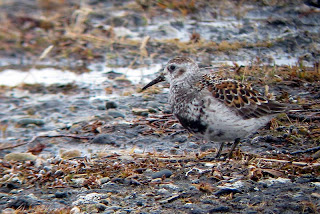
I walked about a mile before returning to my ATV, and this male Common Ringed Plover was right behind it! This may be the only place in North America where this species breeds regularly.

A regular vagrant here is the Lesser Sand Plover. This bird was later seen with a female, making the idea of possible breeding within reason.

On our last day, while I was putting the final touches on our last lunch, Paul Lehman called out a report of this Common Rosefinch on the radio, here perched on a Bowhead Whale jaw bone. Lunch was 15 minutes late as a result.

A panoramic of Gambell, looking northwest

Boarding our flight back to Nome

Thanks to Kenyon for waking me on our flight from Nome to Anchorage to alert me to the amazing view of Mount McKinley.

Despite my spending about 16 hours in the kitchen each day, I still managed to get out and see some birds, including most of the rarities found by the birders coursing the area each day. There was a bit more snow and ice than the previous two times I had been there in the spring, but a lot of melting took place during the week. This is looking NNE towards town from the south end of Troutman Lake at the start of the week.

On this old piece of machinery was a territorial pair of White Wagtails. Most years there are at least a couple around, some years they can be scarce or not present. This year it was hard to be out during an hour's birding and not see 3 or 4.

My first outing (after spending the first two days in the kitchen nonstop) was to look for a Common Ringed Plover reported from the marshy areas south of the lake. As in previous years, all I could find was the very similar Semipalmated Plover.

The tundra here has no trees or bushes, and prostrate willows (in the foreground here) are the only woody vegetation.

Willows have separate male and female plants. These flowers are female catkins (notice the forked stigmas).

Here are catkins from a male plant (as the red anthers open, the yellow pollen can be seen).

A Cackling Goose here was a rarity.

Red-necked Phalarope is a common migrant.

The steep mountain slope on the east side of Troutman Lake is home to breeding Snow Buntings and the occasional vagrant. Paul found a female Siberian Stonechat here halfway through our week. This wheel is from an old plane wreck, but I don't know the story behind it.

The boulders are covered in lichen that are gorgeous gardens of color and structure up close.

These wind power generators were installed last fall on the east side of the village. The little red house is the eastern most of the 175 or so in the village, which is located on a gravel bar at the northwestern-most tip of Saint Lawrence Island. To the right of the windmills you can see Russia. The closest point of land is only 45 miles away, but the visible mountains are about 50 miles away. I compare this to viewing the Cascades Mountains from Mary's Peak near Corvallis Oregon: Mount Jefferson is 87 miles distant.

This Google Earth screen shot of the Bering Sea shows our location.

Zoomed in on the Bering Strait.

There are two kinds of birding at Gambell: looking FOR birds, and looking AT birds. This is one example of looking AT birds at the cliffs to the NE of town, where thousands of auklets and puffins breed. Here is some of our group looking at the six Dovekies that breed here.

Flocks of alcids, mostly Crested and Least Auklets, fly out from the colonies whenever a Common Raven passes by.

Here is a zoomed in shot of them perched on a snow field among the breeding areas. The birders also spent a lot of time looking at thousands of seabirds communting past the beaches west and north of town.

This is the Near Boneyard, an area where the ancestors of the Yupik Eskimos dumped the remains of walrus, seal, and whale carcasses for a few thousand years. This is one of the areas where we look FOR birds. Snow Buntings and Lapland Longspurs are common here, but the clumps of mugwort (an herbaceous Artemesia), rich soils, and wind-sheltered hollows attract lost migrants.

While walking across the boneyard, you could see Tundra Voles scampering along their trails and into tunnels.

Close to Old Town, racks of drying Walrus are a common sight.

Dick and Gaylee Dean beam after successfully seeing the gorgeous male Rustic Bunting, first first exciting vagrant of the week.

Dick's endless energy brought him back out to the boneyards while everyone else took an afternoon break, and he found this lovely female Brambling.

These Long-billed Dowitchers were present for a short time at the marsh at the northeastern corner of Troutman Lake.

I went out again to look for the Common Ringed Plover. A territorial Rock Sandpiper was in the spot that I had been told to look.
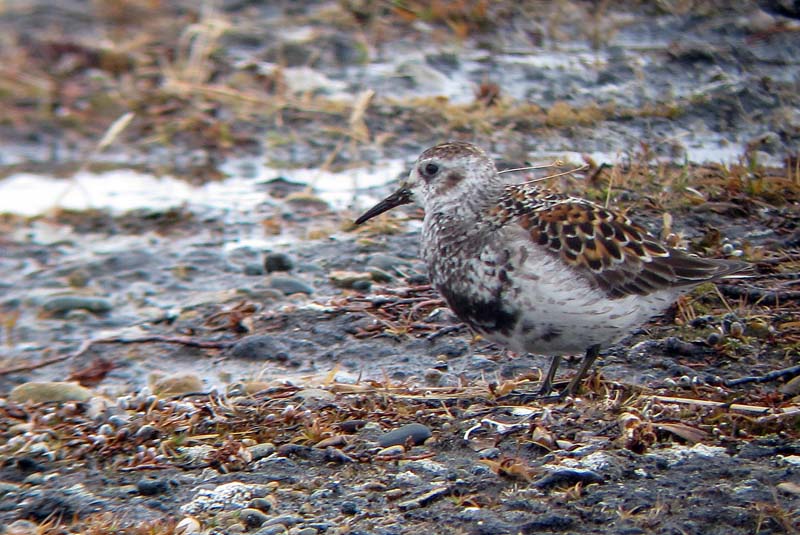
I walked about a mile before returning to my ATV, and this male Common Ringed Plover was right behind it! This may be the only place in North America where this species breeds regularly.

A regular vagrant here is the Lesser Sand Plover. This bird was later seen with a female, making the idea of possible breeding within reason.

On our last day, while I was putting the final touches on our last lunch, Paul Lehman called out a report of this Common Rosefinch on the radio, here perched on a Bowhead Whale jaw bone. Lunch was 15 minutes late as a result.

A panoramic of Gambell, looking northwest

Boarding our flight back to Nome

Thanks to Kenyon for waking me on our flight from Nome to Anchorage to alert me to the amazing view of Mount McKinley.

Thursday, May 27, 2010
Oregon in Spring WINGS Tour: 375 Miles of Unending Scenery
Here are some photos from the last day of the tour, as we drove from Burns to Portland via some of the most scenic forests and landscapes in the state.
Mountain Bluebird has been a common sight while birding east of the Cascades.

We stopped at this wet meadow in the Ochoco Mountains for Lincoln's Sparrow and ended up with a huge group of birds riled up at my imitation of Northern Pygmy-Owl.

This appears to be a Red-naped x Red-breasted Sapsucker hybrid. These birds are common in the central and southern Cascades, where the ranges of the two species overlap, but here we are at least 120 miles east of where Red-breasted Sapsucker should occur.

Several Red Crossbills came in, and these are probably Type 2 birds.

A stop to troll for Veery (which probably occurs here in very small numbers) resulted in this stunning male Calliope Hummingbird.

On our short detour up Aldrich Mountain were some nice wildflowers.
Dwarf Purple Monkeyflower, Mimulus nanus

Allium species

Yellow Fritillary, Fritillaria pudica

Lunch was at the John Day Fossil Beds National Monument.
A Say's Phoebe nest with three nestlings was in the rafters of the log shack behind the historic John Cant ranch house.

The layers of eroding soil are one of the scenic attractions of this area, which has one of the most complete and longest continuous fossil records anywhere. The fossils found here are from 5 to 45 million years old and contain many plants and mammals (but no dinosaurs – they were already long extinct by the time this part of the earth's crust became land).

Mountain Bluebird has been a common sight while birding east of the Cascades.

We stopped at this wet meadow in the Ochoco Mountains for Lincoln's Sparrow and ended up with a huge group of birds riled up at my imitation of Northern Pygmy-Owl.

This appears to be a Red-naped x Red-breasted Sapsucker hybrid. These birds are common in the central and southern Cascades, where the ranges of the two species overlap, but here we are at least 120 miles east of where Red-breasted Sapsucker should occur.

Several Red Crossbills came in, and these are probably Type 2 birds.

A stop to troll for Veery (which probably occurs here in very small numbers) resulted in this stunning male Calliope Hummingbird.

On our short detour up Aldrich Mountain were some nice wildflowers.
Dwarf Purple Monkeyflower, Mimulus nanus
Allium species

Yellow Fritillary, Fritillaria pudica

Lunch was at the John Day Fossil Beds National Monument.
A Say's Phoebe nest with three nestlings was in the rafters of the log shack behind the historic John Cant ranch house.

The layers of eroding soil are one of the scenic attractions of this area, which has one of the most complete and longest continuous fossil records anywhere. The fossils found here are from 5 to 45 million years old and contain many plants and mammals (but no dinosaurs – they were already long extinct by the time this part of the earth's crust became land).

Wednesday, May 26, 2010
Wilson's Snipe Chorus
While waiting for a Great Gray Owl to appear at a mountain meadow north of Burns (fruitlessly, it turned out), we enjoyed the sounds of the Wilson's Snipes winnowing overhead. Here's a short cut of four or five of them, tirelessly flying over the meadow.
Tuesday, May 25, 2010
The Forests North of Burns
We drove through some of the most scenic coniferous forests in the world today. Several species of pine, fir, spruce, larch, and Douglas-fir give the forests here an interesting shape. And great bird diversity. Today we had trees with three species of nuthatches and overall we saw or heard 9 species of woodpeckers. We also saw "Canada" Gray Jay, "Slate-colored" Fox Sparrow, and Clark's Nutcracker, all new to our list, now about 250 species and forms. There aren't many left for us to look for now.
Here are some habitat shots from the day, from the area of Malheur National Forest north of Burns.


Here are some habitat shots from the day, from the area of Malheur National Forest north of Burns.


Sunday, May 23, 2010
Oregon in Spring WINGS Tour: Catlow and Alvord Basins
With temps starting at freezing this moning, we got a slightly later start than usual and began a few blocks from our hotel, where the yard of Larry Hammond must be the #1 feeding station in Harney County. There were dozens of Western Tanagers and Bullock's Orioles fighting for a place among the fresh fruit. These two Western Tanagers were soaking up the morning sun on the lawn. I glimpsed the Baltimore Oriole that Larry found yesterday, but it flew before anyone else got on it.
 (Addendum: all present got to see it on our second attempt in the afternoon.)
This is the where we took shelter for lunch yesterday – along with a half dozen other birders and about 20 motorcross riders. Today we just stopped briefly on our way past to check for migrants. Nothing unusual here, other than a sighting of Eugene birders Kitt Larsen, Larry McQueen, and a friend of theirs.

We rose into the higher elevation Catlow Valley were it must have snowed much more than in the Blitzen Valley. Vesper Sparrows were all over the highway shoulders, making it nearly impossible to keep from hitting them. Cars blasting through at the usual 70 mph must have killed many.

This is the usual stop below the Catlow Rim north of Roaring Springs Ranch where we had Yellow-breasted Chats – unusually beautiful with a snowy background.

Sage Sparrow was one of our targets today.

As was Burrowing Owl – our 10th owl of the tour. The only other possible owl on the route would be Great Gray. Maybe tomorrow?

At the Fields Oasis were rather few birds. This Wilson's Warbler was probably trying to conserve energy after struggling to find food the past few very cold days.

Great Horned Owl is an annual breeder here.

I dove suddenly to catch this Common Racer, which was warm to the touch after sunning down in the windless grass. But I forgot that I had been carefully cradling upright one of the Fields Station's famous milkshakes in my vest pocket. It made more of a mess all over my vest and pants than the snake's musk.

Alvord Hotsprings over a mile below the 9722-feet peak of Steens Mountain.

We stopped to stretch, get some fresh air, and look at the many wildflowers at the northern pass of the Alvord Basin.
Prickly-leaved Phlox, Phlox aculeata

Sheathing Lomatium, Lomatium vaginatum

Stiff Vetchling, Lathyrus rigidus

Toothed Balsamroot, Balsamorhiza serrata


This is the where we took shelter for lunch yesterday – along with a half dozen other birders and about 20 motorcross riders. Today we just stopped briefly on our way past to check for migrants. Nothing unusual here, other than a sighting of Eugene birders Kitt Larsen, Larry McQueen, and a friend of theirs.

We rose into the higher elevation Catlow Valley were it must have snowed much more than in the Blitzen Valley. Vesper Sparrows were all over the highway shoulders, making it nearly impossible to keep from hitting them. Cars blasting through at the usual 70 mph must have killed many.

This is the usual stop below the Catlow Rim north of Roaring Springs Ranch where we had Yellow-breasted Chats – unusually beautiful with a snowy background.

Sage Sparrow was one of our targets today.

As was Burrowing Owl – our 10th owl of the tour. The only other possible owl on the route would be Great Gray. Maybe tomorrow?

At the Fields Oasis were rather few birds. This Wilson's Warbler was probably trying to conserve energy after struggling to find food the past few very cold days.

Great Horned Owl is an annual breeder here.

I dove suddenly to catch this Common Racer, which was warm to the touch after sunning down in the windless grass. But I forgot that I had been carefully cradling upright one of the Fields Station's famous milkshakes in my vest pocket. It made more of a mess all over my vest and pants than the snake's musk.

Alvord Hotsprings over a mile below the 9722-feet peak of Steens Mountain.

We stopped to stretch, get some fresh air, and look at the many wildflowers at the northern pass of the Alvord Basin.
Prickly-leaved Phlox, Phlox aculeata

Sheathing Lomatium, Lomatium vaginatum

Stiff Vetchling, Lathyrus rigidus

Toothed Balsamroot, Balsamorhiza serrata

Subscribe to:
Posts (Atom)

 Posts
Posts


