Saturday, July 11, 2015

Mountain Elaenia Confirmed First For Mexico

I led a second field trip to Ejidos Tapalapa and Coapilla today, and my main goal, besides just finding lots of cool birds for the participants, was to re-find the Mountain Elaenias and get better photos and recordings.

We scored on all accounts. Here is my best and most diagnostic photo of the Mountain Elaenia, and here is also one of the recordings I obtained.
Mountain Elaenia


I actually heard a third bird down the road from this same pair we had yesterday, and then later in the morning found a fourth individual well up the road. So it seems there is a very isolated population on this one mountain. I’ve queried several people now, and all agree that this would be a first record for Mexico – 212 miles from the nearest eBird submission in Guatemala.

I didn’t get many bird photos today, but we did have excellent views of Scaly-throated Foliage-gleaner, Brown-backed Solitaire, Black-throated Jay, and Black-headed Nightingale-Thrush. Some of us also saw Blue-crowned Chlorophonia, Blue-and-white Mockingbird, Blue-throated Motmot, and many others.

This Mountain Trogon female was being wooed by a male who would not give us decent views.
Mountain Trogon

We flushed a Slate-throated Redstart off its nest, which had two eggs.

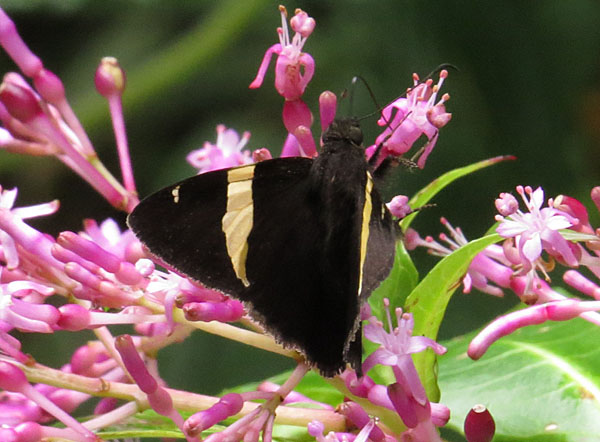
We had some nice butterflies, including Adelpha donysa, Donysa Sister

Anetia thirza, Cloud-forest King

And Catasticta flisa, Narrow-banded Dartwhite

There are some pretty amazing plants up here, from this tiny Castilleja sp.

To this giant Gunnera sp.


Tomorrow I lead the field trip to Sumidero National Park.

Friday, July 10, 2015

Day 1 of the GBNA Chiapas Field Trips


Today I led the field trip of 10 participants to the Coapilla and Tapalapa Ejidos of north-central Chiapas. This area of lush cloud forest is a little-vested by naturalists, and we had high hopes for some of the specialties of the area, such as Resplendent Quetzal. We didn’t find any of those, but we did see Black-throated and Azure-hooded Jays, Green-throated Mountain-Gem, Highland Guan, Ruddy and Scaly-throated Foliage-gleaners, and Black-headed and Spotted Nightingale-Thrushes among several others. We also had one unexpected and exciting discovery.

We were watching this fuchsia bush (Fuchsia arborescens) for some time, trying to get good looks at a Green Violetear and a White-eared Hummingbird. This Flame-colored Tanager came in once to dine on the fruits.
Flame-colored Tanager

To get the hummingbirds to move from their hidden perches, I tried imitating Guatemalan Pygmy-Owl, and this Mountain Elaenia popped up. It kept moving around, making it difficult for everyone to get on it, and I eventually started wondering how unusual a bird it might be for here, since I don’t remember seeing it on the study lists. The short story is that there are no records for here – not for this ejido, not for Chiapas, not even for Mexico! I used playback of recordings from Costa Rica and two birds came in quite excited, and I was able to get a couple more photos and some faint recordings of the call notes. A first country record!
Mountain Elaenia

The weather wasn’t all that great – overcast, windy, and occasionally drizzly, but it eventually got warm enough for some butterfly activity.

Diaethria anna, Anna's Eighty-eight

Autochton vectilucis, Central American Banded-Skipper

Smyrna blomfildia, Blomfild's Beauty

These strange little membracid plant hoppers were on the undersides of a Bocconia leaf.

One of the participants is an orchid specialist, and he recognized the genus of this one. Image searches suggest it is Govenia matudae.
Govenia matudae

On the way back we stopped on the road for Acorn Woodpecker, Clay-colored Thrush, Eastern Bluebird, and Chipping Sparrow in the road, only to discover that they were there because of a swarm of the small army ant Labidus praedator.
Labidus praedator

What an odd mix of species to attend an army ant swarm, but even more unusual was the habitat!

One last stop to stretch and break up the long drive brought us Varied Bunting, Altamira Orioles, Varied Bunting, and this Ferruginous Pygmy-Owl.
Ferruginous Pygmy-Owl

This Gray-crowned Yellowthroat posed very nicely below us.
Gray-crowned Yellowthroat

My friend Paul spotted this grasshopper, a nymph of Aidemona azteca on a leaf.
Aidemona azteca


This Hamadryas glauconome, Glaucous Cracker had staked out a territory on a power pole by the vans.
Hamadryas glauconome, Glaucous Cracker

Thursday, July 9, 2015

A Chiapas Teaser

Just last Saturday I had a very enjoyable day in San Francisco with my friend Clayton. We bought lunch at a market and ate it in Mission Dolores Park.

Two days later I was having lunch in a café in San Cristóbal de las Casas in a slightly different atmosphere but nearly identical temperature.

Tomorrow I lead my first of four field trips for the fourth biannual meeting of the Gay Birders of North America group – an informal email list and Facebook group that has been around for a decade or more. For the past five days I’ve gone scouting with several of the other field trip leaders, and it’s been a blast. Here’s a teaser of some of the amazing stuff we’ve found, much of which I still haven’t identified.

Very cool mushrooms

Gorgeous lizards

Rose-bellied Bunting among about 236 other bird species

Melanis pixe, Red-bordered Pixie among almost hundred butterflies that we tried to identify

A bizarre plant hopper

And many, many cool plants. This is the wet season, everything is lush and green, and flowers abound. I’m pretty sure this milkweed vine is a Gonolobus species.


Hopefully I find the time and energy in the next days to share more of what we’ve found while scouting as well as some highlights from the field trips.

Catch-up Blog #4 – Three Days in Tucson

June 29-July 3, 2015

On June 29 I flew from Eugene to San Francisco, and from there to Tucson. Here’s view from the flight leaving San Francisco – the jet took off headed north, and we did a counter-clockwise U-turn over the peninsula just south of the city of San Francisco, and here we’re headed back south. The San Francisco airport can be seen in the far left-center

I’d been gone for seven weeks, my next trip has me away for just over eight weeks, and this time I’m just three full days at home. Plenty of time to visit with some friends, unpack, repack, open a huge stack of mail, and deal with issues such as health insurance renewal and registering to vote by email.

I was lucky enough to have lunch with the oldest and most interesting couple I know – Manabu and Jack have been together for 64 years, and Manabu (who’s Japanese and should know) thinks Sushi On Oracle is the best sushi restaurant in Tucson.

And I was lucky enough to experience a monsoon downpour in our part of Tucson that only in this neighborhood dropped a few tons of walnut-sized hail, the largest I have ever seen.


Off to Chiapas next!

Wednesday, July 8, 2015

Catch-up Blog #3 – Western Oregon

June 22-28, 2015

After the Dean Hale Woodpecker Festival, my dad came to Sisters to pick me up, and I had a week off based at his and my stepmom’s house in Corvallis. But rather than stay in Corvallis the whole time, I rented a car and decided to visit the southern Oregon coast for a couple days. I hadn’t seen my friends Dave and Kathy in a while, and I consider the Curry County coastline to be one of the most beautiful places in Oregon, if not the entire US.

My first morning of birding found me meeting my friend Terry in Langlois and then spending an hour or so in some hilly, grassy pastures within about four miles of the coast – a habitat you just don’t see anywhere on the Oregon coast north of here.

Western Meadowlarks and Lazuli Buntings were common here, and I recorded the dialects of this pugetensis White-crowned Sparrow here. Here they sounded much like the ones in the northern Oregon Cascades as well as the Puget Sound area, but unlike the ones from northwestern and outer coastal Oregon.

A pair of Common Yellowthroats were apparently feeding young in a nest in some taller grass by the road.

This Violet-green Swallow posed nicely for photos.

I then birded several headlands as I worked my way down the coast nearly to the California Border. A large group of cormorants (Brandt’s and Pelagic) and Pacific Loons were feeding just south of Cape Blanco.

I birded through the campground and recorded the recently described Type 10 of Red Crossbills here.

This is the beach beyond the campground.

This Black Phoebe juvenile was at the Arizona Beach wayside

I then took a short hike down the Cape Sebastian trail, which starts on the highest part of Highway 101 in Curry County.

This is looking down from one of the highest points on the trail before it starts to descend to the beach. I noticed what at first looked like an orange lichen on the rocks.

Upon closer inspection, it was certainly no lichen, but I didn’t know what it was. Thanks to my friend Tim Rodenkirk, I discovered that this is a free-living form of a Trentepohlia sp. algae. Some species, quite possibly this one, also combine with a fungus to form a lichen.

I hiked down to the Indian Sands area of Boardman State Park. The Wildflowers here were gorgeous.

This is Calochortus tolmiei, Tolmie's Star-tulip.

Tim helped me with the ID of this composite, Lasthenia ornduffii, Ornduff's Goldfields. It turns out to have a very restricted range, found only a few areas of coastal Curry County.

I looked for but did not find any vagrants at several places south of Brookings. This Song Sparrow was at the mouth of the Winchuk River, just north of the California border, so it should be the subspecies cleonensis, but I can’t see any difference from morphna from farther north.

This Wrentit came in close to my whistles.

The one rarity I did chase on my way back north to Bandon was this Black-headed X Rose-breasted Grosbeak hybrid in the willows of the Pistol River.

On my second day on the coast I decided to wander around Floras Lake in northern Curry County. I took a long hike through the coastal forest down to Blacklock point and back on the beach. In the dunes were many of this morning glory Calystegia soldanella, Seashore False Bindweed.

The Rhododendron macrophyllum, Pacific Rhododendron were still in bloom.

This shrub was formerly Ledum glandulosum, but a change in the higher taxonomy as well as some species-level rearrangement has given it a totally new binomial, Rhododendron columbianum. Thankfully we have more stable English names and can still call it Western Labrador Tea.

I was the only person on the beach for at least a mile in each direction here.

I scanned the ocean frequently on my way back and was rewarded with a rare June record of Black Scoter. It was almost impossible to get a photo, but I did manage this one for the eBird record. This exact location turns out to be known as the most reliable winter location for Black Scoter in the county.

I then finished my two-day retreat hiking out the south jetty of the Umpqua River before heading back inland. I enjoyed the large numbers of noisy Heermann's Gulls at the tip of the jetty, and got a picture of this immature Brown Pelican with his own kleptoparasite.

Back in Corvallis, I made it out only a couple times, otherwise spending my time working on the computer, trying to catch up and prepare for future tours, as well as knitting from time to time and of course playing cards and marbles with my parents every evening. I spent one full morning with my friend Jamie Simmons looking for birds, butterflies, and odonates near Alsea Falls and the Alsea area. It was surprisingly diverse as early as mid-morning.

I managed photos of eight species of butterfly and one very cool dragonfly at our first stop.

Adelpha californica, California Sister

Boloria epithore, Pacific Fritillary

Epargyreus clarus, Silver-spotted Skipper


Limenitis lorquini, Lorquin's Admirals

Parnassius clodius, Clodius Parnassian

Pieris oleracea, Mustard White

Polygonia satyrus, Satyr Anglewing

Vanessa atalanta, Red Admiral

Octogomphus specularis, Grappletail

Another stop resulted in this Ischnura perparva, Western Forktail.

A brief stop at a quarry resulted in this screaming Peregrine Falcon perched on the rocks. It was later confirmed that a pair had nested here.


Another stop and another butterfly, Strymon melinus, Gray Hairstreak

Taricha granulosa, Rough-skinned Newt

Another couple photos – this Purple Martin was just north of Corvallis, apparently nesting in a snag in a regenerating clearcut.

And this arctic-breeding Least Sandpiper, already in late June at the Philomath Sewage Ponds, is at the forefront of the southbound “fall” migration.