Saturday, March 21, 2020

Cristalino Birthday: Day 3

January 10, 2020

This morning I wanted to sleep in a bit after the big party last night, so I chose to join the late-departing non-birding group on their trail walk on the system that begins behind the lodge.

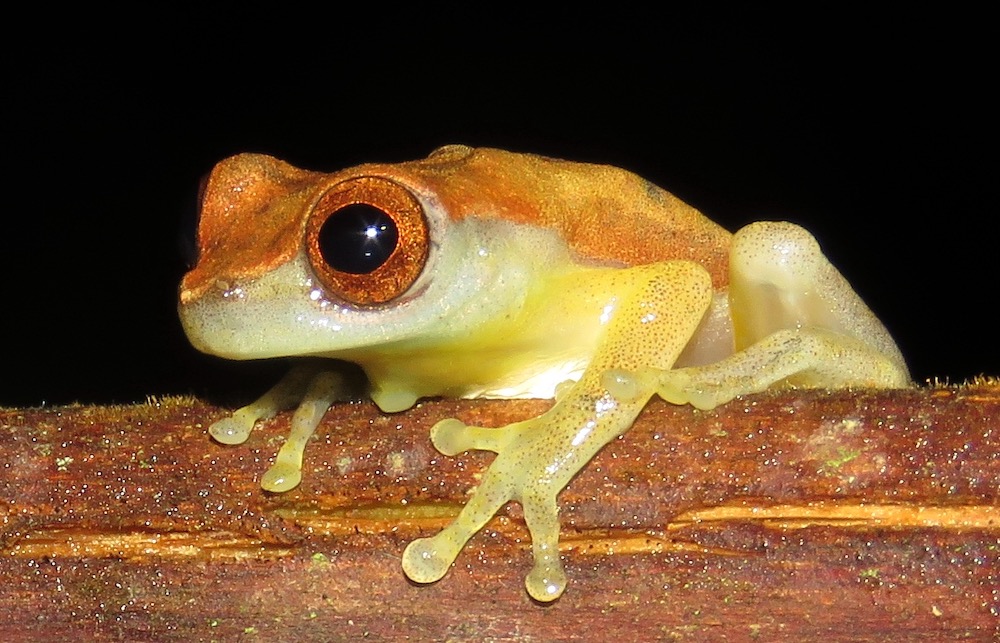
I hung back much of the time, though I didn’t want to miss what their guide Jessica was showing the group. She talks about a lot of other aspects of natural history, uses of plants, and even folklore, most of which I don’t know. I’m sure I missed out while getting photos and a sound recording of this little frog, an Allobates sp. that was not like the one I’ve heard and photographed on the other side of the Cristalino River. No one seems to know what it is, and new species are being described in this long-neglected genus all the time. The Cristalino reserve is ripe for a new herpetological survey by someone who knows what they’re doing.
Allobates sp.

These pleasing fungus beetle larvae were devouring this fungus. There are probably dozens of Erotylids here and thousands of fungi, but this particular species of beetle seems to be the only one that feeds in groups like this on just this one fungus, as there are photos much like this one from all throughout the Amazon.
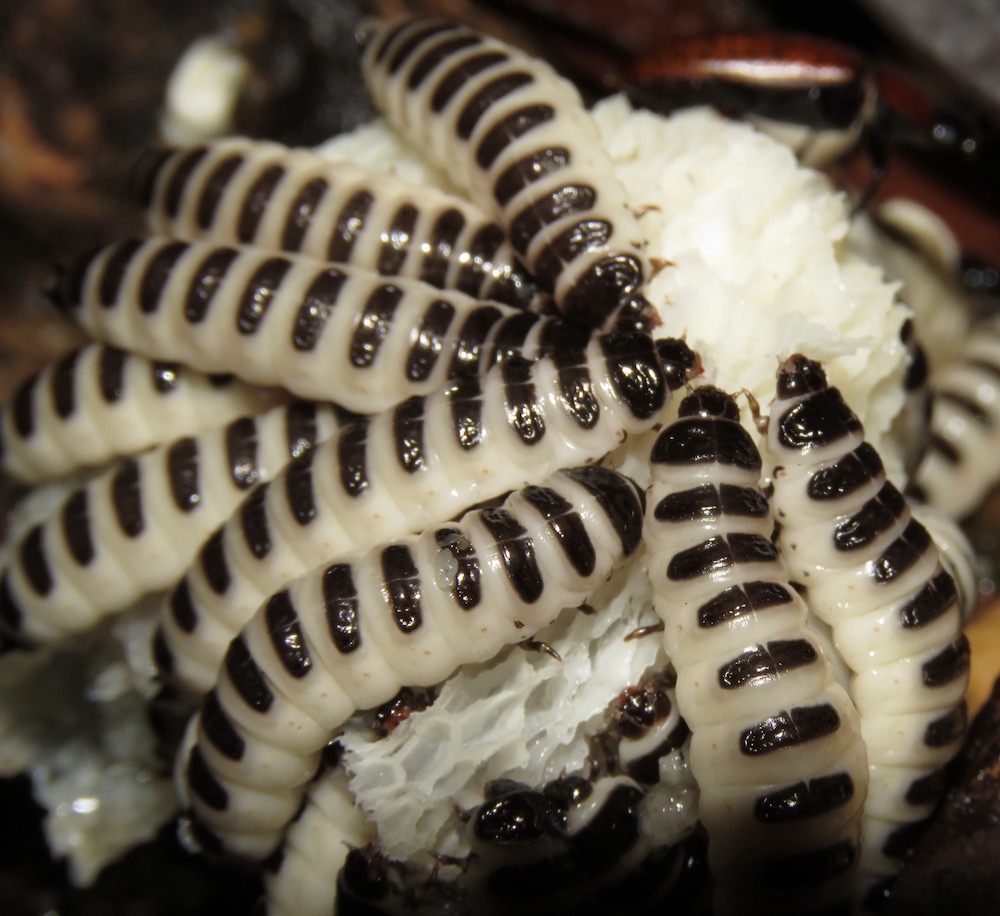
Erotylidae

I found two Cordycipitaceous fungi. This was the first I had found on a cockroach, a first for me.
cordyceps, cockroach

Even more exciting was finding this dead Oxysternon conspicillatum dung beetle with what appears to be the same fungus that I found a week earlier, Nigelia martiales, this one with much more developed fruiting bodies. It’s interesting that these dung beetles are closely related, the only ones I’ve ever found killed by a fungus, and it appears to be the same species of fungus.
Oxysternon conspicillatum, Nigelia martiales

We all walked right under this Reidy’s Wandering Spider, Phoneutria reidyi, guarding her egg sac on a tree trunk. She’s not really that close – I really zoomed in on this. I think a spider this venomous might be quite willing to bite if you got too close to her treasure.
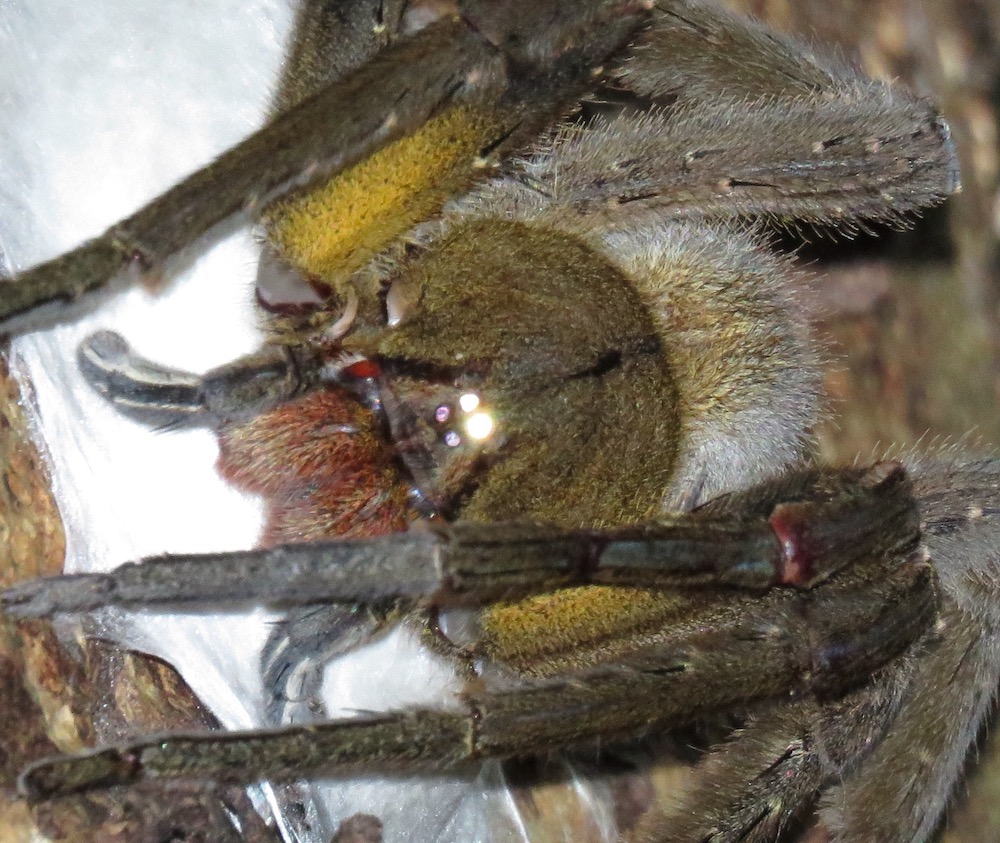
Phoneutria reidyi

While we were maneuvering around each other to get better looks at the spider, Corey looked up into the canopy beyond it and said, “What the f**k is that.” She took a couple steps toward what she was looking at and announced that she had found a sloth! My second ever Linnaeus’s Two-toed Sloth, Choloepus didactylus, was right over the trail.
Linnaeus’s Two-toed Sloth, Choloepus didactylus

We were just 10 minutes from the lodge, on our way to lunch, so I was able to round up everyone else and all got to see this amazing find. The next day it was gone.

At the lodge during the after-lunch break, some cool things were found. This shield mantis, Choeradodis rhomboidea, was one of them.
Choeradodis rhomboidea

I had thought this silver-backed spider was a jumping spider from the general shape, but the eye arrangement is all wrong. It turns out to be in Oxyopidae, the lynx spiders, all members of which I had seen before are the distinctive, green members of the genus Peucetia. Like them, this one does have the very spiny legs.
Oxyopidae

Another group had found a roosting Short-tailed Nighthawk high in a tree on the Caja trail during their morning birding, so I went down the trail with them to look for it. Two different times we were unable to relocate the same tree, so I never saw it (I saw one roosting once in Costa Rica), but as a consolation I heard then whistled in this Purple-throated Fruitcrow, a very rare bird at Cristalino. There are three or four previous records, but I think this is the first photo documentation.
Purple-throated Fruitcrow

For the afternoon outing I stuck with Jessica’s non-birding group for a boat ride up to the Hoatzin Lagoons for the second day in a row. I rarely get up river that far, and I’d never done it in the afternoon. This time, we were treated to a noisy family of Giant Otters, Pteronura brasiliensis.
Pteronura brasiliensis

Also different from yesterday’s outing were the many Scaled Pigeons that we saw; none had been around yesterday morning.
Scaled Pigeons

As we boated through the water-hyacinths in the oxbows, numbers of these Cornops frenatum grasshoppers leapt into the boat.
Cornops frenatum

I led a second night walk this evening, which led to no snakes and had to be aborted when it began to rain, but not before we heard a Long-tailed Potoo and even got a view of it flying over high. Someone spotted this fulgorid on a tree trunk. UPDATE (2 July 2020): This has been identified by Chris Mallory on iNaturalist as Artacie haemoptera – the first submission to iNaturalist!
Fulgoridae

And as I mentioned in a previous blog, most fulgorids have some nice surprise in the hind wing if you open them up.
Fulgoridae

This spiny katydid is advertising that you shouldn’t pick it up.
spiny katydid

This erebid moths is Latebraria albosigma, one I usually see perched on vegetation at night and rarely at lights.
Latebraria albosigma

A second Reidy’s Wandering Spider for the day had been lucky with this huge katydid, though it seems to have been unlucky to have lost a leg in a previous encounter.
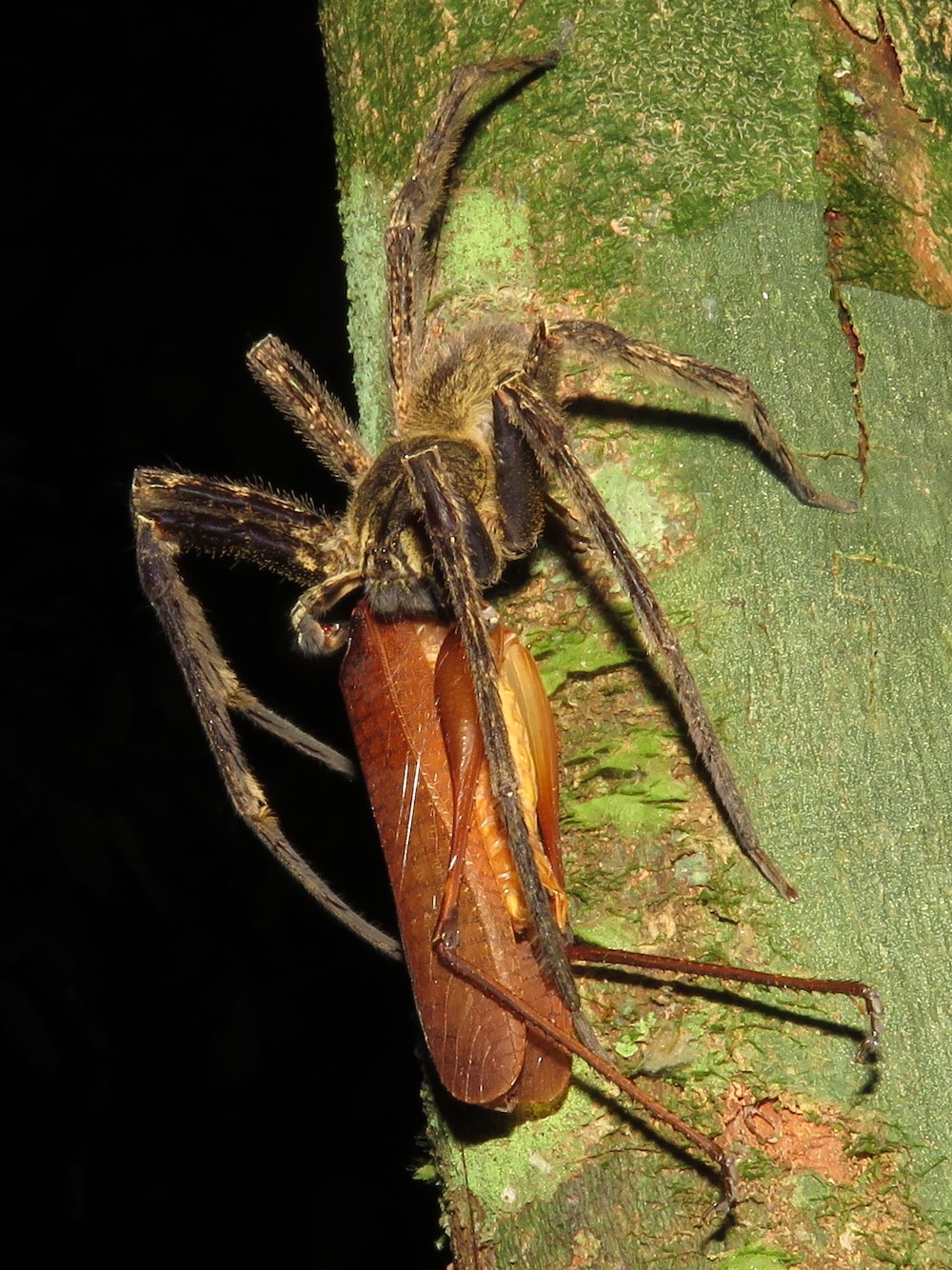
Phoneutria reidyi

Thursday, March 19, 2020

Cristalino Birthday: Day 2

Jan 9, 2020

Today is my actual 50th birthday, but for me, it’s like every day here is my birthday.

I joined the more intense birding group today for a ride upriver to the Hoatzin lagoons. It was hard to get going though, as everything is new for everyone, and there was a burst of bird activity right at the dock. We added lots of birds here, but the best by far was this male Festive Coquette, which perched several times halfway up the canopy. It was Sidnei’s first ever, and when I looked up my info, it turns out I had the first two photographic records from Cristalino. It’s a rarely seen bird here.

We then kept stopping for birds along the river, including Band-tailed Antbird and Speckled Spinetail. When we stopped for the latter, we found this group of Morpho telemachus caterpillars, which I had only ever seen in the late dry season.

We also had this stick hopper, family Proscopiidae.

And as we had paused under a blooming tree, I noticed this rarely seen metalmark, Isapis agyrtus, with only one previously confirmed photo from Cristalino.

We finally arrived at the lagoons and saw Hoatzin in good time. This Rufescent Tiger-Heron was striking its sun-worshipping pose, the first time I’ve seen this species do this.

The lagoons are great for odonata, with most of them perching on the rafts of water-hyacinths. This is the dragonfly Diastatops pullata.

This orchid in an overhanging tree is Ionopsis utricularioides.

On the way back, we stopped to figure out a raptor flying over, and only several days later did I look at my photos, pass them around, and come to the consensus that it had been my first Broad-winged Hawk for Cristalino!

Even the birders were happy to stop for monkeys – we had 2 or three family groups of these White-whiskered Spider Monkeys, Ateles marginatus.

 When we got back, we heard some bad news – Cathy, who was with the group I went with yesterday, slipped on the tower steps and hurt herself early this morning. The steps had been wet with dew, and she had gone fast up to the top ahead of the rest of the group. When she slipped she quickly grabbed whatever she could, and her hand found something sharp, cutting her pinky finger so badly that she had to be taken to the hospital. Long story short, that evening she was flown to GoiĆ¢nia where she was operated on. Then 9 days later she and Gabe were allowed to fly home. Last I heard she had full use of her pinky (even if no feeling) and was continuing physical therapy. We were all super sad that they had to cut their vacation short after just one full day at Cristalino. And I felt fortunate I had chosen to go with their group yesterday and got to spend time with them.

I didn’t go out in the afternoon with any group, mostly relaxing in the room and working on photos. When I came out to the deck in the mid-afternoon, the kayaking non-birders had already returned and were swimming by the floating deck. Their guide Jessica quickly came up to me and said “Come! Diego found an Emerald Tree Boa!” I just about melted there on the spot. When I had arrived on December 29, I had put the word out to all the local guides and boatmen that I had two special requests – I wanted to see a Bushmaster and an Emerald Tree Boa. The former is very rare, but seen occasionally, maybe once a year. It’s kind of the jaguar of the snakes – large, rare, and in mostly in areas of undisturbed, old forest. The latter is probably much more common but extremely rarely seen, as they are green like the leaves and live mostly motionless, high in the canopy. I was aware of only two sightings in some 30 years at Cristalino. Diego, who has been working here full time for several years, had never seen one, and while he was readying the kayaks for the group a couple kilometers upriver spotted this one roosting right over the bank at eye level. Stretched out, it’s probably not much more than a meter long, if that. The southern and western forms have been split from the Guinanan Shield animals NE of here, so this one is now known as Corallus batesii. What a stunning beauty.

Christoph was at the dock right when we were loading up to see it, so he joined me, Jessica and Diego for this fabulous, most unbelievable birthday present.

The rest of the evening was a splendid happy hour and dinner on the floating deck put on by the unbelievably hard-working staff at Cristalino.

Wednesday, March 18, 2020

Cristalino Birthday: Day 1

January 8, 2020

I’ll have four full days at Cristalino with my 33 friends, divided into five groups. Each group has their own guide, so I decided I would just go with each group at least once, either on the morning or the afternoon outing. This morning I joined Gilmar’s group with one of the more generalist natural history groups with a stronger leaning towards birds. Serra 2 is our destination, and I hadn’t’ been there this trip yet. Like Serra 1, it’s an island of unique habitat in the middle of the forest and always holds some surprises.

The trail from the river is about a kilometer or so, and it can be hard to pick up the pace in order to maximize our time on the serra proper. Fortunately it began to rain pretty hard early on the trail, so we weren’t able to see much when there were some bird noises. But of course we still saw things, and one of the most amazing was this horsehair worm, phylum Nematomorpha, in a tiny puddle in the middle of the trail. This is the first one I’ve seen at Cristalino. It’s a parasite in arthropods, and this one presumably emerged from its katydid, grasshopper, cockroach, or some other host recently in order to find another to mate and infect future generations.
horsehair worm, Nematomorpha

horsehair worm, Nematomorpha

The rain stopped while we were on the serra, and we saw some excellent birds while on top (tanagers, hummingbirds, puffbirds, jacamars, etc.), but I didn’t get photos of any of them. Instead I was drawn to the amazing plants, many of which occur only here at Cristalino. One of the more unusual ones I didn’t recognize, and is still a mystery to me, is this delicate annual growing in a pocket in the rock where water collects. Some very good botanists on iNaturalist haven’t been able to place it to family either.


In the dry season you wouldn’t notice many of the plants and lichens here, but this time of year, everything is lush and colorful.
lichen

We also saw some nice frogs, and my herpetologist and photographer friend Steffen Reichle (fourth from left) got some great photos of the very localized Ameerega munduruku and Pseudopaludicola canga.

Back at the lodge for lunch, I checked up on the Suriname Horned Frog, Ceratophrys cornuta, and showed it to most of the group. This is the seventh day that it has been in this very spot.
Ceratophrys cornuta

It was unusual to have Orange-winged Parrot at the lodge grounds, even more unusual that they landed overhead by the dining hall.
Orange-winged Parrot

The Rufous-breasted Hermit is still on her nest by the kitchen.
Rufous-breasted Hermit

In the afternoon I joined the other group more into general natural history rather than birds specifically, and we went on a boat road down the Cristalino River and then around the Ariosto Island on the Teles Pires River.

On the Cristalino we stopped to see these Proboscis Bats, Rhynchonycteris naso. It was so funny when Deb finally saw them. She was still learning how to use her binoculars, but then I knew even when she aimed just right, she was looking at them without seeing them, and you can see why here. When it dawned on her what she was looking at, she was so excited she nearly fell out of the boat.
Rhynchonycteris naso

Two years ago I discovered that Passiflora riparia is a rather common species here, growing in big, thick vine tangles in the wall of vegetation along the river every few hundred meters, and it turns out that January is indeed the month to find this very little-known species.
Passiflora riparia

On the Teles Pires we enjoyed watching this Drab Water Tyrant take a bath within a few meters of our boat.
Drab Water Tyrant

Guide Jessica spotted this very distant Amazonian Umbrellabird from our boat. It could have been passed off for a crow in North America.
Amazonian Umbrellabird

After dinner I offered a night walk just to see what critters might be out and about. As a group of very social, somewhat inebriated friends who hadn’t seen each other in months or even years, we were too noisy for spotting mammals. But there was still a lot to see. This tailless whipscorpion, genus Heterophrynus, is probably deaf anyway, for example.
tailless whipscorpion, Heterophrynus

As is this huge orbweaver, Eriophora sp.
Eriophora

It was a good night for frogs, and we saw at least three of these Osteocephalus leprieurii treefrogs.
Osteocephalus leprieurii

It was an amazing week for Amazon Tree Boas, Corallus hortulanus. I would end up seeing at least five during my whole stay here. This is Christoph holding his first tropical American snake.
Corallus hortulanus

Once we were by the creek, frog diversity grew. This is a glass frog, Hyalinobatrachium cappellei. We didn’t remove it from its leaf, but if we had, we would have been able to see its bones and visceral organs through the transparent belly.
Hyalinobatrachium cappellei

This little tree frog is apparently Dendropsophus cruzi, though the taxonomy of this group is in flux.
Dendropsophus cruzi

Kate really liked holding this White-lined Leaf Frog, Phyllomedusa vaillantii.
Phyllomedusa vaillantii

With our lights out at the Saleiro, someone noticed specks of light glowing in the forest understory. I assumed little beetle larvae, but they turned out to be a large group of tiny bioluminescent mushrooms in the genus Mycena. They were glowing only from the lamellae, or "gills," and were surprisingly bright.
Mycena, bioluminescence


Another fungus I noticed, though not bioluminescent, was this lovely Clavaria zollingeri.
Clavaria zollingeri

For some reason Caspar looked on the back side of a tree trunk by the trail and found three Peanut-headed Bugs, Fulgora lampetis, always a crowd-pleaser. None of this group had ever seen anything like it, and there hadn’t been any stakeouts at Cristalino in at least a year. These will probably be here for several months. I’ll be back in August to find out.

Fulgora lampetis

Most members of the planthopper family Fulgoridae hold some surprise in their hind wing pattern, and this one is no exception.
Fulgora lampetis