Sunday, October 23, 2016

Sunrise at Marys Peak

I had a day and a half in Corvallis, based at my dad’s, house to turn in the rental and clean, pack, and store all my tour gear. On the morning of my afternoon departure, my friend Hendrik and I went up to Marys Peak at dawn to greet the sunrise and see (and hear) if there were any migrants navigating over the peak. In short, the only migrants we had were American Pipits, which were birds that could have been there for a few days.

What we did see was the most amazing show of Cascade Mountain peaks I’ve ever seen. From north to south:

Mt. Rainer and Mt. St. Helens

Mt. Hood

Mt. Jefferson

Mt. Washington

The Three Sisters

Looking towards the coast, we hoped to see the Yaquina Bay bridge, but the whole coast was under a blanket of low clouds. I noticed what appeared to be a dark gray cloud bulging above the low, white clouds, and studied this strange formation for a minute, noticing how oddly similar it was to the familiar shape of the Marys Peak skyline as seen from Corvallis. Suddenly it became clear – right after sunrise, with such clean, dry air, we were seeing the very shadow of Marys Peak on the entire 20+ miles of Coast Range between us and the Pacific Ocean.

On our way down we had this Sooty Grouse in the road, more cooperative than the one I had on the tour.
Sooty Grouse

I would have liked to stay another hour or two on Mary’s Peak to see what other migrants might pop in, but our friend Russ Namitz had reported a Bobolink late the afternoon before from the Philomath sewage ponds, which we could actually see from the peak. But in case it was still there, Hendrik and I wanted to be there earlier and rather not get the news that a bunch of local birders were there at dawn and had seen it fly off. Instead, we arrived about an hour after sunrise to see no birders, and within a few minutes we had great views of this tremendous rarity and even got some of the best photos ever of this species from western Oregon.
Bobolink, Benton County


We also saw this adorable, if despised family of introduced Myocastor coypus, Nutria, or Coypu.
Myocastor coypus, Nutria, or Coypu

Friday, October 21, 2016

Oregon in Late Summer – A Favorite WINGS Tour

This past early September I led my fourth Oregon tour in summer. It’s actually late summer, bordering even on early fall, considering the migration of birds well underway, and each time I do this tour it’s a bit later. Birding is fine in late July too, when I first offered this tour, but many birds are molting and not so pretty then, and southbound migrants aren’t quite as numerous yet either. An advantage over the spring tour is the opportunity to do a pelagic trip, and we went about 25 west of Newport as a pre-tour extension. We saw the necessary Black-footed Albatrosses and a few other tubenoses (Buller’s Shearwater was nice to see), but the highlight for me was the large number of Sabine's Gulls, many very close to the boat. I got just one photo.
Sabine's Gull

We birded from Portland to Corvallis on the first day of the main tour. I always take my tours up Marys Peak at dawn, hoping for Sooty Grouse, among other birds. This time we drove to the top then back down, then back up and back down, and on the second pass down one grouse was in the road, a hallelujah moment. But the weather wasn’t very good, so we returned here a second morning and had this most cooperative of Northern Pygmy-Owls.
Northern Pygmy-Owl

With better weather, we birded some meadows and forest edge before the very top, flushing a single Mountain Quail, then hiked to the peak itself.

We had this Lophocampa maculata, Spotted Tussock Moth caterpillar at our picnic lunch spot on the Alsea River on the way to the coast.
Lophocampa maculata, Spotted Tussock Moth

On our full day on the coast from Florence, we made many stops, all of them stunningly picturesque, and some with birds such as White-winged Scoter and Red-necked Grebe.

We also made a stop of botanical interest for Darlingtonia californica, the California Pitcherplant, where we also had great views of Pacific Wren.
Darlingtonia californica, California Pitcherplant

This Wrentit was amazingly cooperative at the Cape Perpetua Visitor Center.
Wrentit

Before heading inland and over the Cascades, we had a picnic breakfast at the Siltcoos River area. A Steller’s Jay here was a perfect mimic of Red-shouldered Hawk.

Then came our time in utterly different eastern Oregon. Here’s the scenery at Lake Abert, where there were hundreds of American Avocets but no Wilson’s Phalaropes.

Near there at Summer Lake I found a rare Stilt Sandpiper, getting photos just good enough for documentation purposes.
Stilt Sandpiper

Another bonus to doing a late summer tour is the chance to drive to the top of Steens Mountain, where the views are gorgeous.

One has a good chance of seeing Black Rosy-Finches here, but we didn’t find the flock despite walking at least 2 miles at 9700 elevation along the rim. Still, there was stuff to see. This is Epilobium obcordatum, Rockfringe Willowherb.
Epilobium obcordatum, Rockfringe Willowherb


I specifically looked for this grasshopper, having found it here two years ago – Bradynotes obesa, Slow Mountain Grasshopper.
Bradynotes obesa, Slow Mountain Grasshopper

This appears to be a Steiroxys sp., katydid.
Steiroxys sp., katydid

This grasshopper is probably in the huge genus Melanoplus, and no blue-legged ones look like this and are known from here in either Bugguide or in the grasshopper field guide, both of which are woefully incomplete. But there are probably more than 300 species in this genus in North American, many identifiable  based on the shape of itnernal genitalia of the male. Yet I still hope to eventually have a name for this one.

Down at Malheur National Wildlife Refuge below Steens, we birded along the Center Patrol Road, with the HQ still being closed to the public. This is Lycaena helloides, the Purplish Copper.
Lycaena helloides, Purplish Copper

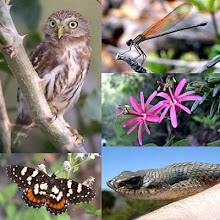
Thamnophis elegans, Western Terrestrial Garter Snake

Crotalus oreganus lutosus, Great Basin Rattlesnake

Crotalus oreganus lutosus, Great Basin Rattlesnake

Sage Thrasher
Sage Thrasher

Arphia pseudonietana, Red-winged Grasshopper

We returned to Portland via the John Day Fossil Beds National Monument., including the visitor center (which has the most reliable Chukar anywhere – check the hillside behind the parking lot), and at the Painted Rocks sector, where we had our final picnic lunch and found this Mantis religiosa, European Mantis.
Mantis religiosa, European Mantis

The ride back was merely scenic, but we did stop for some quick photos of the patch of lovely Mimulus cusickii, Cusick's Monkeyflower.
Mimulus cusickii, Cusick's Monkeyflower


We had dinner within site of one of Oregon’s most beautiful sights and an iconic photo opportunity– Multnomah Falls.

Thursday, October 20, 2016

Oregon Pre-tour Visit

For the sake of blog completeness, I’m going back to this past late August, when I traveled to Oregon for my biannual grand tour of the state in late summer (in odd-numbered years I offer the same tour in May). My short tour to Ashland and the Oregon Shakespeare Festival canceled once again (who knows why; it should be one of the most popular tours that WINGS offers, but I’m guessing that the wider birding public just doesn’t know about how outstanding the OSF is), so I had a free week on my own to visit friends and family. I started in Eugene with my close friend Alan Contreras, and we spend a morning birding at Fern Ridge Reservoir, joined by young birder Tye Jeske.

This Lincoln's Sparrow was just a tad on the early side, though we noted one had been reported from here a couple days earlier.

We didn’t find any of the rarities that others had been reporting from here, such as Ruff, Semipalmated Sandpiper, or Ruff, but we did get to witness the unusually large numbers of Baird’s Sandpipers. Here’s one of the Western Sandpipers we tried unsuccessfully to turn into a Semipalmated.

The birding got hard – I struggled with calling this Greater , then Lesser Yellowlegs, finally settling on the latter. Was I right?

And this gull – which I now think is probably a juvenile Mew Gull, rather than the more expected Ring-billed. California Gulls were quite common, with a few one-year-old Ring-billeds mixed in, but this is a very fresh juvenile bird.

Grasshoppers aren’t any easier here, with no good field guide yet handy. I’m guessing this is the super common and widespread Melanoplus femurrubrum, Red-legged Grasshopper.

While in Eugene I grabbed lunch from an El Salvadoran food stand. I think the richer cultural diversity we get from immigrants is a huge bonus. Let’s not keep America so white.

Speaking of good food, I made a bunch of pizzas at Alan's, and he invited several of our local friends over for a fun social evening.

I then traveled to Medford and Ashland in Oregon’s SW corner to visit some friends, including a couple who weren’t birders when I met them, but they are now. We spent a bird-filled morning at Siskiyou National Monument, which I hadn’t seen before. I might take my future Birds & Shakespeare tours here for morning.

We had Green-tailed Towhees, Sooty Grouse, MacGillivray’s Warbler, and this Northern Pygmy-Owl – all birds that I would have expected on the tour had it filled this year.

Some composites were busy with butterflies where we parked, but all I could identify were Woodland Skippers.

I then drove diagonally across the state from Medford to LaGrande in one day, in order to scout out a couple of sites for a tour I’m leading next August. I found this beautiful spot, a US Forest Service picnic area called Magone Lake near John Day, to view the total solar eclipse next August 21.

I also drove up the road beyond Moss Springs Campground near LaGrande, where I saw a Blue Grouse back in 1989, which later became my lifer Dusky Grouse when it was split. But I hadn’t been there since, and the day before the eclipse I’ll be taking my group there. I wanted to get a renewed idea of the area. Maybe we’ll see the rarer Spruce Grouse or Pine Grosbeak which are sometimes seen there. I didn't see too many birds, but I didn't look to hard, and the area was just beautiful.


I also finally found something that wasn’t a Woodland Skipper – this is Hesperia juba, the Juba Skipper.


Finally back in Corvallis in time to begin my Oregon tour, I visited with my stepmom and dad, the latter here training his recently acquired Harris's Hawk, Orion, to hunt their three beagles, this one being Abby.