Friday, May 22, 2020

The Master Plan for the Yard at Calliope Corner

I’ve often been asked what the plan is for my new yard, but knowing how plants are, I’ve tried to avoid making a firm plan. Some take, some don’t, unexpected problems crop up, and some surprising guests just appear.

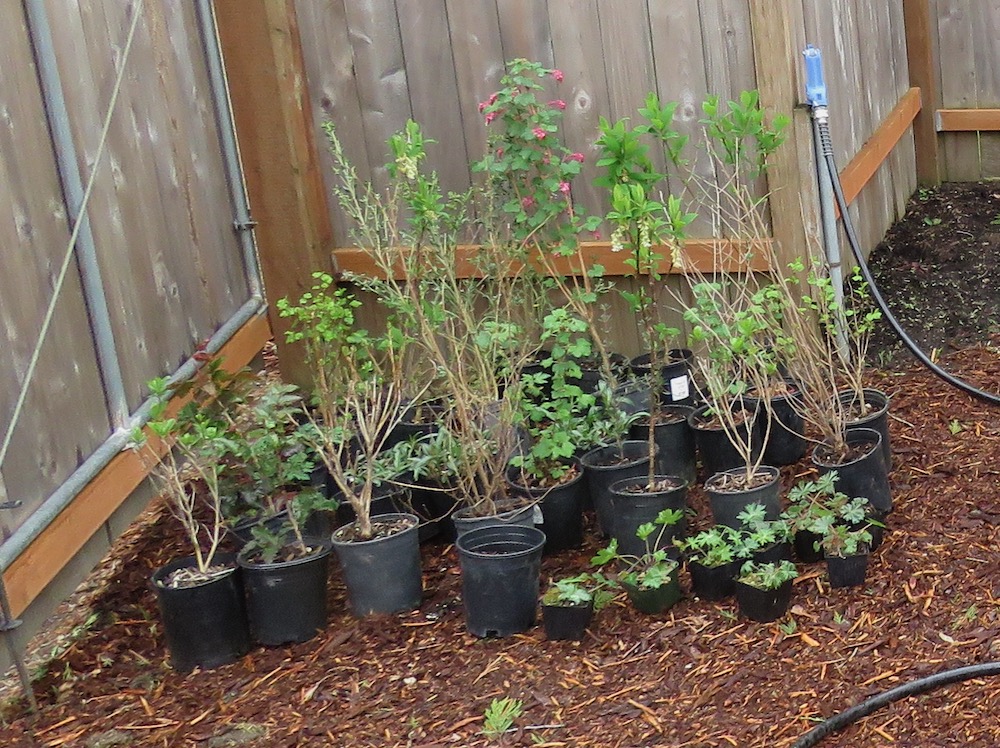
In general, the plan has been to get rid of the lawn (you can see the progress in my last blog) and add more native plants. Which natives, and where to put them will be an ever-evolving plan. I had a few concrete ideas – such as to get some good hummingbird flowers, an idea I’ve been incubating for decades: Red-flowering Currant (Ribes sanguineum), Twinberry Honeysuckle (Lonicera involucrate), and one of the native Delphiniums were definite must-gets. In mid-February I jumped at the opportunity to buy some plants from Native Grounds, one of the several nurseries that grows native plants for the wholesale market. They don’t have stores or greenhouses you can browse – you have to know what you want and order in advance, and if you order fewer than 100 plants there’s a surcharge of up to 50%. My method was to look at their offerings online and order one of this, two of that, three of that, etc., and I ended up stopping by and picking up 40 pots of 14 different species. One problem is that I hadn’t finished covering all the lawn, and the existing perennial beds still were full of weeds and rank patches of last year’s growth. I had to create some order to figure out where I wanted to put all my new plants. So upon arrival I just put them in an out-of-the way spot, and there they sat for a few weeks.
One of the bigger chores during the rest of February and March was to remove two clumps of bamboo. It can be a lovely structural addition to a yard if that’s your thing, but for my vision they were a complete waste of space and had already grown well beyond the bounds of the bed. The only wildlife that used it were the non-native House Sparrows for a night roost. I had received advice from someone to hire a professional remove them, but I managed over several days by hacking away at the shallow but extremely dense roots. I wouldn’t recommend it though and also suggest hiring a professional.


Then the very day that I finished cutting back all the perennials, removing the vast patches of invasive Geranium lucidum, and covering the beds with a layer of organic compost ­– March 26, 2020 – I started setting the pots of natives around the yard to see where they might fit. It was rather like musical chairs as I moved them around, looked at where they were, then started the music again and had them change places. I decided that some would be nice foundational accents, others would be nice in clusters. Some would grow into small trees, others would be shrubby, others very small ground covers. I put some of them into the ground right away, such as this Red-flowering Currant.
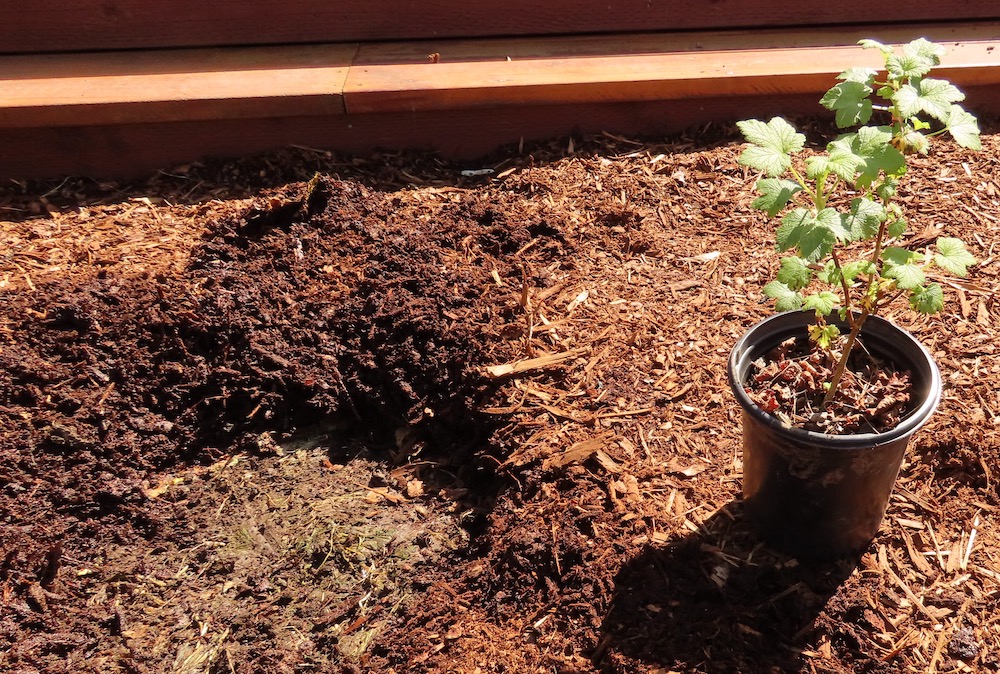
Most of the shrubby ones like this were rather root-bound, so I removed as much of the medium as possible with a spray of water to expose the roots. None were actually potted in soil but rather a loose, bark-heavy mulch, so putting them into the ground without cleaning that out this would have created a very weak central axis as the mulch would eventually decompose, leaving air pockets between the foundational roots. I made sure to mud them in well.


Before the bulk of them went in, though, I had further opportunities to acquire plants from other providers. My neighbors knew of another normally wholesale nursery southeast of Eugene, Trillium Nursery, and perusing their online offerings I bought another five species of 13 plants. And though the same neighbors I found that there’s a local landscaper and grower who specializes in useful plants, including some natives, and I got four more from him. Finally, two weeks after putting in the first ones, in all the rest– a grand total of 58 native plants.

So here’s where some things stand now: in the shadiest SW corner of the yard behind the shed were already some native bleeding heart (Dicentra formosa), and to that I added an Osoberry,  a Snowberry, and Stinging Nettle. Stinging Nettle is the host plant for Red Admiral, and the leaves make wonderful additions to soups. I suspect there are some other native insects that use the plant as well.

Near the walkway by the front of the house I created a cluster of three: Red-flowering Currant, Great Camas (Camassia leichtlinii), and Roemer’s Fescue (Festuca roemeri).

I was doubtful this Showy Milkweed (Asclepias speciosa) would appear, as the pot had just a squiggly root in it, but here it is, triumphantly just emerging in the previously established perennial bed. I’ll pick off any insects this year as it gets established, but in the future, it could potentially be food for Monarch caterpillars.

Coyotebush (Baccharis pilularis) is wonderful as a nectar plant and should tolerate the pretty dry, rocky soil on the west side of the driveway. I had wanted a male and a female, but it looks like from last year’s remaining phyllaries that I have two females. (Baccharis is an unusual genus in the Asteraceae in being dioecious).

Another plant that should like these rocky, well-drained soils is Buckbrush (Ceanothus cuneatus), and this one quickly put on two flower spikes while still in the pot. When in full bloom, the bush will be covered in bees and other pollinators.

I’m excited that this Large-leaved Lupine (Lupinus polyphyllus) is putting on some flower spikes. I’m hoping there will be just enough water retention in the soil here to make this plant of the Willamette Valley prairie happy.

I put several of the plants in clusters in the middle of what used to be lawn. Maybe it will become something like a bit of shrubby prairie here. Here is an Oregon Grape (Berberis aquifolia), Buckbrush, Large-leaved Lupine, and a Twinberry Honeysuckle.

This cluster of six includes Roemer’s Fescue, Great Camas, Twinberry Honeysuckle, Meadow Checkermallow (Sidalcea campestris), Red-flowering Currant, and Douglas’s Aster (Symphyotrichum subspicatum).

Finally, my friend Alan, who lives across town, asked if I wanted some Oregon Grape shrubs that he wanted to remove. I dug them up myself, and the same day he drove them over here, and I put two of them where the bamboo had been.

It’s been almost five weeks since these last ones were put in, and all plants are still alive, some growing by leaps and bounds. But things will change, and one of my hopes for this coming fall is to wander some wild areas, collect seed, and scatter them about the yard and see what thrives. It’s all so very exciting.

Tuesday, May 5, 2020

Birdernaturalist Becomes Gardenernaturalist!

Last I wrote here I had just returned in late January from four weeks in Brazil for my 50th birthday celebration. Seems like years ago, as a lot has happened, and the world looks very different now. Given how things are with the people around the entire globe doing what they can to prevent the spread of coronavirus (except for a few really stupid people), you’d think I’d have lots of time to keep up on my blog, but I really have been busier than ever. My next five tours have been canceled, or at the very least postponed for a year or more. But I was planning on being at home for most of April and May anyway, getting my garden ready for a summer of growing and house ready for living and having guests over.

So much for having the guests over…and I’ve actually done very little work in the house, with books still not in bookcases and most framed objects still in a pile. So in the next few months at least, this blog will mostly look rather like a gardening journal. The goings on in my yard include what’s growing, what I’ve planted, and what wonderful birds, bugs, and other critters I’m seeing in the yard. As I said, I’ve been busy, but things have become less urgent in recent days, and so I’m back to blogging.

As a teaser, here are four photos to show from afar what I’ve been doing.

The front yard on February 12. I’ve already whacked the Phygelius (Cape Fuchsia) back and dug up the advancing roots that were taking over a huge area. I’ve cut back last year’s growth on some of the perennials, and you can see green clumps where this year’s growth is already appearing. I need to prune the two peach trees in front of the porch soon.

The front yard on May 3. The biggest single chore was removing the lilac at the NW corner of the house. It had been damaged in the huge snow storm last February and its panic response was to put out suckers that reached out up to 8 feet away. It was about to become a gigantic lilac thicket, and that wasn’t going to do. It took a couple of weeks of digging down about 3 feet deep, but I persisted, and it’s gone. I pruned the peach trees (as well as another peach elsewhere in the yard, two plums, and an apple). You can see I finished spreading mulch – a fir bark mulch on top of a layer of cardboard boxes to get rid of the lawn and a shallower layer of organic compost in the perennial beds to help with the soil and work against weeds. I reduced the size of some plant clumps, moved some to elsewhere in the garden, and completely removed any and all Centranthus ruber, or Jupiter’s Beard. It’s just too large, reseeds too widely, and doesn’t offer enough to natives in my opinion. I also added some plants, but I like to start small, so they’re not really obvious in this photo. I’ll highlight them in future blogs, perhaps.

The back yard on February 12. I’ve layered the cardboard, but I still have about half of the 38.5 cubic yards of fir bark mulch to distribute. You can see the beginnings of where I’ll create my brush pile. Notice how the evergreen Clematis armandii is leaning over the fence; it’s supported on a piece of what’s called hog wire fence, not really strong enough for its weight, and I’ve come up with a plan. Also notice the pot with the pansies on the deck.

The back yard on May 3. I think it looks beautiful without the lawn, and all that area of bark mulch will become home to native and useful plants (useful to me in the sense of food, but also fragrance and aesthetics). Native plants are almost by definition useful to wildlife. The pansies are filling the pot with colors, and the clematis is extremely happy on its new trellis that I’ve built. I’ve also extended wires for the vines to continue on, which will offer additional privacy to the back yard. The brush pile became complete with the addition of the fruit tree prunings, the lilac, and finally topped with trimmings from the staghorn sumac in the front on March 5. The very next day, a Fox Sparrow declared it home, and for the next weeks it owned it, though it did allow more migrant Fox Sparrows, Golden-crowned Sparrows, and others in the next weeks.

I did actually take two trips abroad since late January, so I’ll blog about those trips in between gardening updates.

Wednesday, April 8, 2020

Rare Birds Waiting for Me

January 24-26, 2020

I got home late on January 23 from my four-week birthday vacation in Brazil. I was working on my laptop most of the next day rather than spending time in the yard, but I did glance out the window frequently. My neighbors have been keeping my feeders full while I was gone, and there was plenty of activity. At one point in the early afternoon I noticed some movement farther away when something strangely mottled flew in beyond my southern fence and landed on a trunk of a cedar tree. It just sat there, so I jumped and scrambled to find my binoculars in my piles of luggage in the living room. I couldn’t believe my eyes – a Yellow-bellied Sapsucker! This is a very rare bird in Oregon, and I remember when there were fewer than 10 records for the state. It’s now seen regularly enough (almost every year, some years 2 or 3 statewide) so that it’s no longer on the review list, but it still classifies as a genuine eastern vagrant, the principle winter range being the SE quarter United States and southward into Central America. It stayed long enough for me to find my camera and sneak outside for a close shot. I’m writing this two months after the fact, and despite my and other birders’ looking over the next days, I never saw this bird again.

Another nice rarity waiting for me was this female Vermilion Flycatcher at Alton Baker Park in Eugene. I had heard about its discovery while I was a Cristalino Jungle Lodge: found by Roger Robb while on a jog, who thought it might be a Say’s Phoebe, and relocated and correctly identified by Ramiro Aragon the next day. I wasn’t panicked to see it, as I was among the listers in the early 1990’s when Bend, Oregon hosted Oregon’s first record. Still, it’s fun to see such a “mega” that’s only a half-hour bike ride away, and so I was lucky that this bird appeared to be successfully wintering here. I think this is the sixth record for the state.

I was very grateful that my neighbors have kept the neighborhood wintering birds happy and well-fed. Here are two of the half dozen or so Townsend’s Warblers that have been visiting my homemade peanut butter suet blocks.

Monday, April 6, 2020

Serra do Cipó – Extension to the Birthday Extension

January 21, 2020

After the long drive back to the Belo Horizonte airport from Canastra, our group of 17 began the preparation for our flights homeward.  That is, all but four of us, who, because of the flights we were able to book, had an extra night and much of the next day. While my initial thoughts had been to just spend the day working on photos on my laptop at the hotel before my afternoon flight, queries and suggestions from Jake and Jim prompted me to help them plan a quick overnight trip to Serra do Cipó, just an hour and a half drive away. Mich decided he had enough time to join us at least for the early part of the morning. We rented a car right there at the airport and soon were on our way.

My main target was the Cipo Canastero, a small, wren-like furnariid that lives among the hyper-rugged rocky outcroppings, a habitat that is very hard to get access to. But we judged ourselves up to the challenge and went even deeper into the hills that I have dared take my WINGS tours.


We still came up empty handed, but for the other guys nearly everything was new. We didn't leave until after it was dark but there was only a little activity and nothing vocalizing: a Great Horned Owl flew in and landed briefly, a Least Nighthawk flew by giving great views, but our prize for the night was this Band-winged Nightjar.
Band-winged Nightjar

I was excited about some of the orchids we came across. This fuzzy crane orchid hasn’t been identified for me yet.
Cranichideae

This is a member of the huge and complex genus Oncidium.
Oncidium

This being the rainy season, frogs were in evidence. It took some time to find one, as they tend to shut up just as you get close enough to figure out where they are. Finally, I spotted this one. It’s tiny but deafening. As best as I can determine, it is Pseudopaludicola matuta, a confusing genus with several species only very recently described.
Pseudopaludicola matuta

Right next to it was this pair of mating frogs that looked similar enough I assumed they would be the same species, but they’re not. These are probably Pseudopaludicola munduru.
Pseudopaludicola munduru

The next morning we gave the canastero another shot, but still no sign of it, despite our having precise latitude and longitude from a friend who had had them here recently. At least the botanizing was exciting. This amazing orchid growing on the rocks is Acianthera johannensis.
Acianthera johannensis

Velloziaceae is a very prominent family here. This one is Vellozia epidendroides.
Vellozia epidendroides

This one is Barbacenia gentianoides.
Barbacenia gentianoides

I recognized this as a Phyllanthus sp. from my time in Jamaica, where the red-flowered P. arbuscula is endemic. Note that these are flattened branchlets (phylloclades) on a leafless plant.
Phyllanthus sp.

This huge and showy mistletoe is a Psittacanthus sp., family Loranthaceae (not Viscaceae as our temperate mistletoes).
Psittacanthus sp.

The form of the inflorescence in this pipewort, Paepalanthus villosulus, is very distinctive.
Paepalanthus villosulus

Paepalanthus villosulus

This is Physocalyx major, looking rather like a gesneriad at first glance, especially with the waxy blooms, but it’s instead in Orobanchaceae, a family with many hemiparasitic plants like broomrape and Indian paintbrush.
Physocalyx major

Physocalyx major

We had a bit of sun this morning, and there were a few butterflies around. This well-marked, small skipper is Thespieus homochromus. The only other iNaturalist submission for this obscure species, described in 1978, is from about 75 miles SSW of here. And interestingly enough it was submitted by my friend Jeff Harding, who lives just 40 miles NNE of me in the Willamette Valley of Oregon.
Thespieus homochromus

The habitat where the canastero might be found isn’t very rich in bird species, so we finally ditched it and headed for brushier cerrado closer to the hotel. We scored a good number of birds here, many of them lifers for Jim, Jake, and Mich. This Pileated Finch was really excited about our owl imitations and pishing.
Pileated Finch

One of the last new birds of the trip and always a good find was this stunning Blue Finch.
Blue Finch

Sunday, April 5, 2020

Minas Gerais Birthday Extension

January 17, 2020

The second half of my post-birthday extension in Brazil was to the state of Minas Gerais. The attractions here are Maned Wolf at the Caraça Sanctuary and the wild grasslands with chance of Giant Anteater at Canastra National Park, and of course some really great birds. I planned on two nights in each place to keep the trip affordable, and 16 of my friends joined me for this part of the adventure. Having departed Cuiabá on a pre-dawn flight I thought for sure we’d have some time for birding once we got to Caraça that afternoon. It’s only about 3 ½ hours from the Belo Horizonte airport, unless there is a traffic issue.

There was a traffic issue. At least we got some birding in while waiting for the line of vehicles to move.

It seems to have been highway construction that caused the long delay, and it took us about 6 hours and 15 minutes, arriving just at dusk. In any event, we were in time for dinner, and right afterward we assembled on the porch in front of the church entrance. In a short time our hoped-for guest appeared – Maned Wolf, Chrysocyon brachyurus (this photo is from my tour year before last).
Maned Wolf

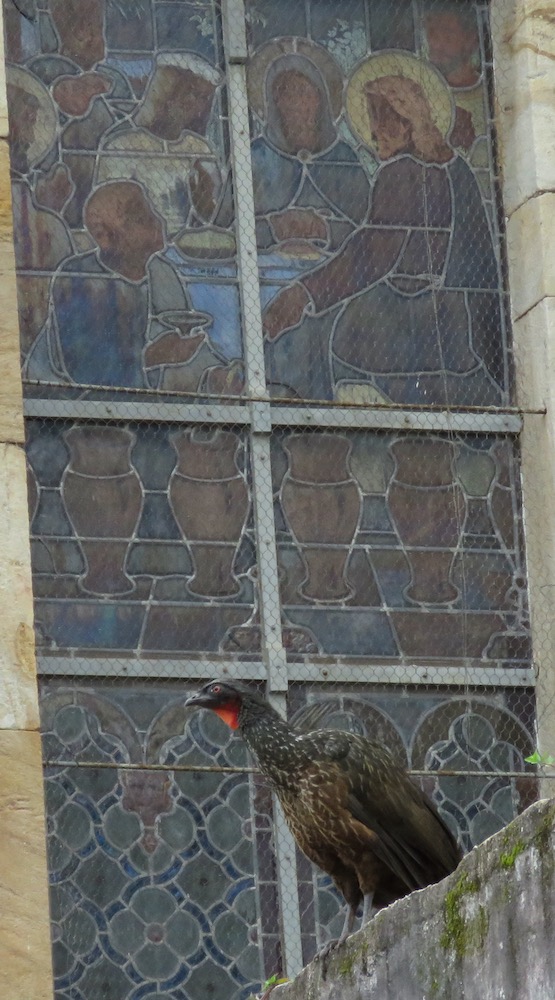
January 18 was our one full day in the lushly forested valley and naturally scrubby hillsides of Canastra. It’s a gorgeous place, with plenty of draw for even the non-birders – waterfall hikes being a favorite. There are birds everywhere, including many Dusky-legged Guans right around the buildings.
Dusky-legged Guan

We saw many local specialties such as this Dubois's Seedeater, which looks like a washed-out Yellow-bellied Seedeater (and some consider them to be one variable species).
Dubois's Seedeater

Surely a caterpillar host for a local species of swallowtail, this pipevine is Aristolochia smilacina.
Aristolochia smilacina

Not all skippers are brown and boring; This firetip is Sarbia soza, and this submission was new for iNaturalist.
Sarbia soza

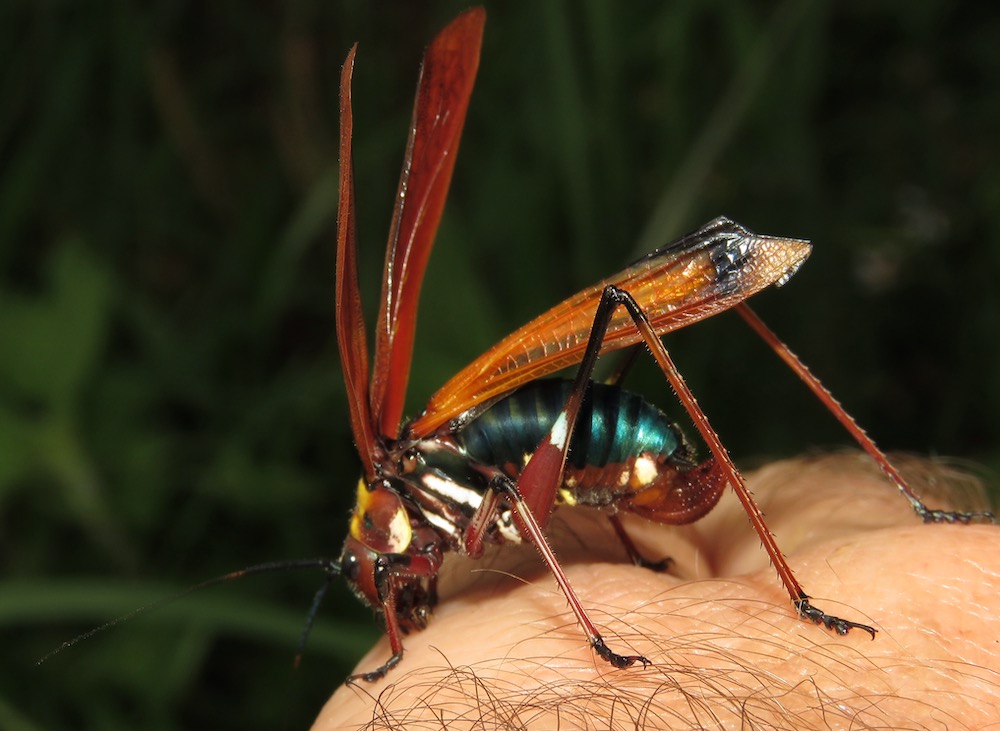
This wasp-mimicking katydid was a stunner. It even flicked its wings like a tarantula hawk. Thanks to the orthopterists at iNaturalist, I learned that it's in the genus Scaphura sp.
Scaphura sp.

We then had a long day’s drive across the state of Minas Gerais to São Roque de Minas, with a lunch stop where we saw both White-rumped Monjita and this Gray Monjita in an adjacent field.
Gray Monjita

Like at Caraça, we had just one full day at Canastra, which I divided into two halves. The morning was devoted to driving up the São Francisco River (locally nicknamed Velho Chico, which I roughly translate as Old Frankie), making frequent stops at all likely places for the super rare Brazilian Merganser. We practically wrung the river dry without a single duck of any kind. Our driver knew birds too, and he had a way with tinamous. First he coaxed a Small-billed Tinamou to walk across the road, then a little later he got this Spotted Nothura to walk out in the open and sing at point-blank range.
Spotted Nothura

I found another pipevine (Aristolochia), this one much larger, but I don’t have a species name for it yet.
Aristolochia

The other half of the day was spent on the top of the national park, primarily in search for Giant Anteater. On the way up our driver stopped opposite this Red-legged Seriema which was perched by the side of the road. It was unfazed and unimpressed by this big bus.
Red-legged Seriema

Alas, we never did see a Giant Anteater, despite our odds being pretty good (the November WINGS tour has never missed it so far). Perhaps a bit of a consolation for the mammal watchers was this Pampas Deer, Ozotoceros bezoarticus.
Pampas Deer, Ozotoceros bezoarticus

While some of us birded, the non-birders enjoyed a lovely walk along the road through the magnificent grasslands. We stopped for just a few, such as this local Ochre-breasted Pipit, which was a lifebird for me just this past November.
Ochre-breasted Pipit

Pearly-breasted Seedeater turns out to be very common this time of year; in November only a very few were starting to set up territories.
Pearly-breasted Seedeater

I had hoped we could rush along to the end of the road at the top of the waterfalls of the São Francisco, where we would have one last chance at the merganser, but not only were there more specialty birds to see (like Sharp-tailed Grass-Finch, Black-masked Finch, and Cock-tailed Tyrant), but our bus was excruciatingly slow on these dirt roads, not going more than about 10-15 km per hour. It was getting to be dusk while we were still a few kilometers before the falls, so we made one last stop for plants when Jake spotted a Brazilian Merganser flying super fast, way out over the grasslands! Most of the group got it, missed by those who were standing on the wrong side of the bus and never saw which way it was flying. Not the best views ever, but still a magnificent find.

The plants here were also just amazing. There are several confusing genera in the family Eriocaulaceae, but all are fascinating, distant relatives of grasses called pipeworts.
Eriocaulaceae

Also typical of this region is the family Velloziaceae, most closely related to the Cyclanths and screwpines. This one is Vellozia peripherica.
Vellozia peripherica

This gorgeous member of the amaranth family is Gomphrena arborescens; it had me fooled as a composite at first glance.
Gomphrena arborescens