Monday, March 22, 2021

Nocturnal Duck Commutes: Is a Flying Duck a Sitting Duck?

I think I’ve finally solved a huge mystery that has been bugging me for nearly a year. The very foundation of the scientific world is shaking, and the journal Nature is begging to publish my earthshattering discovery: Lesser Scaup, American Wigeon, and other ducks are commuting in the dark between the Willamette River and Fern Ridge Reservoir twice each day, and their route takes them directly over my house.

Ok, I was being facetious. I know full well that no one in the world cares, and that this is only barely worth blogging. And though my neighbors are nodding in a polite way of wanting to share in my excitement, I actually feel like I’ve cracked the DaVinci code here. Such are the simple pleasures during a year of quarantine.

The whole intrigue actually started well over a year ago, when my next-door neighbors’ son Thomas was visiting between seasonal birding and natural history jobs (yes, I’m envious). He texted me at dusk as he was jogging just a block away and saw a Barred Owl fly right towards our houses. I looked at the text maybe a minute too late but ran outside anyway, and of course I never saw the bird. That sighting, plus Thomas’s having seen a Barred Owl in their yard a few years ago when he was in high school, started my habit of having an evening glass of wine or herbal tea up on the carport roof, hoping to see or even hear an owl as it slowly got dark. I probably gave it up after a few days, but I sporadically continued my vigils over the next several weeks when it wasn’t raining, and in early April a year ago, I saw 11 ducks zip by right at dark, headed west-northwest. Over the next few days I noticed a pattern of this late evening fly-by, and at one point was confident enough only to call one bird an “Aythya sp.”, meaning it was either Lesser Scaup or Ring-necked Duck (both common here), but it was just too fast and and there wasn’t enough light to see details. A few days later I got good views of a pair of Hooded Mergansers making the same fly-by. But until now, “Aythya sp.” has been a dirty mark on my yard list. It has counted as a species, because I had not identified any other member of that genus to species.

Barred Owl from Tillamook County, Oregon. I'm still waiting to add this to my yard list.

This winter I’ve become a more regular fan of sitting out on the back or front deck as it gets dark, still hoping for a Barred Owl. And I noticed that every night, about 20 minutes after official sunset, a total of about 18-35 smallish, fast, diving ducks would fly over in 3-4 small groups. All were headed in exactly the same direction, and it was a nightly thing. The birds I was seeing each dusk were consistent with Lesser Scaup – not tiny like Bufflehead, and not long-billed like mergansers – but I couldn't be sure they weren't Ring-necked Ducks. Finally, one evening I got a longer and better view of the commuting ducks on one of their earlier arrivals, and I was convinced they were Lesser Scaup.

Dusk Vigil from my front deck

At about the same time in mid-January this year, I noticed that a similar number of Lesser Scaup were feeding along a ¼-mile stretch of the Willamette River just over a mile east of me. (It’s awesome to have bike paths along both sides of the river here, with a pedestrian and bike bridge due east of me – one of five such bridges in Eugene, as opposed to just four for cars.)

West Bank Bike Path along the Willamette River in Eugene

I suspected these might be the birds that are flying over my house.

Lesser Scaup on the Willamette River

I used Google Earth to draw a line from where this loose congregation of feeding scaup were to my house, and then extended that line to the next body of water, and bingo – Fern Ridge Dam! For these ducks, this would be a commute of about nine miles.

The flight path commute of Lesser Scaup

On March 1, just before dark, I biked over to the area of the Willamette River where the ducks tend to feed most often, and just a few minutes after I got there, a group of some 20+ Lesser Scaup pattered across the river into flight, zipped downstream as they gained altitude, circled around, flew right over me, and headed in exactly the direction of my house. That’s when I knew I had basically confirmed the identity of the commuting ducks.

The westernmost bend of the Willamette River closest to Fern Ridge Reservoir

One thing I have not done is positioned myself at Fern Ridge Dam to see the ducks arriving. Given that it would probably take them at least seven minutes to get to the dam, it would be too dark to see by the time they got there, and then I’d have a 45-minute bike ride back in the winter dark along busy roads. No thank you. Still, I’d like to know whether they are roosting just above the dam on the reservoir or on Kirk Pond just below the dam.

I’ve also been having my early morning coffee on the back deck well before light, and I can hear the ducks flying back to the Willamette River each morning. But a just like every scientific inquiry that has been answered, more questions are raised.

Why these birds are making this commute only while it’s dark? My guess is that it’s safer. Peregrine Falcon is not a rare bird in this region, and they almost exclusively prey on birds in flight. Once a Peregrine has gained altitude above its target, there is little chance to escape its terrifyingly fast dive, and diving ducks, while built for horizontal speed and efficiency aren’t the most agile of birds in flight. As long as the ducks are on the water, they are safe from Peregrines, but in flight during the day, they are, well, sitting ducks.

Another bonus of my daily sunset vigils has been adding American Wigeon to my yard list. For several nights in a row, at least 10 minutes after the Lesser Scaup, when it’s much darker, I’ve been able to hear a flock of wigeon, and at least twice managed to spot the flock as they commuted in more or less the same direction. I presume these birds forage during the day at Delta Ponds and also move to roost on the reservoir. But this was a phenomenon that begun suddenly at the end of January and ended in early March. Why just then, and not earlier in the winter? Could these have been migrants and not locally wintering wigeon?

I’ve also started wondering how identifiable ducks are solely based on the whistle their wings make. There have been about five Common Goldeneye foraging on the Willamette River alongside the scaup, and I’m almost certain that I’ve heard them in flight when it’s been too dark to even see shapes; they have a very loud wing whistle, and I managed to get one pretty solid recording of them. I’ve determined that the scaup don’t have much of a wing whistle, but how distinctive is Common Goldeneye whistle? How does it differ from Hooded Merganser, or the obvious wing whistle in some dabblers, like Mallard and Wood Duck? Are the spectrograms of the wing whistles of each species diagnostic? My own sound library is lacking recordings of most of these, and while a Cornell compilation has an amazing recording of a Common Goldeneye whistle, it’s of a bird taking off, not one in mid-flight. The primary frequency and first harmonic of my recording match that one well, but it's not strong enough to show the higher harmonics nor the shape of each individual wing beat sound.

Incidentally, I’ve also noticed a pattern to the flight direction to many of the Double-crested Cormorants I see here. While a few seem to be clearly just commuting between the Willamette and Fern Ridge, a majority are off to the NE of my house by a few blocks, quite high, and headed in a NNW direction. I drew a line between the location on the Willamette where I frequently see numbers of them, just downstream from the Greenway Bridge, to the Junction City Fish Pond, which also is the only other place regionally where I see numbers of them. And bullseye – the line I draw between those two places on Google Earth falls exactly on the flight path where I see them. Curiously, this flight is almost exactly the same distance as what the ducks are doing.

Presumed Double-crested Cormorant commute


Friday, February 19, 2021

A Willamette Riparian Jewel: Hileman Landing County Park

I’ve known about this park since shortly after I moved to Eugene, and though it’s only 30 minutes by bicycle from my front door, I only finally visited it weekend before last. My friend Thomas said it was his favorite birding spot in Eugene while he was a birder here in high school (he lived next door to where I am now, and his parents still do). I was even close several times this past year as I visited the delightful Small is Beautiful Farmstand for their incredible selection of veggies, eggs, milk, flowers, and other goodies. I also rode right past it on a 40-mile biking trip with my friend Andrew Broan and two other friends last August. I even pointed it out to them as a well-known birding hotspot. Hileman Landing is the largest swath of undeveloped riparian habitat near the city of Eugene, on the west bank of the Willamette River. As an undeveloped, natural park, it’s not a place for disk golf, soccer, or such. Wear your rubber boots, be prepared to brush against stickers and thorns, and enjoy the nature. I was only five minutes from home when I realized I left my camera at home, oops. So this blog is populated with photos from my mobile phone.

This isn’t a truly natural area though, and we can only guess at what this place must have looked like just two hundred years ago. Through a mere century and a half of deforestation in the surrounding mountains as well as through prevention of fires and floods, European immigrants have upended the very nature of disturbance in nature. Where there wasn’t, there is now too much. Where there was once much disturbance is now much less. Then add to that the immense effect that introduced plants and animals have had, it is forever changed. In this photo you can see the main forest of cottonwoods isn’t old (they grow very fast), and the understory is dominated by introduced Himalayan Blackberry.


One source of disturbance that remains the same is that from the American Beaver. It’s amazing how they can chew through huge trunks. There probably aren’t as many of them now as in pre-settlement times, but there are more than some people would like.


This wasn’t always a park though, and while some people consider things like this truck and these trestles to be historical markers, I think they are just old trash that should be removed.

Much of the park is actually along a small side-channel of the Willamette River, and with the current high water levels typical of this time of year, it was flowing fast and clear, giving me the impression that I was on a secluded wilderness river (if you ignore the trash that has floated down from Eugene and got caught in the driftwood). Black Phoebe was here.


I eventually emerged onto the banks of the main channel of the Willamette, and the gravel bar here had a roosting group of about 20 Killdeer (it seems to be little known that this bird is largely nocturnal – just think about it: what do you usually see Killdeer doing during the day? Actively foraging? Or just standing there? Their activity kind of reminds me of Burrowing Owls, actually.) I also saw a Spotted Sandpiper and heard a Greater Yellowlegs here.

One of the most exciting things I saw was our first true sign of spring – which in western Oregon begins in January and lasts through early June: the flowers of Oemleria cerasiformis, which I grew up knowing as Indian Plum and is now more commonly known as Osoberry. It’s a member of the rose family and the fruits are indeed edible. I have four that I planted in my yard, and I hope to have enough fruits to follow a recipe I found for jam made from our native Osoberry, Red-flowering Currant, and Oregon Grape. This is also a hummingbird plant, and here, miles from any feeders, were several territorial Anna’s Hummingbirds feeing on the Osoberry flowers, beating the first arriving Rufous Hummingbirds to the punch by a couple of weeks.

This is the growing season for Polypodium glycyrrhiza, the Licorice-root Fern. I used to like the sweet, licorice flavor from chewing on the rhizomes, but I now don’t care for the lingering bitter aftertaste. My grandmother made a tea from the dried rhizomes.

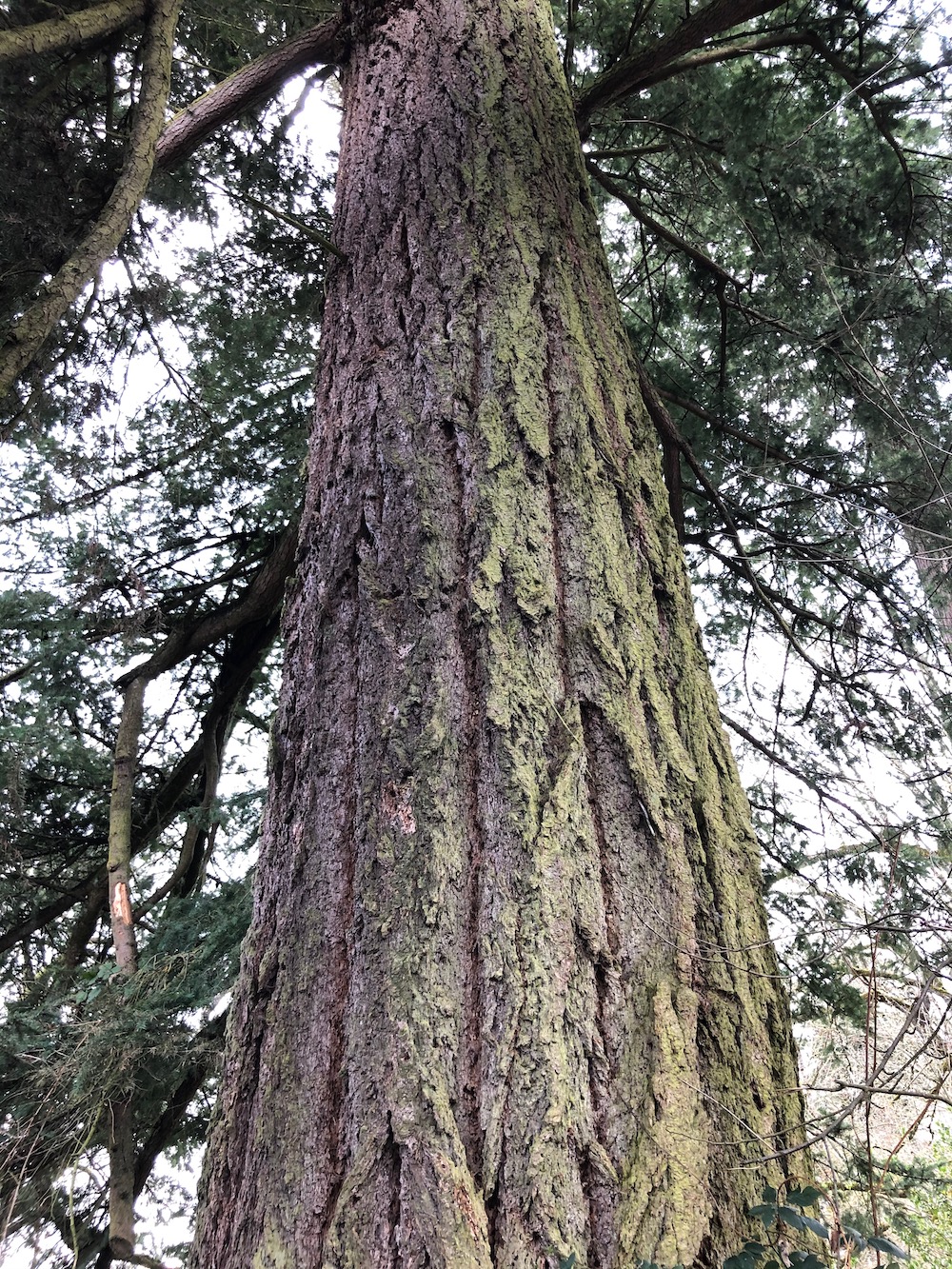
One of the banks rises quite a bit above the floodplain, and the few Douglas-firs here looked old enough to pre-date European colonists in the area. But I wonder if they are old enough to have been seen by the Native Americans before their populations were wiped out by introduced human diseases.

This beautiful bracket fungus is Rhodofomes cajanderi, the Rosy Conk.


I look forward to coming back here as the spring progresses and migrant birds begin populating the air with their songs.

Friday, February 12, 2021

A Murmuration of Ring-billed Gulls and Hybrid Ducks

This blog post is a bit out-of-date, but I’m still gobsmacked every time I watch my short video. Monday, January 11 was my last day with a rental car, so I decided to explore the Willamette Valley of north-central Lane County and the Willamette River landing parks north to the Linn and Benton County borders. I was just into Linn County, south of Harrisburg when I spied a field full of gulls. I was about to start sifting through them to ID them all when they took off and appeared to be avoiding a predator. They formed a murmuration, which until now I had only seen in European Starlings, Dunlin, and Yellow-headed Blackbirds. When they finally landed again, I determined that they were at least 90% Ring-billed Gull, the rest Mew Gull, and the total came to about 3700 birds. I posted this video to Facebook and it also seemed to surprise a lot of my birding friends that gulls would do this.


Back on the west side of the river, I stopped to check Brown Landing park, where I found this Orange-crowned Warbler, the fourth one I’d seen this year so far. It seems to be a very good winter for this species, most wintering well south of us.


I also stopped to check a wetland west of Junction City that seems to be a private duck reserve. It’s basically a flooded field full of Northern Pintail, and the hedgerow along the ditch makes it nearly impossible to see into. So some of my birding was right along the road where I saw this Swamp Sparrow and heard a second one, a rare species in much of Oregon.


Much more cooperative was this Marsh Wren.


At one of the very few spots I could peer over the bushes and see the pond, I found this strange duck that appears to be an American Wigeon x Mallard hybrid.


Just three days later, I biked to another flooded field with large numbers of ducks just 20 minutes northwest of me and found another hybrid duck. This one is clearly at least half Green-winged Teal, and the other parent (or perhaps a grandparent) is probably Northern Pintail. I know I’ve seen a few hybrid ducks before (though I have none in my photo library), but I don’t exactly remember ever finding one, let alone two in one week.


Friday, January 29, 2021

A Bird In A Gilded Cage

This week I auditioned to join the Eugene Gay Men’s Chorus. My tour guiding schedule has prevented me from joining any chorus for the past decade. In the late 90’s and early aughts I still hadn’t built up a docket of tours to be truly full-time, and so I could sing with Tucson’s Reveille Gay Men’s Chorus and also was part of a very informal English madrigal group with 4-5 friends. We called ourselves the Kinglet Singers, as half of us were birders. What fun we had over those years, including two weekend camping retreats.


While the pandemic has now given me the time once again to enrich my life with making music in a group, it’s also prevented such groups from gathering in person. Like so many others, EGMC has continued its existence with Zoom meetings and performances, so I thought it was better than nothing. Maybe we’ll be able to meet in person before my guiding schedule becomes too crazy. A fortuitous coincidence is that the church where they rehearse and usually perform is exactly two blocks from my house. I imagine afterglow parties at my house becoming a tradition in the distant future.

In any event, Evan Miles, the director, held auditions this week, adding four newbies to the chorus. It wasn’t a rigorous audition, mostly to figure out how to place us, and nearly anyone can join (I suppose unless you’re utterly tone deaf). But he did request that we prepare a short piece to sing a capella for him. Yikes! For a few days, I just assumed I would sing Happy Birthday or Twinkle Twinkle Little Star. I’ve probably memorized 50 pieces of music over the years, but only the baritone or tenor parts – I just don’t sing solo. Then the day before the audition it occurred to me that I have reams of ancient sheet music from the first half of the 20th century, and the first thing I grabbed out of the box was this 1985 issue of Sheet Music magazine, one of a stack given to me by the music teacher my freshman year of high school in Upper Lake, California (1984-85). She admitted I played piano better than she did, and I ended up being the accompanist for our high school choir that second semester (the band teacher quit, so we no longer had a band, and choir was the only option).

I opened it up to the middle, and the first song was simple and just the right length, and now I’ve memorized one more song that will be my audition piece, should I ever need one, for the next decades.


Wednesday, January 13, 2021

The Christmas Bird Count season ended January 5th. But wait – there’s one more!

Pleasant Hill Proto-CBC – January 10, 2021

This past weekend, at personal request, several teams of some 15-20 birders helped Alan Contreras test a new CBC circle he is considering proposing to National Audubon. Just to the southeast of the very old Eugene circle, this new one is centered about 1.5 miles southeast of the town of Jasper on the Willamette River, and extends from the eastern suburbs of Springfield in the NW to Dexter reservoir in the SE.

Anyone can start a CBC circle, joining the more than 2600 circles that contribute to the database of early winter bird records. Last year, 23 new counts were held across the country (and another 17 elsewhere). But there are rules, and it takes time to get a circle officially approved. Your new circle can’t overlap with existing ones, for example. You have to show that you’ll be able to guarantee a certain number of participants in the reasonable future and will carry out the duties of compiler as well. And you obviously have to know the entire circle well enough to be able to create team sectors and make sure the circle has enough interesting habitats and bird species to make it worthwhile for everyone. These are the reasons it makes sense to a hold a trial count in a proposed circle, and to avoid conflicting with established circles, having it outside the official CBC window of December 14 to January 5 makes sense. A trial run might discover an incredible bit of habitat that lies just outside the circle, in which case the circle can be adjusted before it becomes official. Alan probably hopes that this year’s participants will offer critical pointers on how well the proposed sector boundaries worked and what changes might work better.

Here’s a summary of my day with my mostly bad photos, as winter light in Oregon isn’t the best for distant and backlit birds. But at least it documents what I’ve been up to.

My area was the southeastern-most sector, including all but the uppermost stretches of Dexter Reservoir and about a half-mile of the Middle Fork Willamette downstream from the dam. I also had the little town of Dexter and all the side roads south of it to the circle boundary. A state park right at the dam was a good place to start. Some of the best access to riparian habitats is below the dam, but the deep water right above the dam is usually bird-free. The maintained lawns where I parked had a flock of about 7 flickers, and at least two among them were Red-shafted x Yellow-shafted intergrade males. The abundance of such intergrades in western Oregon in winter is a good sign that it’s not likely they’ll ever be split.


I hiked about a quarter mile below the dam to find five Barrow's Goldeneyes in the swift current but well away from the hypernitrogenous zone immediately below the spillway. I also had an Osprey here, scarce in the winter this far north.

The shallower, upper half of Dexter Reservoir is home to hundreds of wintering American Coots, and I counted 2020 total. (I probably missed a few.) Mixed in with them are many scaup of both species, Ring-necked Duck, and Bufflehead with a very few Ruddy Ducks and Canvasback.

One task for this sector is to carefully scope through these flocks for rare ducks and check the open water for unusual grebes, loons, or other water birds. I found no rare ducks (a Tufted or Redhead would be good), but this Red-necked Grebe was possibly the rarest bird in my area, with maybe four previous winter records for the reservoir, but I actually found it while scouting here last week. It’s always good to have stakeouts.

Eared Grebe was new find by me during the day, but it’s not quite as rare as the Red-necked. It was very distant and a small bird, so the photos are barely useful to document it. (Horned Grebe is rather similar and far more common here.)

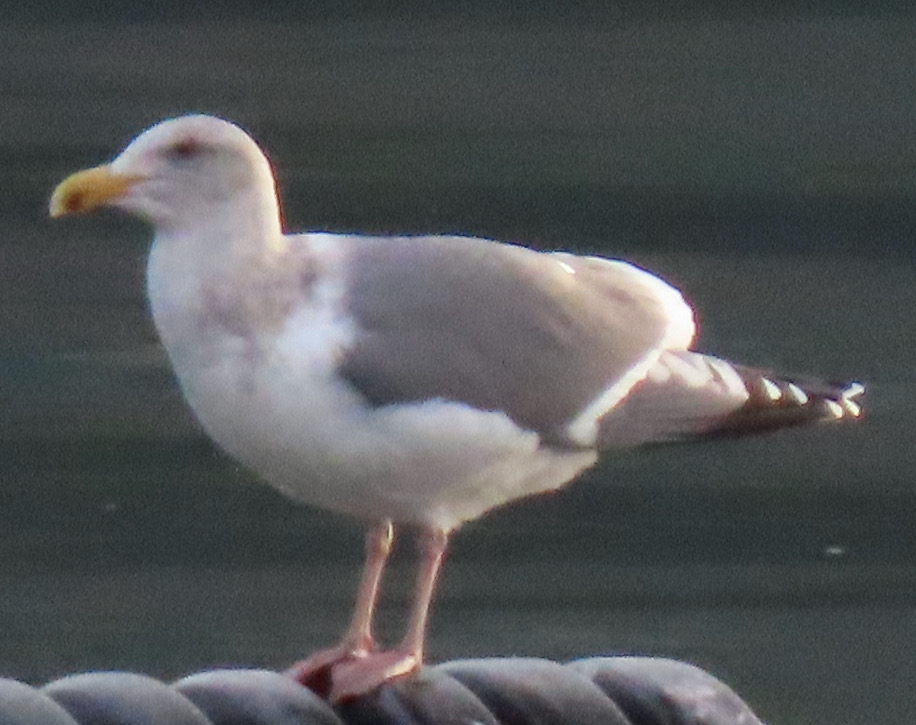
This Western Gull was also an unexpected bird inland, as they rarely leave the coast, even in winter. A little black smudge by the red spot on its bill tells me that it may not be 100% mature, perhaps in its 4th winter, and that might explain grayish grizzling on the head and breast. However, this latter feature might mean that it has some Glaucous-winged Gull in its heritage, though the dark back and black (not just dark gray) wingtips indicate that it’s not an F1 hybrid.

I was pleased to learn that the entire northern shore of the reservoir upstream from the town of Lowell is open public access, and most of it is good habitat. English Ivy is a bad invasive exotic here that should be removed, however. I was exploring right near the edge of the circle when I hiked to the edge of the water and took this photo looking NE, upstream. The foreground marsh and near water is in the circle while the line of trees directly over the first patch of water is outside. Amazingly, all of those rafts of ducks and coots were well within the circle, while the uppermost piece of the reservoir and short outflow from the very close Lookout Point Reservoir are apparently not of much interest to birds.

Yet another rare bird at this spot was this Mountain Chickadee, my second one this winter out of range. There have been only three others found in western Oregon and Washington this winter, which is about average, nothing like the big irruption of 2015-16 when there were dozens.

After I was back in the car and finishing up my eBird list, I looked out and saw a flock of large birds overhead. I jumped out and was amazed to see these 12 swans flying high in a southeasterly direction. They were clearly headed towards the Willamette Pass of the Cascades, and the from there, I’d guess to either to the Summer Lake Wildlife Area or the Klamath Basin wildlife refuges. My photos seem to show a more slender bill indicating Tundra Swan, but from what we know about swan migratory patterns here, these can be safely assumed to be that species.


If you read my last blog, from the Eugene CBC, you’ll remember I had four Trumpeter Swans in flight on January 3, headed south. At the Zoom meeting we held for this new CBC, we learned that Tom Mickel, who covered the limited-access Willamette Confluence Preserve of The Nature Conservancy, had 16 swans: Four Trumpeters and 12 Tundras, and he actually saw the Tundra Swans pick up and fly away off to the SE. I’ve never been to that preserve, but I’ve seen the swans that like to use it!

Near the end of the afternoon I did a bit of exploring around the town of Lowell where I was hoping to find some access to the former oak savannah habitat now growing over to thickets of younger Oregon White Oak and in places showing the inevitable succession to Douglas-fir forest. The powerline right-of-way north of the town turns out to be Seneca Jones Timber Company property with public access, at least on foot, and it goes right through this habitat. I had some very nice mixed flocks of kinglets, chickadees, nuthatches, creepers, Hutton’s Vireo, and woodpeckers here.


Keep an eye out for the announcement of this new CBC circle for the 2021-22 season!


Sunday, January 10, 2021

Eugene Christmas Bird Count, January 3, 2021


The Eugene CBC is now my “home count,” as I live just 2.3 miles from the circle center (a CBC circle is 7.5 miles in radius). Last year I was in Brazil, so I missed it during my first winter in this house. It always gets the most participants of any circle in the state, including a huge number of feeder watchers, and ranks high nationally as well. This year, despite the pandemic, the organizers still managed to have 140 people in the field and 119 counting at their home feeders, the latter a record by 8, which is not surprising during this pandemic winter.

The rules regarding CBC conduct during the pandemic meant that I got an area to cover by myself, which was actually a good thing this year, as I didn’t really know it well and wouldn’t have known how to divide and delegate had I been given a larger group. I probably spotted some birds only because I was on my own but am also quite confident that I missed even more. You always see more with more eyes watching in all directions – everyone also has their own, unique pattern-spotting abilities and search images. I missed Peregrine Falcon, Merlin, Cooper’s Hawk, and Red-shouldered Hawk, for example, and I wouldn’t be surprised if all of these species saw me.

Having said, that I enjoyed the spontaneity of deciding where I would linger, when I would continue, which side road I might turn down at the very last second, and being able to get around by bike. All of those would have been more difficult with a group. 

The Spotted Towhee at the top was one of 87 that I had during the day. Yes, I had a lot of blackberry thickets to pish at, and I pished a lot. How about 197 Song Sparrows, 110 Fox Sparrows, and 53 Bewick’s Wrens? 83 species and 2878 individuals were the grand tally from my area, making it the most diverse on the CBC.

My first bird of the day was actually a Western Screech-Owl at a park just ½ mile south of my house, one that I had seduced into calling in broad daylight during eBird’s October Big Day. It was in the same trees pre-dawn this morning after coffee #1, and soon I was back home for breakfast and coffee #2. One of the first songbirds I had shortly after sunrise though was this Swamp Sparrow that I had found over three weeks ago just barely into my CBC sector, exactly 1.8 miles and 10 minutes from my house, mostly by bike path. To give you an idea of how good the bicycle path system is here in Eugene, to get to this location by car would be a 4.2-mile, 10-minute drive, followed by a 4-minute walk.


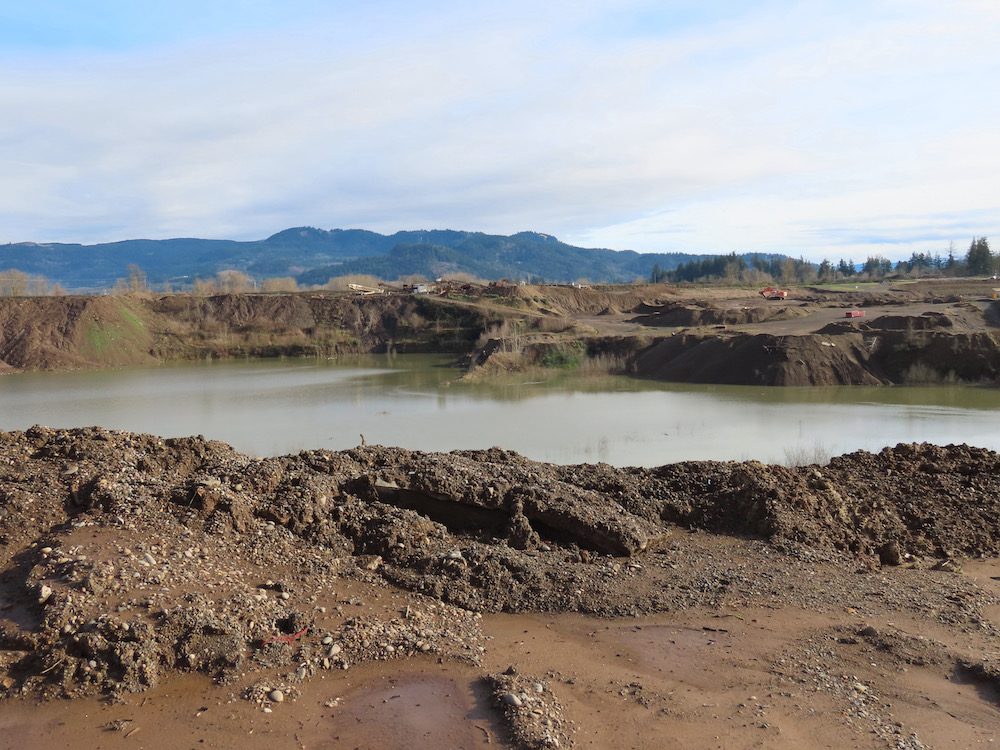
The best birding in the area I was assigned lies on the east bank of the Willamette River and west of Delta Highway and continues north from the Beltline Highway to the Mackenzie River, including special permission to bird private gravel pits right up to the confluence of those now very swollen rivers. I also have all of suburbia east to I-5, but it’s not as rich in habitat or birds. I had a mix of older stands of cottonwood and younger thickets of willow and alder, but also some grassy fields and tons of blackberry thickets. My big species list of 83 benefitted from a good diversity of ducks on three main gravel pits (as well as one grebe, cormorant, heron, and coot species each), and a spotting scope was necessary as some ponds were big and I couldn’t safely get very close to this most of this one.


This is the Mackenzie River just east of its mouth.


Here’s my bike by a field that had a Western Meadowlark, several Lincoln’s Sparrows, and a Wilson’s Snipe. Note my tripod sticking out of the pannier.


Even though my tendency to rely too much on my ears had me missing some raptors, Red-tailed Hawks are too common to ignore. It’s courtship time already in January here in mild western Oregon, as evidenced by these lovebirds.


The riparian woods had plenty of Downy Woodpeckers, and this year’s CBC had a record number. I had 14, contributing to the count’s amazing total of 180 (which pales to the numbers found on eastern US counts, but it’s a lot for here).


House Finch is common bird here that we don’t really pay too much attention to, but I rarely have such a nicely colored male perch in good sunlight.

I did not have what you would call typical Wrentit habitat, but the dense, non-native blackberries along the Willamette River are continuous for miles in some areas, and in recent decades they have expanded their range into this habitat. Learn to whistle like their song, and you’ll find they are very gullible and come right out. Since discovering that I no longer use recordings to find them.


I found two Orange-crowned Warblers, one palling around with a flock of Bushtits, and the second one a third of a mile away with a flock of Dark-eyed Juncos. The first was of the subspecies lutescens, unlike the gray-headed one (probably orestera) that was at my feeders for much of December, was gone for two weeks, then reappeared at my bananas a couple days ago. But this second one looks somewhat intermediate. It’s not a very common species here in the winter, and only a total of six were found by all teams.


I thought this Common Yellowthroat was going to be my one and only true rarity. It was indeed the only one for the count, but the species is found about once every five years here. They are common in the winter not too far south of here in California.


Since I had never been here before, I came across this very different gravel pit in the mid-afternoon as I was about to leave the area. It’s older, shallow, and wall-to-wall cattails (Typha latifolia). I gasped when rounded the corner and saw this, as it is perfect habitat for rails and could have something even more unusual. So I first did playback for the only species that is common here in winter, Virginia Rail. I instantly had two responding, and later I heard two more. But this habitat also screams Sora to me, so I played that and had an instant response from one. I tried again from a different side of the pond, and one from the same location called back, followed by one from right in front of me. Since this species has been recorded on only 1 out the past 50 years, it’s my officially rarest bird for the day, though it’s also surely vastly under-detected.


I used the later afternoon to cruise the mostly rather new suburbs of NE Eugene, trying to stay on smaller roads. I found American Goldfinches feeding in an older (and non-native) sycamore tree, and I certainly boosted my Anna’s Hummingbird tally. But eventually I learned that no back roads connected through to the eastern part of my area, and so I was just pedaling along on the busier Ayers Road when I saw four swans in flight up ahead as I looked through powerlines and the numerous sweetgum and other obnoxious, non-native trees. I stopped quickly but didn’t even raise my binoculars as I know that there are two species possible. Instead I was ready with fast shutter speed and a positive exposure compensation on my camera when they emerged into open view. My first impression looking at my camera’s screen was confirmed in the evening when I zoomed in on the photos on my desktop computer. Trumpeter Swans! They have a larger bill than the much more abundant Tundra Swans, and the lack of any “pinch-off” between the eye and the bill is also distinctive. It’s a rare bird in western Oregon, with only a few dozen each winter in select localities, but very rare in the Eugene CBC circle with only four records in 50 years.


I’ve heard that the total species count was 133 species, which is the sixth highest ever for this count, a remarkable total, considering the situation. The weather was unbelievably beautiful – calm, sunny, and warm for mid-winter (54°F). Clouds moved in mid-afternoon, and at about the time one should think about finishing up for the day, 4:00 p.m., it began to rain, and the decision was made. Perfect. It was a great day, but I missed the camaraderie of birding with a group, sharing fun sightings, and getting together at the end of the day for the countdown dinner. Next year. January 2, 2022.