Tuesday, May 12, 2015

A Final Day of SW Wings Field Trips

My final field trip for the Southwest Wings Spring Fling Birding Festival this past Saturday was titled “Chasing Rarities.” The two obvious rarities in the nearby Huachuca Mountains were Rufous-capped Warbler and Sinaloa Wren, so those were our targets.

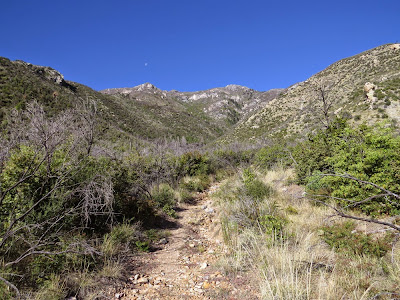
Rufous-capped Warbler is one of the rarest breeding birds in  the United States; there are only 2 or 3 known pairs in the country. The pair we sought has been known in the rarely-visited Hunter Canyon on the east side of the Huachuca Mountains since early September 2013. Who knows how long they were there before being discovered. I had never been here before, so it was fun getting know a new area.
While we were looking, listening, and waiting at several different spots in the upper canyon – the few times I played a bit of song there was no response – this Greater Pewee came down just a few feet away to investigate my owl imitation.

We were watching a male Ornate Tree-Lizard do pushups to impress a female when I caught a bit of movement in the bushes nearby on the trail. Rufous-capped Warbler! It foraged for a while, was joined briefly by a second bird, then it came over towards us and sat up to sing. This was several minutes since I had played just a couple songs, and this didn’t look like the typical excited response to playback that I usually see in birds. I think we just lucked into being in the right place at the right time.

Here’s a bunch of happy birders.

On the way down I photographed this Acmon (or Lupine or whatever) Blue. The taxonomy is still in flux.

We then spent a few hours in Huachuca Canyon on Fort Huachuca, hoping for the Sinaloa Wren, but neither we nor another 20 birders, including a tour group, another festival field trip, and lots of independent birders could find it. This is the parking area by the stream where it is usually seen, but no one knows where it goes when it disappears.

While looking for the wren I looked up at a sycamore tree and noticed this Black-necked Garter Snake about 7 feet off the ground. I had never seen one off the ground before.


We finally had to give up on the wren and worked on the participants’ wish lists. Up canyon we found the recently arrived Sulphur-bellied Flycatchers and a female Elegant Trogon, then in the grasslands towards Garden Canyon we scored Canyon Towhee and Botteri’s Sparrow. On the way back to the Cochise College field trip meeting site, we looked for Chihuahuan Raven, the species “known” to occur in parking lots and visit dumpsters in Sierra Vista. Things have changed since I birded Sierra Vista frequently 20 years ago. All we could find were Common Ravens, including this one. Notice how the nasal bristles only cover the basal half of the bill. This one also called, a typical throaty Common Raven croak.

Friday, May 8, 2015

A Second Day at Southwest Wings and More Owling

Just a few photos from today’s long day of field trips for the SW Wings Birding Festival. We started with good views of a Botteri’s Sparrow in the lower elevations then saw the male Elegant Trogon in Ramsey Canyon, where it is a rare bird. We walked up the canyon where we saw a lot of the regular madrean pine-oak specialties such as Greater Pewee, Hepatic Tanager, Grace’s Warbler, and several Painted Redstarts.

We then worked up to Carr Canyon where we added all the sought-after warblers, such as Virginia’s, Red-faced, and Olive (finally). A highlight was a flock of Red Crossbills, which had at least two different types. This one appears to be Type 6, the largest and largest-billed of all the types, which are all probably good species.

We ended the day’s birding with 74 species. I then led a second owling field trip which was a great success. Back up the Carr Canyon Road we re-found the same owls I had found on Wednesday, including this Elf Owl sticking its head out of the nest cavity.

This time I got a photo of one of the very responsive Whiskered Screech-Owls. Notice the little feet and green bill.

And this is the same Western Screech-Owl as the other night. Notice the big feet and black bill. Of course, they also sound very different.

We had these three species of owls in just about 20 minutes, so we went a bit farther up the road and tried for Common Poorwill. It seemed that we weren’t going to even hear one for a while, but then one flew right overhead, popping its wings in defense of its territory as I played its song. Then I spotted its eye shine in my headlamp on a dirt bank above the road.


I played a little bit of Mexican Whip-poor-will, and then to just demonstrate how different it is from Eastern, I played that too, as well as the Mexican's closer relative, the Dusky Nightjar from Costa Rica. Then a Mexican Whip-poor-will began singing it’s “will-poor-whip” song just up the road, and within five minutes it was flying over our heads. To wrap it up, we drove a few miles down to Casa de San Pedro and finished out night with a ghostly Barn Owl also flying overhead. Not a bad night.

Southwest Wings Birding Festival Spring Fling

I’m in the middle of leading field trips for the “Spring Fling” of the Southwest Wings Birding Festival in Sierra Vista, Arizona. This is their second year offering a short festival of field trips only during the spring, while they still do a full-fledged festival (with talks, workshops, vendors, displays, etc.) in August. I’ve been leading field trips off and on for this festival since 1994.

Wednesday night was my owling field trip, and we quickly connected with Elf Owl (in a nest cavity in a dead Arizona Sycamore), a Whiskered Screech-Owl pair, and this Western Screech-Owl.

The passage of a front to the north of us brought some brutal winds up higher though, so our attempts at seeing Flammulated or Spotted Owl and Mexican Whip-poor-will were thwarted.


Then yesterday (with the winds continuing), I took my group of nine participants to a couple places on the San Pedro River, where we saw nearly 60 species of birds, including a pair of Northern Beardless-Tyrannulets at their nest, migrant Western Tanagers, and this handsome male Pyrrhuloxia.

Sunday, May 3, 2015

Violet-clouded Skipper in the Garden

I was putting out fresh hummingbird food in the yard yesterday morning when I noticed this small skipper on the purple asters.

I quickly put the feeder up, put down my coffee, ran in for the camera and got the above shot. Several minutes later I refound it in my garden, as it briefly landed on the sneezeweed cultivars I planted in hopes of attracting butterflies, but then it decided to sun itself on the tomato plants, where I took a bunch more photos. It turns out to Violet-clouded Skipper, an uncommon bug in grassy desert canyons, and downright rare in places like urban gardens. I’ve seen it twice before, but never in the yard. The last time I saw one, coincidentally, was the last time I hiked into Pima Canyon with Jake Mohlmann, six years and two months ago. I had seen it only one other time in Arizona, about three years before that.

I realized I hadn’t really figured out what these lovely purple asters are in the yard, so I tried keying them out.


The species that Kearney & Peebles (1951) led me to was Aster tephrodes. In the 1960 supplement they mention that it’s been moved to the genus Machaeranthera. Then sometime in the intervening decades it was changed to Machaeranthera asteroides, and then that genus has been changed once again to the currently accepted Dieteria asteroides, with the common name Fall Tansyaster.

It is very close to Dieteria canescens, but if the characters in K & P are still correct, this one shows the phyllaries having the green tips relatively long, gradually narrowed, and bent back. D. canescens should have a very short green tip that rather abruptly narrows from the white (“chartaceous”) basal portion to the pointed tip. K & P also correctly characterize D. asteroides  as occurring on alluvial soils (which our yard most definitely is) and blooming as early as March, while D. canescens blooms after June.

While keying it out, I noticed this miniscule and nearly transparent ambush bug, family Phymatinae.
Update 1: This is actually a lace bug, family Tingidae.


There have been plenty of Pallid-winged Grasshoppers in the yard all winter long, but this was the first Gray Bird Grasshopper, Schistocerca nitens, that I have seen this year.


Finally, here are three shots of my little vegetable garden that I have been enjoying for the past nearly three months. The first photo is from March 5, the second is April 8, and the third is from April 29. I’ve already eaten three grape tomatoes, one zucchini, several little crookneck squashes, a bouquet of basil, and lots of kale.


Saturday, May 2, 2015

A Morning Hike in Pima Canyon

This past Thursday, Jake Mohlmann and I made a quick early morning hike into Pima Canyon, partly for the exercise, partly with the hope of finding some good birds, and knowing that there’s always cool critters and stunning scenery.

We started hiking at about 6:15 am, when most of the canyon, draining toward the SW, is still in the shade. This is a view from near the start of the trail looking south over Tucson and at the Santa Rita Mountains in the distance.

Along the first part of the trail were dozens of these Lateral Seed Bugs, Melacoryphus lateralis.

And shortly after that was this Giant Cactus Longhorn, Moneilema gigas.

A little while later we found another doing what this odd, huge, flightless cerambycid does – eat cactus.

The sun rose quickly to enter the upper parts of the canyon. This is Jake next to a Saguaro, Carnegiea gigantea.

Large stretches of the trail were wonderfully perfumed by the abundant blooms of the Catclaw Acacia, Senegalia wrightii.


There were lots of bees, flies, wasps and other insects attracted to these flowers. This syrphid fly is probably Mexican Cactus Fly, Copestylum mexicanum.

One could spend weeks botanizing here. I took time to key out just two pink composites, both new for me. The first was Acourtia wrightii, Brownfoot or Wright's Desertpeony, which I recognized from its close relative Acourtia thurberi, common south of here.
Acourtia wrightii, Brownfoot or Wright's Desertpeony

It has a very unusual flower structure similar to Trixis, in that instead of having one-petaled ray flowers, five-petaled disk flowers, or a combination of the two, each flower has two petals on opposite sides – one with three minute teeth and one with two minute teeth. It hints at the evolutionary origin of ray flowers, each tooth being the end result of what once was a single petal of a regular tubular flower.

This one is Stephanomeria tenuifolia, Narrowleaf Wirelettuce. Like all members of the chicory tribe (like true lettuce and dandelions), the entire head is composed of five-toothed ray flowers.

While enjoying the wirelettuce, I noticed that an unusual skipper landed on it, and I quickly snapped a photo before it took off. It was a Cestus Skipper, Atrytonopsis cestus, which I had only seen once before in Brown Canyon near the Mexico border. It’s very scarce anywhere in the U.S. but is known from the Santa Catalina foothill canyons like this one where the host plant occurs, the grass Bamboo Muhly, Muhlenbergia dumosa. We didn’t see any of the grass, but there must be a clump or two somewhere in the canyon.

There were lots of butterflies everywhere, but we stopped to photograph just this one Mexican (or Sonoran) Metalmark, Apodemia mejicana.

We stopped by a wet part of the stream where there were several caterpillars belonging to Common Buckeye, Junonia coenia, feeding on the monkeyflower.

At the same spot I photographed some lovely damselflies, which, upon inspection of the photos, turn out to be Spine-tipped Dancers, Argia extranea. In this photo you can actually make out the tiny projection on the lower appendages at the end of the abdomen that give it the name.

We made it as far as the lower dam at nearly 3 ½ miles, a spot with permanent water, also well known amongst birders as having the northernmost record of Rufous-capped Warbler.

There was lots of bird activity around, and we dallied here for some 15 minutes. This juvenile Anna’s Hummingbird came to bathe on the face of the dam.

Jake called out a very distant Turkey Vulture…or Zone-tailed Hawk, he admitted. It was too far to see for certain, even with our top-of-the-line Zeiss binoculars.

But I snapped a photo with my Canon PowerShot SX50 HD, zoomed in, and I could see that it was indeed a Zone-tailed Hawk.

This canyon has a known territory of Golden Eagles which when seen on the Tucson Valley Christmas Bird Count are the only ones. Sometimes they are missed. But looking upstream from the dam, I spotted one flying high across the canyon, and soon we were watching two Golden Eagles soaring and doing a roller coaster display flight to broadcast the occupation of their territory to anyone watching.

Jake, with his trained eyes, started scanning the cliffs up the canyon and spotted the nest with a juvenile, no less.


We saw and heard a total of 53 species, amongst which were several migrants. Lazuli Buntings were often in pairs, and the males singing, but they aren’t known to breed here so must have been passing through.

There were plenty of lizards around, and this Clark's Spiny Lizard, Sceloporus clarkii, was particularly photogenic.

We’re past the prime prickly pear blooming season, but there were still a few on what I think is Tulip Pricklypear, Opuntia phaeacantha.

This one had a pollinator in the form of a beetle in the family Cleridae ­­­­­­­– Ornate Checkered Beetle, Trichodes ornatus.

With views like this, it’s no wonder that this is such a popular hiking destination for Tucsonans. We came across 12 hikers, all in pairs, on this weekday morning.


Near the end of our hike I noticed the first bloom on a Saguaro, the state flower. It’s said to be fragrant, but I haven’t had an opportunity to smell one yet.